Introduction
In the context of higher education, students’ learning is far beyond memorizing facts and/or accurately carrying out procedures. What they are facing is complex learning which requires integrating knowledge, skills and attitudes, qualitatively coordinating different subskills, and transferring what is learnt in the formal education settings to daily life and professional work environments. Furthermore, university students are expected to not only master complex skills and professional competences during their studies but also to continue their learning journey throughout their career. Hence, how to design instruction for complex learning and life-long learning should be the central focus of the pedagogical support on course design/development at university.
There are a number of instructional design (ID) models which promote complex learning:
➢ Cognitive apprenticeship learning (Collins, Brown, & Newman, 1989; Woolley & Jarvis, 2007)
➢ First principles of instruction (M. David Merrill, 2002; M David Merrill, 2012)
➢ Constructivist learning environments (Jonassen, 1999)
➢ Learning by doing (Schank, 2010)
➢ Four-component instructional design model (Van Merriënboer & Kirschner, 2017)
Life-long learning competences involve cognitive as well as metacognitive skills and motivation1. Theories on metacognition, self-directed learning (SDL) and self-regulated learning (SRL)2 offer frameworks which illustrate key processes involved in successful life-long learning as well as concrete training tips. For instance, the motivational ID model (Keller, 1987) offers tools and procedures for designing effective instructions that promote intrinsic motivation.
In short, the theoretical inputs from the aforementioned literature offers guidance on how to design instructions that support metacognitive and cognitive development, and stimulate and maintain motivation. This document describes the key instructional design principles that can be found in the majority of aforementioned learning theories and instructional design models, accompanied with specific recommendations to implement those principles in teaching and learning environments.
Instructional design principles
The principles listed below can function at two levels.
- On the first level (part 1) are the common principles that can be found in the majority of learning theories and ID models. As most researchers emphasized their importance, they are proposed here as a set of baseline principles to be integrated in any ID work and in the tools developed by KU Leuven Learning Lab to aid instructional design (the ABC LD visual approach, Snelgids Blended Leren, Module ‘Basics of Course Design’ …). In this manner, they will be communicated as main design principles in addition to the alignment principle (Biggs, 1996) and the process of backward design (Wiggins & McTighe, 2005). As you may recognize, the alignment principle is actually embedded in all principles listed here because the main idea behind them is that the design needs to be logical and systematic (coherent & aligned) to maximize its impact on learning.
- On the second level (part 2) are the specific principles which are relevant for specific learning & teaching situations. They also serve as illustrations on how the principles from part 1 can be implemented. They are formulated either as nuanced recommendations or as concrete tips for answering the question “how do I follow the six ID principles to design particular learning tasks to engage students in meaningful (meta)cognitive activities that have a positive impact on learning?”.
Part 1: Six baseline instructional principles
In total, 6 principles are proposed here.
1. Activate Prior Knowledge (PK)
Allow and encourage students to make connections with previously learned material [recall of prerequisite skills; use of relevant examples, analogies].
Why
Prior knowledge is one of the most influential factors in student learning because new information is processed through the lens of what one already knows, believes, and can do. Prior knowledge not only includes subject content knowledge, but also refers to skills and beliefs. When prior skills – both domain-specific and more general, intellectual skills – are honed, accessed appropriately, and used fluently they help students to learn more complex skills (Benassi, Overson, & Hakala, 2014).
References
Benassi, V. A., Overson, C. E., & Hakala, C. M. (2014). Applying science of learning in education: Infusing psychological science into the curriculum.
Collins, A., Brown, J. S., & Newman, S. E. (1989). Cognitive apprenticeship: Teaching the crafts of reading, writing, and mathematics. In L. B. Resnick (Ed.), Knowing, learning, and instruction: Essays in honor of Robert Glaser (pp. 453-494): Lawrence Erlbaum Associates, Inc.
Jonassen, D. H. (1999). Designing constructivist learning environments. In C. M. Reigeluth (Ed.), Instructional-design theories and models: A new paradigm of instructional theory (pp. 215-239).
Merrill, M. D. (2012). First principles of instruction: John Wiley & Sons.
Schank, R. C. (2010). The pragmatics of learning by doing. Pragmatics and Society, 1(1), 157-172. doi:https://doi.org/10.1075/ps.1.1.10sch
Van Merriënboer, J. J., & Kirschner, P. A. (2017). Ten steps to complex learning: A systematic approach to four-component instructional design: Routledge.
Woolley, N. N., & Jarvis, Y. (2007). Situated cognition and cognitive apprenticeship: A model for teaching and learning clinical skills in a technologically rich and authentic learning environment. Nurse Education Today, 27(1), 73-79. doi:https://doi.org/10.1016/j.nedt.2006.02.010
2. Demonstration
Learners observe a demonstration which guides them to understand new knowledge.
Why
Demonstration has been stated as an effective way for conceptual learning (by use of examples and non-examples), as well as for learning procedures and rules (by use of worked out examples). The emphasis here is that information is not merely told but illustrated in a concrete case/situation: what does it mean, how is it applied and what are the possible consequences. This way lecturers can avoid talking about information in a too general and abstract manner without referring to specific situations. Moreover, it has been found that demonstration combined with self-explanation can have better outcomes because the process of explaining their thinking helps students to deepen their understanding of the principles they learned from demonstration and by applying (Marzano, Pickering, & Pollock, 2001; M. David Merrill, 2002).
References
Marzano, R. J., Pickering, D., & Pollock, J. E. (2001). Classroom instruction that works: Research-based strategies for increasing student achievement: Ascd.
Merrill, M. D. (2002). First principles of instruction. Educational Technology Research and Development, 50(3), 43–59. https://doi.org/10.1007/bf02505024
3. Engage students in deep cognitive activities
Deliberately stimulate and enable students to apply newly-acquired knowledge and skills [activate learning, apply principles]. Provide coaching and feedback to further enhance the learners’ engagement in cognitive and metacognitive process, and to maintain motivation. Fundamental ‘instructional design’ principles in higher education Educational Development Unit (2020)
Why
Learning is facilitated when plenty opportunities are available for the learner to apply the newly acquired knowledge to new specific situations, and to connect this knowledge to prior knowledge in order to reconstruct a meaningful knowledge structure. (Sweller, van Merrienboer, & Paas, 1998)
References
Sweller, J., van Merrienboer, J. J. G., & Paas, F. G. W. C. (1998). Cognitive architecture and instructional design. Educational Psychology Review, 10(3), 251-296. Retrieved from http://www.jstor.org.kuleuven.ezproxy.kuleuven.be/stable/23359412
4. Assessment as learning [integrate assessment into teaching]
Build a system which allows constant monitoring of students’ understanding and level of application. Collecting and interpreting reliable evidence from multiple and diverse sources on students’ understanding is a necessary precondition for offering adaptive & appropriate feedback and guidance to enhance learning.
Why
A considerable body of evidence has shown that assessments can be strongly associated with gains in learning if they are used with a deliberate intention of supporting (assessment for learning) and enabling learning (assessment as learning) (Black & Wiliam, 1998; Gibbs & Simspon, 2005; Jackel, Pearce, Radloff, & Edwards, 2017). When assessment is seen as learning, specific emphasis is put on building students’ capacity to make accurate judgements of their own learning. Such judgements not only use the information and feedback from the assignments, tests, or learning activities offered by lecturers, but students should also be enabled to create own assessment strategies, and to assess themselves in monitoring accurately how effectively they learn and how well they master the targeted content. With ‘assessment as learning’ the ultimate purpose is to make students adaptable, flexible and independent learners & decision-makers (Earl & Katz, 2006).
References
Black, P. and D. Wiliam (1998). Assessment and classroom learning. Assessment in Education: Principles, Policy & Practice 5(1): 7-74.
Earl, L. and S. Katz (2006). Rethinking classroom assessment with purpose in mind: Assessment for, as and of learning. Winipeg, Manitoba, Western and Northern Canadian Protocol for Collaboration in Education (WNCP).
Gibbs, G. and C. Simspon (2005). Conditions under which assessment supports students’ learning. Learning and Teaching in Higher Education (1): 3-31.
Jackel, B., et al. (2017). Assessment and feedback in higher education. A review of literature for the Higher Education Academy. Heslington, The Higher Education Academy.
5. Stimulate & develop metacognition and self-regulated learning (SRL) and promote reflection [learn to learn and teacher/student control]
Metacognition, SRL, and reflection serve as mean for effective learning and teaching, and as a goal for life-long learning
Why
Substantial research results have indicated a positive relationship between SRL and academic achievement (Dorrenbacher & Perels, 2016). Moreover, developing metacognition and promoting reflection are preconditions for students to benefit from feedback. Feedback can stimulate students to critically reflect on the quality of their products as well as on their thinking process so they can develop more effective strategies and mental model to deal with similar tasks. To realize these benefits, students must understand the criteria and standards used. Only when students have this metaknowledge and are able to self-reflect, one can be certain about the benefit of feedback on students’ learning (Butler & Winne, 1995).
Developing metacognition and promoting reflection are a goal of higher education on their own: students who graduate from higher education need to have the life-long learning ability to further enrich knowledge and develop their competences. Deploying metacognitive knowledge and skills to set personal goals, monitoring thinking processes and performances, and making adaptions based on critical reflections are the foundations for life-long learning. Also, a higher level of awareness of one’s own thinking and reflection on one’s own and others’ thinking (i.e. metacognition) is the key precondition for critical thinking (Kuhn & Dean, 2004). As both (life-long learning and being able to think critically) can be seen as important educational goals, developing and promoting metacognition and reflection should be a red line throughout a course.
References
Boekaerts, M., & Niemivirta, M. (2000). Self-regulated learning: Finding a balance between learning goals and ego-protective goals. In M. Boekaerts, P. R. Pintrich, & M. Zeidner (Eds.), Handbook of selfregulation (pp. 417-450). San Diego: Academic Press.
Butler, D. L., & Winne, P. H. (1995). Feedback and Self-Regulated Learning: A Theoretical Synthesis. Review of Educational Research, 65(3), 245-281.
Dorrenbacher, L., & Perels, F. (2016). Self-regulated learning profiles in college students: Their relationship to achievement, personality, and the effectiveness of an intervention to foster selfregulated learning. Learning and Individual Differences, 51, 229-241. doi:10.1016/j.lindif.2016.09.015
Kuhn, D., & Dean, D. (2004). Metacognition: A bridge between cognitive psychology and educational practice. Theory Into Practice, 43(4), 268-273. doi:DOI 10.1353/tip.2004.0047
6. Application & integration
Use authentic tasks in which learners have to integrate the knowledge, skills, and attitudes necessary for effective task performance.
Why
The application and integration principle focuses on using authentic tasks to help learners integrate the knowledge, skills and attitudes necessary for effective task performance. This gives them the opportunity to learn to coordinate constituent skills that make up this performance. Empirical evidence has suggested that working on learning & assessment tasks that are based on real-life tasks can eventually enable students to transfer what is learned to their daily life or work settings (M David Merrill, 2012; Van Merriënboer & Kirschner, 2017).
References
Merrill, M. D. (2012). First principles of instruction: John Wiley & Sons.
Van Merriënboer, J. J., & Kirschner, P. A. (2017). Ten steps to complex learning: A systematic approach to four-component instructional design: Routledge.
Part 2: specific suggestions in designing instruction
1. Activate Prior Knowledge (PK)
Determine the most effective manner to organize and structure new information to tap the learners’ previously acquired knowledge, abilities, and experiences.
- Pre-assessment of students can be done to determine where instruction should begin (learner analysis).
- The use of analogies and metaphors is an effective cognitive strategy to organize information in such a manner that learners are able to connect new information with existing knowledge in some meaningful way (Curtis & Reigeluth, 1984). Other cognitive strategies may include the use of framing, outlining, mnemonics, concept mapping, advance organizers, and so forth (West, Farmer, & Wolff, 1991).
How
How can you implement the aforementioned principles for activating relevant prior knowledge? Here are some examples for inspiration:
- Have students take a prior knowledge test (e.g. quiz, case-based open question or a problemsolving question using a poll) before studying the targeted material (e.g. a day in advance). The feedback of the test (individually or collectively) could be an introduction of the subject matter. This way, learners are stimulated to recognize their knowledge gaps, identify misconceptions and/or have more ideas on the implication of the to-be learnt information. This may help them see the relevance and increase study motivation.
- Make a short video (screencast, recording or animation) or podcast to repeat/review relevant concepts that students need to be able follow the content of the upcoming class. Preferably, combine these with a (formative) quiz. You can also do this with concepts that students need to be able to do homework effectively.
- Use clear and concise online videos (screencast, recording or animation) to repeat working methods that students have to automate. For instance, before in-campus laboratory work, students can be asked to review procedures and working methods.
- Let students make an inventory of what (s)he already know about the topic via a mind map, blog post, online poster, or online bulletin board. Depending on the ‘level’ of the students (novice, advanced, and anything in between), you may consider offering them a structure for a mind map in advance to facilitate students to accomplish such an activity. Later, this individual work can also be put together on a Toledo discussion forum (involve students-students and students-teacher interactions as feedback to the individuals).
- Use advance organizers by the start of the class, including or mentioning an overview of the class and highlighting the main points of discussion.
- In a visual form, giving an overview of the subject matter, such as animations, infographics, or online posters.
- Use a video, podcast, virtual reality or 360-degree video (multimedia tools) to ‘warm up’ the group with a (personal) story that connects to the new material. For example, imagine a virtual visit to the Sagrada Familia or a refugee camp, if you want to discuss these themes.
References
Curtis, R. V., & Reigeluth, C. M. (1984). The use of analogies in written text. Instructional Science, 13(2), 99-117.
West, C., Farmer, J., & Wolff, P. (1991). Introduction to cognitive science and instructional design. Instructional Design. Implications from cognitive science, 3-35.
2. Demonstration
This principle is well implemented when demonstrations are consistent with the type of the to-be learnt information (e.g. concepts should be demonstrated via examples while a process is best demonstrated when being visualized) and when relevant media are being used (e.g. words should be placed near corresponding illustrating graphics).
How
How can you implement the aforementioned principles for demonstrations? Here are some examples for inspiration:
Cognitive modelling is one of the two most effective ways of using modelling: it is shown that modelling combined with explanation is more effective in teaching skills than explanation alone (Schunk, 2012). Cognitive modelling incorporates modelled explanation and demonstration with verbalization of the model’s thoughts and reasons for performing given actions (Meichenbaum, 1977). Two types of information must be provided: the procedure (steps/operations) and the decision (when judgement is needed, what indicators to look at and what criteria to use for the making decisions).
For effective modelling, errors may be deliberately build into the modelled demonstration to show students how to recognize and cope with them.
Self-instruction is the second of the two most effective ways of using modelling (Schunk, 2012). It has been used to teach students to regulate their own activities during learning (Chiu & Chi, 2014; Meichenbaum, 1977). Suggested by Meichenbaum and Goodman (1971), this includes:
o Cognitive modelling: lecturer tells what to do while performing the task.
o Overt guidance: students performs under direction of lecturer.
o Overt self-guidance: student performs while self-instructing aloud.
o Faded overt self-guidance: student whispers instructions while performing task.
o Covert self-instruction: student performs while guided by inner silent speech.
Observing similar peers (peer modelling) performing a task can increase students’ self-efficacy (i.e. confidence) for learning (Schunk, 2012). Some examples are:
o Ask students to complete exercises or problems at the board or for the entire group.
o In small-group work make sure each team member takes some of the responsibility and make them accountable for the group work.
References
Chiu, J. L., & Chi, M. T. H. (2014). Supporting Self-Explanation in the Classroom. In V. A. Benassi, C. Overson, & C. M. Hakala (Eds.), Applying science of learning in education: Infusing psychological science into the curriculum (pp. 91-103): University of New Hampshire.
Meichenbaum, D. H. (1977). Cognitive-Behavior Modification. An Integrative Approach: Springer US.
Meichenbaum, D. H., & Goodman, J. (1971). Training impulsive children to talk to themselves: A means of developing self-control. Journal of Abnormal Psychology, 77(2), 115-126. doi:http://dx.doi.org/10.1037/h0030773
Schunk, D. H. (2012). Learning theories. An educational perspective (Sixth ed.). Boston: Pearson.
3. Engage students in deep cognitive activities
How
How can you implement the aforementioned principles for engaging students? Here are some examples for inspiration:
Use cues, shaping and practice to ensure a strong stimulus response association. Sequence the practice opportunities from simple to complex, or include prompts in texts to induce critical reading.
Actively involve the learner in the learning process by giving learner control: e.g. learning content, subject, sequence and pace, metacognitive training (e.g., self-planning, monitoring, and revising techniques). Adaptive, online learning paths are one way of implementing this.
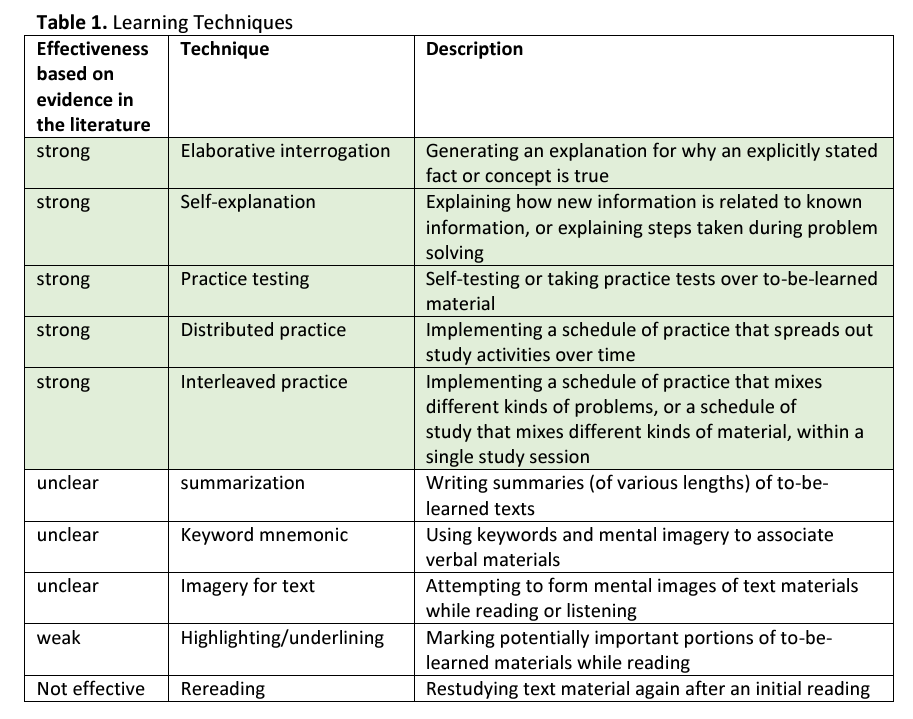
Depending on the activity you want students to perform, different didactic formats are possible such as one-minute paper, one-sentence summary, asking questions etc. Also have a look at table 1 (under principle 5) where an overview of different types of learning techniques is given together with the effectiveness level based on empirical study evidence (Dunlosky, Rawson, Marsh, Nathan, & Willingham, 2013).
4. Assessment as learning [integrate assessment into teaching]
How
How can you implement the aforementioned principles for assessment as learning? Here are some examples for inspiration:
Arrange practice with feedback so that the new information is effectively and efficiently assimilated and/or accommodated within the learners’ cognitive structure.
Provide opportunities for students to apply feedback from one task to another, or to rework an assignment. Prompt students to revisit and apply previous feedback. (Winstone & Carless, 2019)
Support the development of feedback literacy: the development of skills required to understand and act upon feedback (Winstone & Carless, 2019).
o Accompany feedback with reflection questions, such as ‘what do I feel/think about this feedback?’ and ‘what actions could I take to improve my work (for another assignment)?’
o Let students formulate feedback on their own or others’ work.
o A portfolio assessment is a useful facilitator for students to engage with feedback and act upon it.
Support the development of evaluative judgement: the capability of students to make decision about the quality of work of oneself and others (Tai, Ajjawi, Boud, Dawson, & Panadero, 2017).
o Let students self-assess their own work, with a focus on how to identify and choose criteria for judgement.
o Give opportunities for peer feedback in which students focus on how the work of peers (do not) meet agreed standards and criteria. Emphasize the benefits for the feedback provider rather than the feedback receiver.
o Co-create rubrics with students to develop a shared understanding of criteria and how they might be applied.
o Discuss exemplars to uncover what the range of quality indicators might be.
Make sure the outcomes expected from students are observable and measurable, and focus the feedback from this point of view.
Offer authentic assessment tasks, relating to real-life uses of the discipline, that stimulate maximum integration (Van Merriënboer & Kirschner, 2017).
Engage in dialogue with students (and provide opportunities for peer-peer dialogue) about the purposes of assessment, the used criteria and standards and how to interpret them, the given feedback … (Winstone & Carless, 2019)
o In large groups, one way of promoting dialogue are interactive coversheets which students hand in together with their assignment. In this coversheet they can indicate on which aspects they would like feedback, how they have applied previous feedback, how they assess themselves on the criteria, etc.
Stimulate self-monitoring
o Include pre- and post-assessments (in a course or before/after an assignment).
o Have students take a quiz after reading or watching videos, or reading a text. Multiple choice questions and/or automated feedback enable students to quickly self-check their understanding of the key concepts and ideas learnt from the given materials. This is an effective way to prevent illusion of knowing.
o Determine which parts of the ‘learning at home’ they found difficult. You can do this, for example via a discussion forum, or even an assignment.
References
Tai, J., Ajjawi, R., Boud, D., Dawson, P., & Panadero, E. (2017). Developing evaluative judgement: Enabling students to make decisions about the quality of work. Higher Education, 76(3), 467-481. doi:10.1007/s10734-017-0220-3
Van Merriënboer, J. J., & Kirschner, P. A. (2017). Ten steps to complex learning: A systematic approach to four-component instructional design: Routledge.
Winstone, N., & Carless, D. (2019). Designing Effective Feedback Processes in Higher Education. A Learning-focused Approach.
5. Stimulate & develop metacognition and self-regulated learning (SRL) and promote reflection [learn to learn and teacher/student control]
Quite some studies on metacognition and SRL have suggested that many students are unprepared for the independent learning aspect of a course. Students need explicit instruction and activities to improve their capacity for effective individual learning (so-called “learning-to-learn”).
Many teaching strategies have been suggested to stimulate and develop metacognition and SRL. A few examples listed below for inspiration:
o raising students’ awareness of the importance of metacognition,
o gaining students’ knowledge and skills in effective learning strategies (also know what ineffective learning approaches are),
o stimulating students to deploy diverse assessments at different learning stages (e.g. practicing peer and self-assessment, using prior knowledge assessment and retrospective post-assessments) to stimulate accurate monitoring;
o engaging students in taking action in making adaptions.
How
How can you implement the aforementioned principles for metacognition/SRL and reflection? Here are some examples for inspiration:
Provide explicit instruction and activities:
o Encourage students to examine their current thinking by using preassessments.
o Give students practice in identifying confusions, by asking for ‘the muddiest point’ of a class or course part.
o Push students to recognize conceptual change by using retrospective assessments: “Before the course I thought X was … Now I think that X is …”
o Provide a forum (e.g. a portfolio or blog) in which students monitor their own thinking.
Develop a culture in your (online) classroom around metacognition:
o Ask students about their confusions, and acknowledge difficulties. o Integrate reflection in course work or assignments.
o Model the thinking processes involved in your field of expertise.
Help students to deploy (more) effective learning techniques, such as elaborating, selfquestioning, practice testing, distributed practice, rephrasing, and self-explanation, instead of sticking to ineffective ones (such as rereading and highlighting).
o Create online flash cards with a question on one side and the answer on the other.
Note: the impact of flash card activity on learning largely depends on the quality of the question. If the goal is the application of a concept and the learner sticks to writing retrieval of factual information questions, then a pre-made teacher-produced flashcard or quiz is better.
o Use weblogs. Have learners post blogs about the similarities and differences between subject matter or about the links between new subject matter and their prior knowledge.
o Add questions in video, text, and diverse forms of study materials. Ask students to rephrase, summarize, give examples, and argue reasoning.
An evidence-based overview of learning strategies is given in table 1, together with the effectiveness level based on empirical study (Dunlosky et al., 2013).
Actively involve the student in the learning process by keeping an appropriate balance between teacher control and student control (Vermunt & Verloop, 1999) on e.g. learning content, subject, sequence and pace, etc. Ensure the degree of learner-control is appropriate for the learning goals and your learners (e.g. prior knowledge, level of metacognitive skills). (Clark & Mayer, 2016; Vermunt & Verloop, 1999).
More resources:
o Putting metacognition into practice: https://cft.vanderbilt.edu/guides-subpages/metacognition/
o Ten metacognitive teaching strategies:
References
Clark, R. C., & Mayer, R. E. (2016). E-learning and the science of instruction: Proven guidelines for consumers and designers of multimedia learning: john Wiley & sons.
Dunlosky, J., Rawson, K. A., Marsh, E. J., Nathan, M. J., & Willingham, D. T. (2013). Improving students' learning with effective learning techniques: Promising directions from cognitive and educational psychology. Psychological Science in the Public Interest, 14(1), 4-58. doi:10.1177/1529100612453266
Vermunt, J. D., & Verloop, N. (1999). Congruence and friction between learning and teaching. Learning and Instruction, 9, 257–280.
6. Application & integration
How
How can you implement the aforementioned principles for application and integration? Here are some examples for inspiration:
Design learning tasks and instruction in which
o students are encouraged to integrate (transfer) the new knowledge or skill into everyday life;
o opportunities are provided for students to create, invent, or explore new and personal ways to use their new knowledge or skill;
o students can reflect on, discuss, and defend (the use of) their new knowledge or skill.
Sequence learning from mastering early steps to more complex levels of performance (Ertmer & Newby, 2013).
Structure, organize, and sequence information to facilitate optimal processing.
Design authentic tasks which are ill-structured or relate to real-world problems:
o Provide problems to students which cannot be solved with absolute certainty, to engage students in critical thinking and reflective judgement.
An example (video fragment ‘Rome wasn’t built in a day’): https://www.kuleuven.be/onderwijs/learninglab/inspiratie/monique-snoeck
Bronnen
De verschillende bronnen kan je onmiddellijk online raadplegen in LIMO of downloaden via volgende leeslijst: https://eu.alma.exlibrisgroup.com/leganto/public/32KUL_KUL/lists/2234790422110001488?auth=SAML
Benassi, V. A., Overson, C., & Hakala, C. M. (2014). Applying science of learning in education: Infusing psychological science into the curriculum. University of New Hampshire.
Biggs, J. (1996). Enhancing teaching through constructive alignment. Higher Education, 32(2), 347364.
Black, P., & Wiliam, D. (1998). Assessment and classroom learning. Assessment in Education: Principles, Policy & Practice, 5(1), 7-74. doi:10.1080/0969595980050102
Boekaerts, M., & Niemivirta, M. (2000). Self-regulated learning: Finding a balance between learning goals and ego-protective goals. In M. Boekaerts, P. R. Pintrich, & M. Zeidner (Eds.), Handbook of self-regulation (pp. 417-450). San Diego: Academic Press.
Borkowski, J. G. (1996). Metacognition: Theory or chapter heading? Learning and Individual Differences, 8(4), 391-402. doi:https://doi.org/10.1016/S1041-6080(96)90025-4
Butler, D. L., & Winne, P. H. (1995). Feedback and Self-Regulated Learning: A Theoretical Synthesis. Review of Educational Research, 65(3), 245-281.
Chiu, J. L., & Chi, M. T. H. (2014). Supporting Self-Explanation in the Classroom. In V. A. Benassi, C. Overson, & C. M. Hakala (Eds.), Applying science of learning in education: Infusing psychological science into the curriculum (pp. 91-103): University of New Hampshire.
Clark, R. C., & Mayer, R. E. (2016). E-learning and the science of instruction: Proven guidelines for consumers and designers of multimedia learning: john Wiley & sons.
Collins, A., Brown, J. S., & Newman, S. E. (1989). Cognitive apprenticeship: Teaching the crafts of reading, writing, and mathematics. In L. B. Resnick (Ed.), Knowing, learning, and instruction: Essays in honor of Robert Glaser (pp. 453-494): Lawrence Erlbaum Associates, Inc.
Curtis, R. V., & Reigeluth, C. M. (1984). The use of analogies in written text. Instructional Science, 13(2), 99-117.
Dorrenbacher, L., & Perels, F. (2016). Self-regulated learning profiles in college students: Their relationship to achievement, personality, and the effectiveness of an intervention to foster self-regulated learning. Learning and Individual Differences, 51, 229-241. doi:10.1016/j.lindif.2016.09.015
Dunlosky, J., Rawson, K. A., Marsh, E. J., Nathan, M. J., & Willingham, D. T. (2013). Improving students' learning with effective learning techniques: Promising directions from cognitive and educational psychology. Psychological Science in the Public Interest, 14(1), 4-58. doi:10.1177/1529100612453266
Earl, L., & Katz, S. (2006). Rethinking classroom assessment with purpose in mind: Assessment for, as and of learning. Winipeg, Manitoba: Western and Northern Canadian Protocol for Collaboration in Education (WNCP).
Ertmer, P. A., & Newby, T. J. (2013). Behaviorism, cognitivism, constructivism: Comparing critical features from an instructional design perspective. Performance Improvement Quarterly, 26(2), 43-71. doi:10.1002/piq.21143
Gibbs, G., & Simspon, C. (2005). Conditions under which assessment supports students’ learning. Learning and Teaching in Higher Education(1), 3-31.
Jackel, B., Pearce, J., Radloff, A., & Edwards, D. (2017). Assessment and feedback in higher education. A review of literature for the Higher Education Academy. Retrieved from Heslington:
Jonassen, D. H. (1999). Designing constructivist learning environments. In C. M. Reigeluth (Ed.), Instructional-design theories and models: A new paradigm of instructional theory (pp. 215239).
Keller, J. M. (1987). Development and use of the ARCS Model of Instructional Design. Journal of Instructional Development, 10(3), 2-10. Retrieved from http://www.jstor.org.kuleuven.ezproxy.kuleuven.be/stable/30221294
Knowles, M. S. (1975). Self-directed learning: A guide for learners and teachers.
Kuhn, D., & Dean, D. (2004). Metacognition: A bridge between cognitive psychology and educational practice. Theory Into Practice, 43(4), 268-273. doi:DOI 10.1353/tip.2004.0047
Marzano, R. J., Pickering, D., & Pollock, J. E. (2001). Classroom instruction that works: Researchbased strategies for increasing student achievement: Ascd.
Meichenbaum, D. H. (1977). Cognitive-Behavior Modification. An Integrative Approach: Springer US.
Meichenbaum, D. H., & Goodman, J. (1971). Training impulsive children to talk to themselves: A means of developing self-control. Journal of Abnormal Psychology, 77(2), 115-126. doi:http://dx.doi.org/10.1037/h0030773
Merrill, M. D. (2002). First principles of instruction. Educational Technology Research and Development, 50(3), 43-59. doi:Doi 10.1007/Bf02505024
Merrill, M. D. (2012). First principles of instruction: John Wiley & Sons.
Pintrich, P. R., Wolters, C. A., & Baxter, G. P. (2000). Assessing metacognition and self-regulated learning. In G. Schraw & J. C. Impara (Eds.), Issues in the Measurement of Metacognition (pp. 43-97). Lincoln, NE: Buros Institute of Mental Measurements.
Schank, R. C. (2010). The pragmatics of learning by doing. Pragmatics and Society, 1(1), 157-172. doi:https://doi.org/10.1075/ps.1.1.10sch
Schunk, D. H. (2012). Learning theories. An educational perspective (Sixth ed.). Boston: Pearson.
Sweller, J., van Merrienboer, J. J. G., & Paas, F. G. W. C. (1998). Cognitive architecture and instructional design. Educational Psychology Review, 10(3), 251-296. Retrieved from http://www.jstor.org.kuleuven.ezproxy.kuleuven.be/stable/23359412
Tai, J., Ajjawi, R., Boud, D., Dawson, P., & Panadero, E. (2017). Developing evaluative judgement: Enabling students to make decisions about the quality of work. Higher Education, 76(3), 467481. doi:10.1007/s10734-017-0220-3
Van Merriënboer, J. J., & Kirschner, P. A. (2017). Ten steps to complex learning: A systematic approach to four-component instructional design: Routledge.
Vermunt, J. D., & Verloop, N. (1999). Congruence and friction between learning and teaching. Learning and Instruction, 9, 257–280.
West, C., Farmer, J., & Wolff, P. (1991). Introduction to cognitive science and instructional design. Instructional Design. Implications from cognitive science, 3-35.
Wiggins, G., & McTighe, J. (2005). Understanding by design (2nd Edition ed.). Alexandria, Virginia USA: Association for Supervision and Curriculum Development.
Winnie, P. H., & Hadwin, A. F. (1998). Studying as Self-Regulated Learning. In D. J. Hacker, J. Dunlosky, & A. C. Graesser (Eds.), Metacognition in educational theory and practice (pp. 277304): Routledge.
Winstone, N., & Carless, D. (2019). Designing Effective Feedback Processes in Higher Education. A Learning-focused Approach.
Woolley, N. N., & Jarvis, Y. (2007). Situated cognition and cognitive apprenticeship: A model for teaching and learning clinical skills in a technologically rich and authentic learning environment. Nurse Education Today, 27(1), 73-79. doi:https://doi.org/10.1016/j.nedt.2006.02.010
Zimmerman, B. J. (2000). Attaining self-regulation: A social cognitive perspective. In M. Boekaerts, P. R. Pintrich, & M. Zeidner (Eds.), Handbook of self-regulation (pp. 13-39). San Diego: Academic Press.