Discussion Assignment
In the discussion forum, you are expected to participate often and engage in deep levels of discourse. You are required to post an initial response to the question/issue presented in the Forum by Sunday evening and then respond to at least 3 of your classmates’ initial posts. You should also respond to anyone who has responded to you.
You have read about many literacy tools and instructional strategies for cross-curricular use in classrooms. These strategies and tools are also useful for diverse learners. After analyzing and reflecting on the readings for Unit 5 and Unit 6, explain:
- The definition of a cross-curricular approach to teaching
- The benefits of using a cross-curricular approach to teaching
- Benefits for learners
- Benefits for instructors
Hello Dr. Amanda Nugent and colleagues,
Interdisciplinary integration (a cross-curricular approach) is the synthesis of facts, concepts, principles of two or more disciplines.
The realization of interdisciplinary links contributes to the formation of a holistic view of the phenomena of nature and their interrelation in students. It helps students to utilize their knowledge in other subjects and also gives them the opportunity to apply it to specific situations (Using Science in Cross-Curricular Teaching : Fizzics Education, n.d.). I wanted to find examples of cross-curricular connections in English classes. I would like to share some examples from my colleague's work
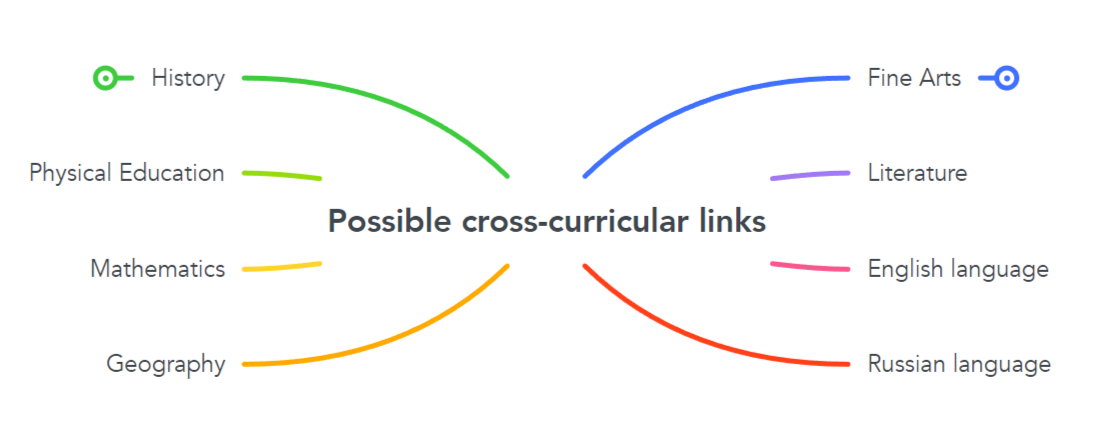
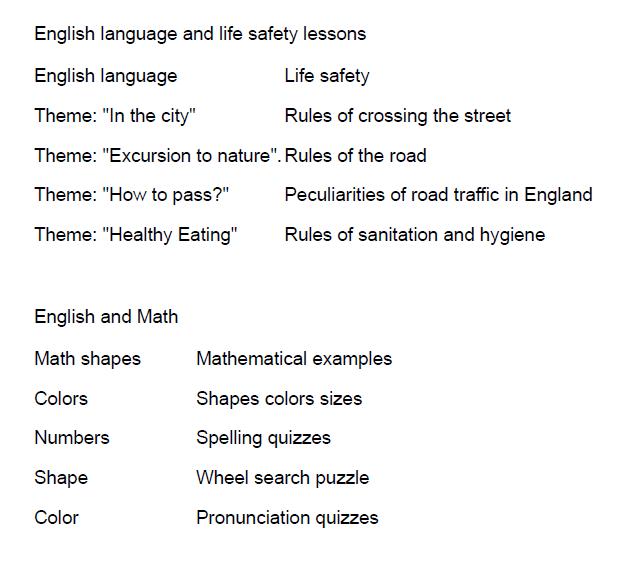
COMPUTER SCIENCE + ENGLISH
1. Screen view. Menu. Palette. Drawing a circle, ellipse, arc. Creating a self-portrait using the AutoFigures Panel.
Repetition of lexical material. Creating a label for an English notebook with students' self-portraits.
2. Creating a simple table in WORD. Filling cells. Filling. Adding and deleting rows and columns. Formatting cells. Drawing the boundaries
of the table. Creating a crossword puzzle.
Repetition of grammar material (Past Simple).Creating a grammar game "Irregular Verbs Lotto". Theme: "School Life". Creating a crossword puzzle based on the studied lexical material.
3. Creating a postcard using information from the INTERNET. Inserting a picture. Reflection and rotation. Using WordArt application.
Creating a greeting in Power Point.
Repeating the theme of British Holidays. Learning how to create greetings. Creating a Christmas Card (frame, drawing, text of an English Christmas poem).
4.Using the frame "inscription" to design a plan of the apartment and the area. Establishing the width and height of a table cell.
Theme "The Place I Live In "Use of new vocabulary, use of prepositions. Draw a plan of your apartment (room). Theme "Town Life. "Draw and describe the way from home to school.
5. Creating a multimedia presentation in the program "Power Point". Setting up animation, slide transition. Customizing the presentation.
Theme "Town Life. London" Description of the sights of London. A story about London, accompanied by a presentation on the computer.
6. Creating a grammar scheme using the menu "Autofigures".
Present Perfect Tense.
English and Fine Arts
Find your letter to Santa Claus and color it in.
Benefits for students
The use and implementation of interdisciplinary links in the learning activities contributes to the development of the child's emotional sphere, feelings and soul. A thinking and feeling person is the person we want to bring up. Integration helps the student to see the richness and diversity of the world.
Benefits for teachers
While creating interesting cross-curricular connections, the teacher needs to communicate with supervisors because they may already have a system in place to support interdisciplinary teaching (How to Make Cross-Curricular Teaching Part of Your Plan - Classcraft Blog, 2019). Next, the teacher should create their concept map to begin planning specific ways to integrate other skills into the core lesson and use those skills to reinforce the lesson objective. The thematic units can be planned to be tools for practical application of knowledge in different areas. They can be illustrated with primary sources. The advantage of a combined lesson is that a single piece of work can be assessed using different criteria that are specific to different subjects.
Through concerted, cooperative, and conceptual collaboration, teachers can expand the scope of their project work and create a unified field for collecting, sharing, analyzing, and synthesizing the information that teachers will need to teach both their students and their colleagues. This can allow for "one style" lessons to be taught during the course of work on a particular topic.
References
Formation of linguistic competence on the basis of interdisciplinary links of English with other subjects. (n.d.). Compedu.ru. Retrieved
March 10, 2024, from https://compedu.ru/publication/formirovanie-iazykovoi-kompetentsii-na-osnove-mezhpredmetnykh-sviazeiangliiskog.
html.
How to make cross-curricular teaching part of your plan - Classcraft Blog. (2019, December 3). Resource Hub for Schools and
Districts. https://www.classcraft.com/resources/blog/how-to-make-cross-curricular-teaching-part-of-your-plan/
Using science in cross-curricular teaching : Fizzics Education.
(n.d.). Www.fizzicseducation.com.au. https://www.fizzicseducation.com.au/articles/using-science-in-cross-curricular-teaching/