Discussion Assignment
This unit focuses on assessment as it relates to sustainability issues and the range of assessments techniques that can deepen the learning experience. To frame this discussion, take a few minutes to review the “Assessing Pupil Learning with Rubrics” section of the Education for Sustainability Sourcebook. As an education professional and a UoPeople student, you are very familiar with rubrics, so this reading should serve as added learning on how to relate the use of rubrics to serve student learning through globally-competent teaching and adapting Education for Sustainable Development (ESD) techniques, as learned in Unit 3.
Take your knowledge of rubric development as you now view a short video titled “Eco-Schools Indian Ocean: from Schools to Communities.” The video highlights the Eco-Schools program that helps students to take actions to protect their environment and to be the change for sustainability. Notice too that at timestamp 1:55 that the student experience also segues well with our attention to this unit’s learning objective that you will be competent to “...determine the instructional purpose and quality indicators of assessment as they relate to global issues, advocacy, and life-long learning.”
Choose a learning project identified in the video. Develop a rubric that provides you, the instructor, with an assessment of how your students are doing in terms of meeting objectives such as:
- Demonstrating a global competence
- Determining the instructional purpose and quality indicators of assessment as they relate to global issues, advocacy, and lifelong learning
- Demonstrating authentic, performance-based, assessment using multiple sources
Discussion Requirements
Your Discussion should be at least 300 words in length. Use APA citations and references for the textbook and any other sources
used. Refer to the UoPeople APA Tutorials in the LRC for help with APA citations.
Discussion Responses
It is your responsibility to respond to three classmates by providing comments, asking questions, or having a conversation about their main post. Feedback should be appropriate, meaningful, and helpful. For instance refer to how your own experience supports/contradicts the opinions developed by your peers. If you think they are too general or not rooted enough in personal experience, you may also ask for more detailed examples supporting these opinions. In particular make sure that the examples provided are properly referenced and that you are able to access them. Overall, your comments should contribute positively to the conversation by broadening or clarifying it. Feedback should be at least 3-4 complete sentences.
Discussion Rating
After posting an appropriate, meaningful, and helpful response to your three classmates, you must rate their posts on a scale of 0 (unsatisfactory) to 10 (Excellent). The rating scores are anonymous; therefore, do NOT mention in your remarks the separate rating score you will give the peer. The instructor is the only person who knows which score matches the comment given to a peer. Some classmates may worry that some peers will not provide a fair rating, or be unable to provide accurate corrections for grammar or other errors. It is the instructor’s responsibility to ensure fairness and accuracy.
Please review and follow the guidelines on the discussion forum rubric for assessing your peer's responses to the Discussion Assignment.
Here are some questions to consider as we think about the feedback and rating to give our classmates:
1. Did the peer respond to everything asked by the assignment prompt?
2. Was the peer’s overall response organized and logical? Was it easy to follow and smooth?
3. Was it easy to understand the ideas the student was trying to communicate, or did you have to make assumptions to make
sense out of what the peer wrote?
4. Did the peer use their own words, or if they borrowed from somewhere else, did they give credit to the source they used?
5. Were there consistent errors in grammar and punctuation that made it hard to understand or make sense out of the writing?
If at any time you suspect that a post in this Discussion Forum violates UoPeople's rules regarding plagiarism and/or any aspect of UoPeople’s Academic Code of Conduct, please notify your instructor immediately.
Remember that your instructor will be reviewing responses, ratings, and comments. Your instructor will adjust ratings if he/she believes that they do not seem warranted or supportable.
Hello Dear Dr. Lozano and Colleagues,
Authentic assessment differs from summative and formative assessment by taking an individualized approach to the student's personal performance. It helps to maximize attention not only to the overall, whole result, but also to provide feedback on all items of a completed assignment, which may have inherently different degrees of completion. Sourcebook (2012) offers a step-by-step plan for creating a rubric for criterion-referenced assessment that is part of an Authentic assessment.
1. First, the teacher should have a sample of the assignment the student will be completing.
2. Second the teacher needs to list the elements that students should include in the outcome of this assignment or obtain in the final product.
3. The most important aspects should be at the beginning, keeping the order from important to less important, or as they should be presented in the assignment.
4. Assign a value to each item so that the total is 100%.
5. Verify that the assignment is completely consistent with the rubric.
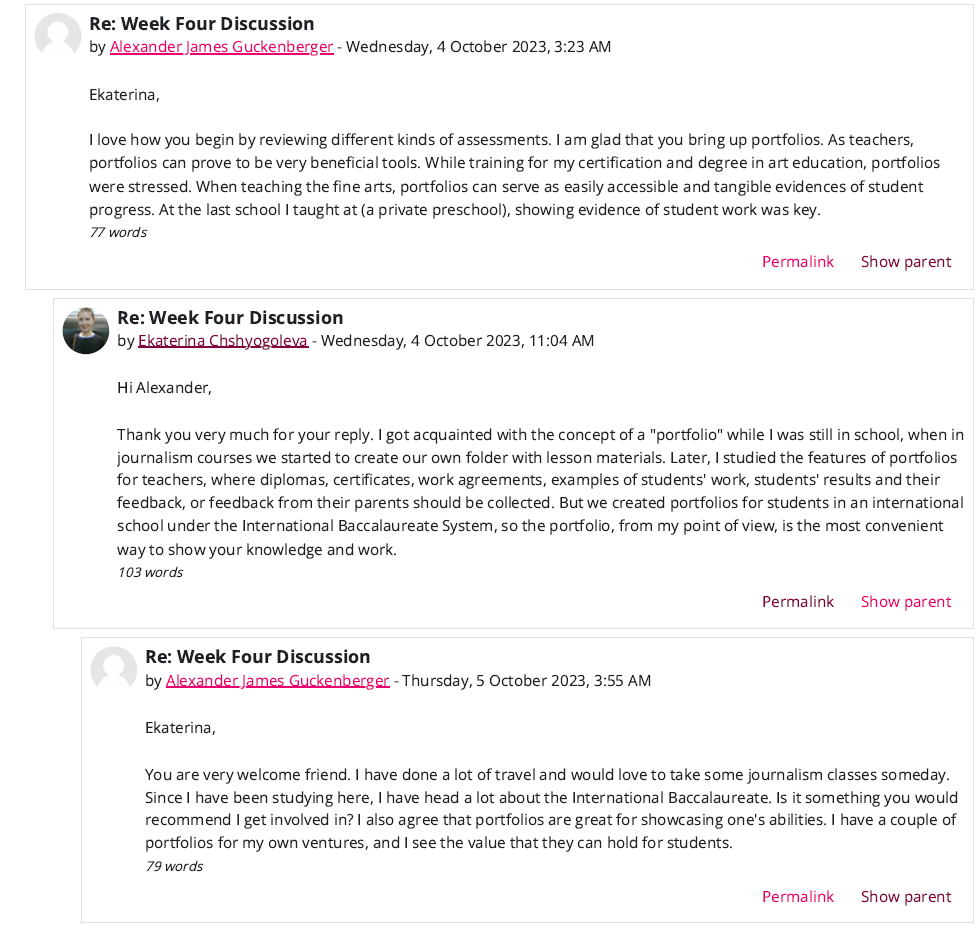
Further research into thematic plans for sustainable development found the Russian E-School website, where ecology is included in the list of subjects. The most curious lesson was Lesson 7. "Urbanization. Demographic Problems of Russia and Sustainable Development" for 11th grade (Bikanova, n. d.).
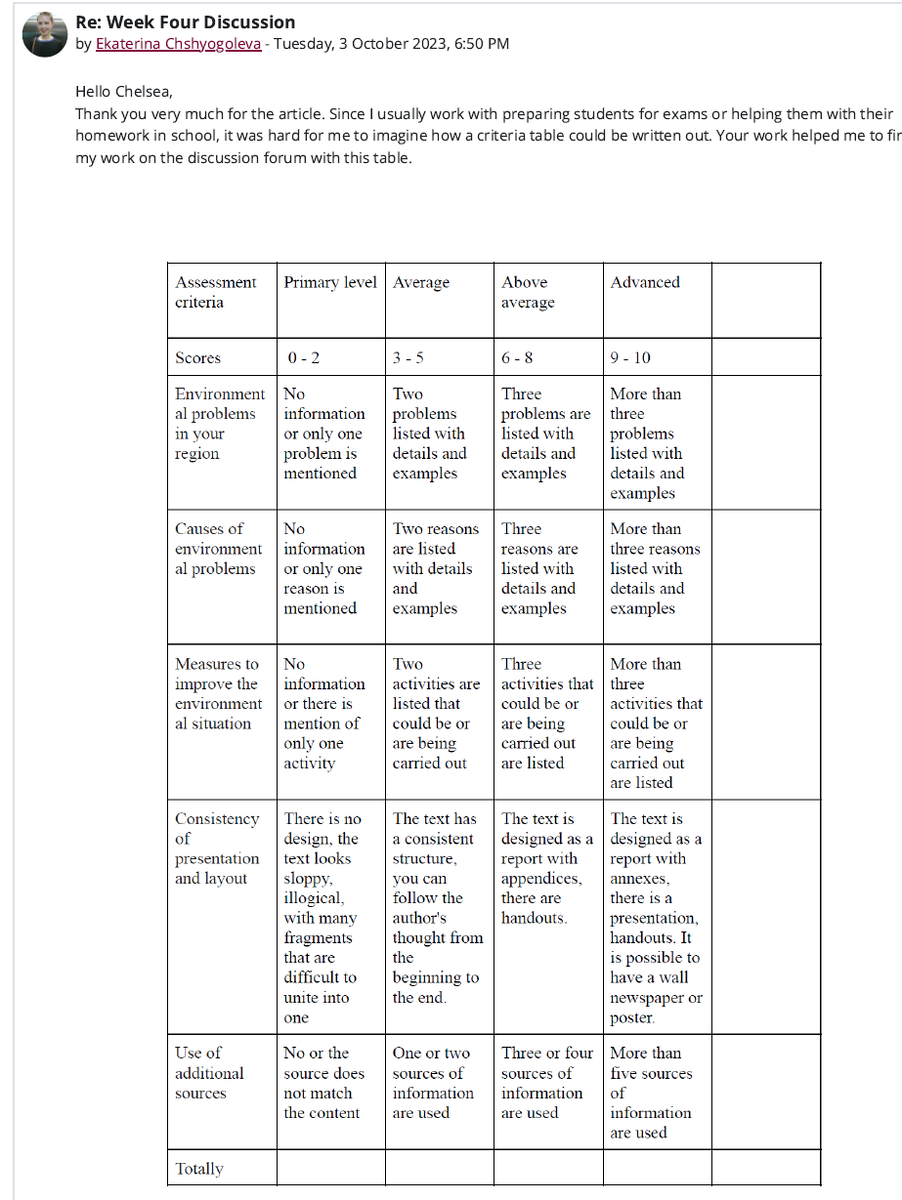
This lesson has an interesting assignment: Describe the environmental problems where you live. Think about and describe what they might be related to. Propose measures to improve the environmental situation in your community. And as a final result you are required to make your own project. In this way you can talk about the student portfolio as a product.
Cox Janelle (2019) in her article suggests five steps of a student portfolio: defining the purpose, assessment method, content, paper or digital options, and student engagement. And Melissa Kelly (2020) believes that the portfolios may be used to show student growth, to identify weak spots in student work, and/or to evaluate your own teaching methods. Therefore, Derrick Meador rightly points out that A portfolio assessment requires a great level of individual interaction between the student and teacher wherein they are always collaborating about the requirements and components going into the portfolio.
Since the portfolio assessment criteria can be the result of a creative approach to understanding the assignment, students can be prepared to understand the criteria and their value gradually, for example through written assignments. Grading can be done using a table that describes the four or five main criteria, graded from Advanced to Beginning, with a detailed analysis of each outcome. At the end, each criterion is given a certain percentage of quality and becomes part of the overall grade.
This type of assessment is good in that it does not allow for an undervalued grade overall, but accurately indicates the strengths and weaknesses of the assignment.
References
Bikanova Natalya, n. d., Ecology, 11th grade, Lesson 7. "Urbanization. Russia's demographic problems and sustainable development"
https://resh.edu.ru/subject/lesson/5919/main/77864/
Cox Janelle, 2019, 5 Steps to Building a Student Portfolio, Tracking students' work with portfolios can help them focus
https://www.thoughtco.com/steps-building-a-student-portfolio-4172775
Cox Janelle, 2020, Writing Rubrics, Samples of Basic, Expository, and Narrative Rubrics
https://www.thoughtco.com/writing-rubric-2081370
Kelly Melissa, 2020, Getting Started With Student Portfolios, What to include, how to grade, and why to assign portfolios
https://www.thoughtco.com/getting-started-with-student-portfolios-8158
Meador Derrick, 2019, The Purpose of Building a Portfolio Assessment
https://www.thoughtco.com/the-purpose-of-building-a-portfolio-assessment-3194653
United Nations Educational, Scientific, and Cultural Organization. (2012). Education for sustainable development: Sourcebook.