Objectives
By the end of this chapter, you should be able to:
• understand how the assessment policy of individual schools may impact on the
implementation of assessment for learning;
• appreciate how the concepts of AfL of individual teachers can influence their
assessment practices;
• recognize through the case studies provided the ways that AfL can shape and be
reflected in the instructional and assessment practices of classroom teachers;
• relate the concepts of assessment for learning to your own teaching.
In most educational contexts, assessment guidelines are stated and defined in the national curriculum or system for schools to refer to. In Hong Kong, the learning function of assessment has been brought to much wider attention than it has been in the past, especially in recent years. The message of assessment for learning has been conveyed very explicitly to schools in the basic curriculum guidelines as well as in many education occasions such as workshops and seminars offered by the government. However, because of different circumstances, the good intentions may not be easily transferred to classroom actions. This chapter shows that individual schools may have their own interpretation of the government assessment guidelines. Similarly, individual teachers may have variations in understanding assessment for learning and therefore implement the concept in their own way. The deep thinking and tutorial exercises in the three sections in this chapter will provide the first platform for deliberation and for putting the assessment for learning concepts into practice.
This chapter uses three schools and their three teachers as the focus of discussion. The information of the following case has been derived from an examination of the assessment practices in three secondary schools in Hong Kong. The information presented is based on the findings of a study conducted by the author of this book. It is worth noting that the information is fact-based with no added interpretation. The sources of information include school documents, teacher interviews, teacher reflections, student interviews and student portfolios. The three schools represent three different levels of academic performance. School A is high, School B medium, and School C low. The chapter is divided into two parts. The first part presents the assessment practices of the three project schools and the three teachers from these schools. In the second part, a learning and assessment plan is presented in which various important assessment for learning concepts are showcased. The second part also presents how the three teachers used the learning and assessment plan for their teaching. At the end of part one and the two sections of part two, some deep thinking exercises about assessment for learning are provided. The review questions at the end of this chapter aim to take the understanding to an even deeper level.
Part 1: Three Project Schools
School A was a prestigious school. On the whole, the students were keen workers and outperformed their counterparts in many other schools in Hong Kong. In the 2006 school self-assessment report, School A stated that it saw assessment as a tool both to evaluate student performances and to reinforce learning. The assessment used included class work, home assignments, oral presentations, portfolio and project production, short quizzes, formal tests and examinations.
The school used summative assessment and increasingly used formative assessment. One formative assessment example the school gave was a secondary assessment task, social studies project. There were some learning tasks related to the project which students were required to submit. The tasks would be assessed by the teachers throughout the project time. In addition, the students were required to orally present the end product (the project itself), which would be given marks. The marks assigned to the oral presentation plus those given to the final product would be counted towards students’ overall performance of the subject. In addition, to assist students with diverse learning needs, the school organized an English language bridging course and an English language enhancement course for those who recently joined the school and were seen to need further support in English language. For this academic year, from the data gathered, the school saw the need to give the new intake extra support in Chinese language and Maths. Consequently, more teaching time was allocated for these two subjects in the Secondary 1 curriculum. There were, however, no descriptions of how the assessment was organized to match the diverse learning needs of the students. School A always maintained high academic performance and was a top band school.
School B emphasized academic performance. The school depended heavily on tests and exams, dictations, and homework to assess students. The purpose of using these assessment strategies was to motivate students to learn. Dictations and homework were treated as “formative assessment” by the school, based on the interpretation that these assessment methods were given during the term. It was believed that the assessment strategies could create a washback effect and students would therefore “learn”. Teaching methods tended to be traditional. Lecturing was the normal practice, and students had very little involvement in the learning process. The role of students was to complete the assignments as set and study hard for the tests and examinations.
To help them pass the summative tests and examinations, students were given a large amount of homework and/or a number of tasks to do every day. The style of assignments was rather traditional, for example exercises usually found in the workbook or at the end of a chapter/unit. More often than not, the assignments were mechanical exercises which students could complete by looking in the book. Other times, students would be asked to memorize the spelling of some newly taught vocabulary items for the next day’s dictation. School B used to be a popular school in the district area because it was perceived to be a high-performance school. However, recently, the students’ academic performance had gone down, slipping from its position as a top band school.
School C moved to a new site only several years ago. It was a millennium school well equipped with a lot of learning facilities, including modern information technology and computer equipment. The students were mainly from the low-income group of the community. According to the teachers, many students experienced family problems, for example difficulty in being a child in a single-parent family. There were students who were physically disabled, and a few were identified as autistic. Teaching and learning were traditional. Teaching tended to cover the content of the textbook. Students in general were rather passive in learning and were very used to following the activities in the textbook. Assessment policies were also traditional. Although the school had a vision of acknowledging all achievements of students, the assessment was mainly focused on determining students’ academic results in different subject areas. Standardized tests and examinations (paper-and-pencil tests) were employed as mechanisms to make students learn. For senior forms, the tests (daily marks) and exam (final marks) allocation was twenty percent and eighty percent. The assessment practice in junior forms basically resembled the senior form assessment practice. The only difference was that daily marks increased to thirty percent, ten percent of which were generated by projects, dictations and compositions. The school did make a note in its last year’s report that, in addition to assessing students through tests and exams, students’ performance in the class should be taken into consideration. Teachers could use projects to assess student learning from different perspectives. However, the results of the interviews with the schoolteachers revealed that the assessment practice of the school still relied heavily on evaluating results rather than using assessment to support learning. Tests and examinations were the standardized assessment practice and were used solely for summative purposes. The school had not mentioned how assessment was used for catering for the diverse needs of some of their students. School C was a low band school. There was no evidence to show that it was moving out of its current band bracket.
Deep thinking and tutorial activities:
1. Critically examine specific aspects of the assessment practice of the three
schools. Look for what seemed well done, what might have been done differently
or better, and what wasn’t. Based on the assessment concepts discussed in the
previous chapters, make suggestions on how to use assessment to help the
students of the three project schools learn better.
2. Compare the assessment practices of the three project schools. Hold a debate on
the topic: “Assessment practices are related to student performance”.
Part 2: Three Teachers from the Three Project Schools
As part of the study, three teachers from three schools were invited to try out a learning and assessment plan, presented in Figure 10.1 (see p. 190). Some basic learning activities were provided to them, and ideas of assessment for learning were discussed between the teachers and the researcher (i.e. the author). The teachers were given a free hand to use the basic set of learning and assessment activities provided, with an understanding that more thought from them was needed, especially about their assessment strategy use.
The learning and assessment plan
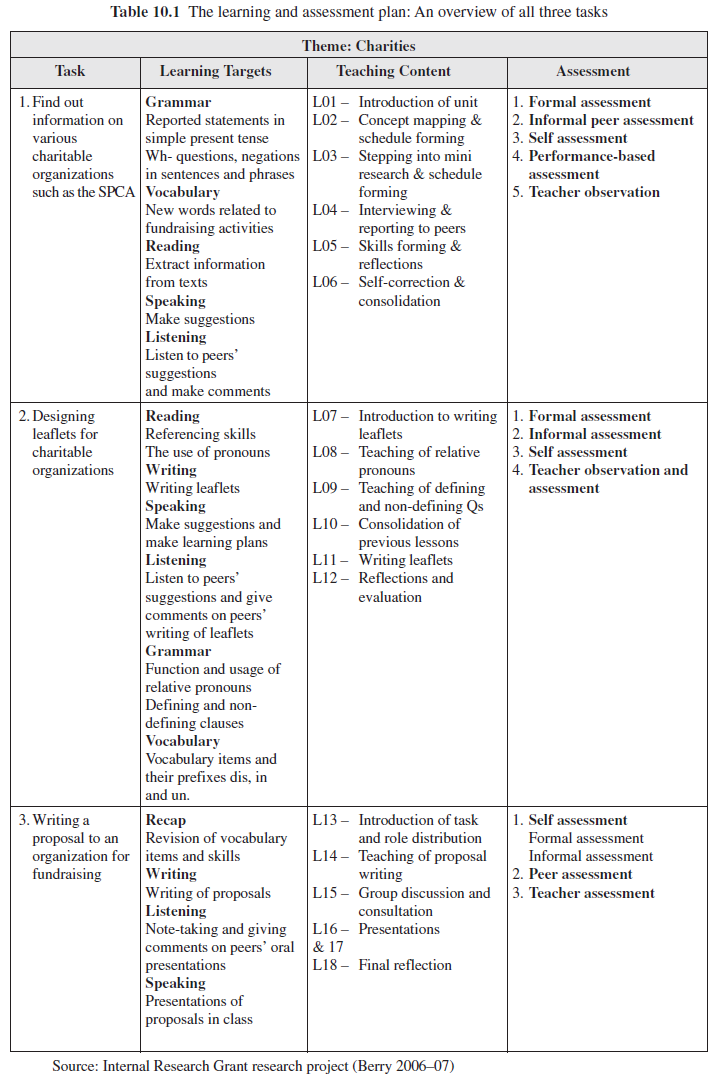
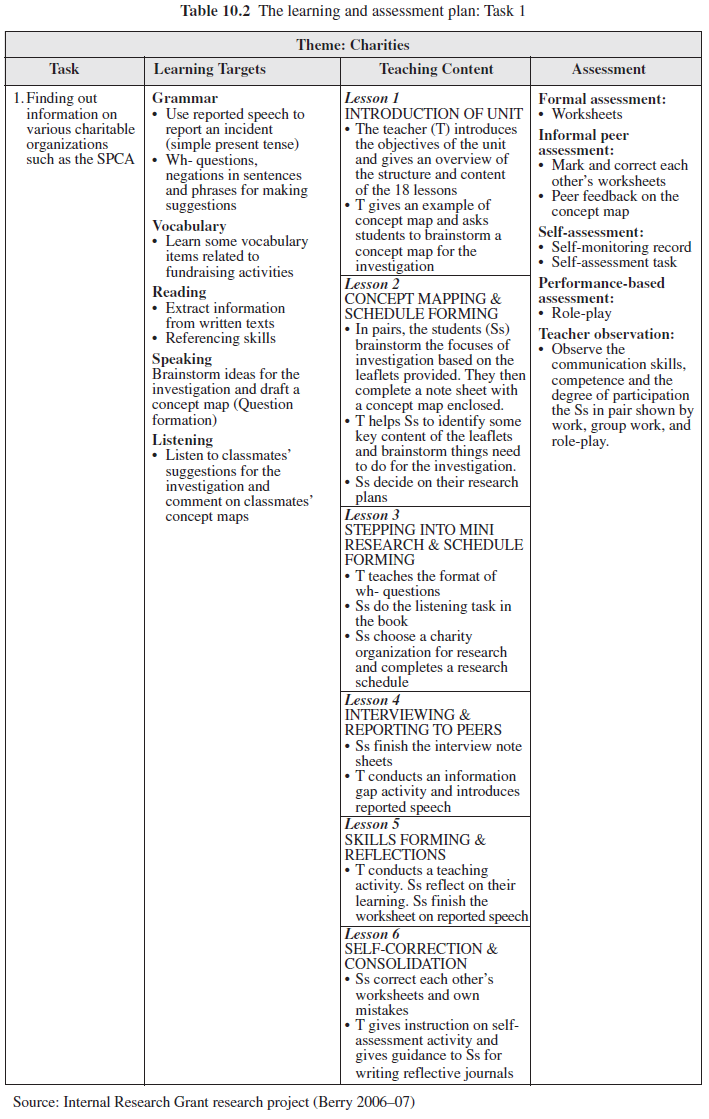
The theme of the learning and assessment plan was charities. The plan used a taskbased approach. The worksheets for the task sheets and related information would be kept in a portfolio, which would have to be submitted to the teacher for marking. Table 10.1 provides an overview of all three tasks of the plan. Task 1 in Table 10.2 (p. 189) will be used to further elaborate the learning and assessment activities encompassed in the plan. The task is used to highlight the learning objectives, learning activities, and assessment strategies of the plan. A detailed description of all six lessons is given as further elaboration of the assessment strategies and learning activities.
Lesson 1: Introduction of unit
Task 1 required students to look for information about charitable organizations in Hong Kong. Lesson 1 began with giving students a broad overview of the learning and assessment plan as well as a brief account description of the three tasks. After introducing the objectives and learning targets of the tasks, students were given a goal-setting record sheet to complete (Figure 10.1). There were twelve learning targets on the record sheet, reflecting language development of the four language skills:
listening, speaking, reading, and writing. The goal-setting record sheet helped students understand the learning objectives of the whole plan. It was also be used as a self-needs analysis.
Lesson 2: Concept mapping and schedule forming
At the beginning of the second lesson, the teacher introduced concept maps to the students. A number of concept maps were used to illustrate the characteristics of good concept maps. The students were then given a vocabulary sheet with twenty vocabulary items on it (Figure 10.2, see p. 191). The new words were related to the main theme, charity. Students were asked to clarify their understanding of the words. They could brainstorm or confirm the meaning with their peers (informal peer assessment), or refer to a dictionary or any other means they found useful. Then individually, students drew a concept map to show their understanding of the words and their perceived conceptual linkage among these words. Upon completion of the individual concept map, students gave each other feedback based on the pre-discussed concept maps characteristics (peer assessment). To further support the activity, the teacher had demonstrated how a conversation could be maintained. Students could ask for a copy of sample discussion dialogue only when they felt more support was needed. During the peer assessment, the students were encouraged to raise questions (informal questioning) and give comments on each other’s work. Students should make a judgement on whether the suggestions were useful for them. If the suggestions were deemed useful, students would then make further adjustments of their concept map before submission to the teacher (formal teacher assessment). The teacher conducted observations by looking at students’ competence in language use, their communication skills, and the degree of participation in pairs and group work in the whole lesson. The teacher then conducted a whole-class discussion and provided feedback to students to clarify some misunderstood meaning and concepts. With this new understanding, students drew a new concept map or added new ideas to the old one. An example of a final product of the concept map is shown in Figure 10.3 (see p. 191). The bubbles with dotted lines were pre-discussion concepts, and the ones with solid lines were added after the peer assessment and receiving feedback from the teacher.
Lesson 3: Stepping into mini research and schedule forming
In lesson three, students were provided with a leaflet of a charitable organization. They were asked to identify some information they thought useful, and then individually they wrote it down on the note sheet provided. The information could include a brief description of the organization, vision and mission, their service, donation methods etc. Then the teacher held a whole-class brainstorming session during which questions could be used for prompting answers (questioning). The questions would lead into setting a schedule for research information (Figure 10.4, see p. 192). Peer feedback could be invited (informal peer assessment). The teacher could give immediate feedback as well (teacher informal assessment and feedback). Students were asked to do some research on charity work and organization as homework. They would need to choose a charitable organization and design a leaflet by themselves, which would be marked by the teacher (formal assessment).
Lessons 4 to 6: Interviewing and reporting to peers, skills forming and reflection, self-correction and consolidation
These three lessons are discussed together, to keep a coherent flow of the description. At different times of these lessons, the teacher taught wh- questions and reported speech. The teachers distributed an interview note sheet with one guiding question (wh-question) as an example. The students needed to write down a number of wh- questions on the note sheet (Figure 10.5). The purpose was to find out the results of the research conducted by their partners. After giving students some time to draft a few questions, the teacher held a whole-class discussion. The teacher invited the students to talk about the questions they had drafted for the interview (informal peer assessment and teacher feedback). Students revised their questions. In pairs, they interviewed each other. They could negotiate better questions to ask and different answers to the questions.
They were encouraged to comment on each other’s suggestions (informal peer assessment). A number of self-assessment opportunities were created for students to reflect on their learning, which the teachers could use at their discretion. For example, a self-monitoring checklist (Figure 10.6) could be given to students to self-assess their learning progress. Two other examples were given, including the one which asks students to reflect on their own progress and to make plans for improvement (self-assessment learner logs in Figures 10.7 (see p. 196) and 10.8 (see p. 197), with student reflection). The portfolio would be collected and marked as teacher assessment.
Written feedback would be given to the students.
Deep thinking and tutorial activities:
3. The learning and assessment activities presented above offer some ideas of how
assessment can support learning. In groups, critically examine them and make
suggestions on how these can be further improved to support learning. Explain
why.
4. Develop an assessment plan and design some learning and assessment activities
for teaching your own students. Support your design with assessment for learning
concepts.
Three different experiences
Three teachers from the three different schools were involved in the study. Using the same learning and assessment plan presented in Figure 10.1, the three teachers implemented the plan in the school they taught. Using self-assessment and teacher assessment as the context, the following presents the experience of the three teachers in using assessment for teaching and learning. Individual teachers inevitably had their own way of using the assessment activities provided. The information presented in the following is again fact-based with no further elaboration or interpretation added.
Student self-assessment
The self-assessment tasks
Self assessment was conducted with the use of a self assessment checklist (Figure 10.6) as well as two learning logs (Figures 10.7 and 10.8). The self assessment checklist required students to self-evaluate their strategies for learning English in the lessons.
For example, the students indicated how often they would communicate with teachers and students during the lesson. A number of open-ended follow-up questions were used to prompt students to look into their learning and to make suggestions for improving their own learning. The two learners’ logs required students to reflect on what they did in the lessons, what they thought they had learned well and not too well, and what kinds of future plans they would need, in order to improve further. The checklist and learners’ logs would be submitted to the teachers for monitoring progress and for giving support whenever it is deemed necessary.
The responses of the three teachers to students’ self-assessment
Miss Chan (School A) made numerous responses to students’ self-reflections. For example, when a student wrote that she would try not to speak Cantonese during English lesson, in order to improve her English, Miss Chan drew a smiley face right next to the statement, to show her appreciation. Other times, she showed her approval by writing comments such as “Good idea”. To acknowledge good progress, she would write, for example, “You have made good progress in your research”. She made suggestions to help students improve. For example, “You will need to gather more information to enrich this part” (indicated in the worksheet). “You could look into (a website) for further information”.
Mr Au (School B) read through the self assessment checklists and logs and gave some ticks. However, he opted not to give any comments in writing. It was not clear whether Mr Au had given verbal feedback to his students.
Mr Wu (School C) also provided feedback to students. Some feedback was to suggest ways for improvement, for example, “This word doesn’t fit here” (with indication). “Look for the meaning in your dictionary. You can either use the same word in a different context or find another word to replace it.” Mr Wu sometimes used questions to stimulate students’ thinking. For example, “Now, you have collected some information about a charity organization you want to write about. Is the information enough? How would you organize the information you have got?” Students in School C were usually low achievers and had low self-esteem. One student said that he loved to improve his English by doing more reading. However, he found it very hard to start this. Mr Wu then wrote, “Choose some interesting but very easy books to start with. How about bringing one to me so we can read together first?” In one lesson, when one student showed his frustration about the pronunciation mistake he made, Mr Wu said, “Don’t worry. Let’s say it again. Repeat after me?”
Miss Chan said that she experienced a number of difficulties when promoting self assessment in the classroom. Her students did not seem to be keen on taking control of their own work. Things like monitoring their own work did not seem to interest them much. Her students were very used to following instructions. Except for a number of high achievers, most students preferred to have the instructions from their teachers rather than making plans for themselves. On the whole, students lacked the skills of doing self and peer assessment. Despite this, Miss Chan was very positive about self assessment. She believed that self assessment would benefit students, as learning would not be spoon-feeding. It would be something from them.
Mr Au said that students did not know what to write in their self assessment. They were not able to make suggestions about what to do to become better. Probably because of their low level of language proficiency, students could not truly express themselves in writing. Therefore, many of them just copied exactly the same words as the teachers used as examples in the instructions. Mr Au said that he had a lot of trouble when he first got his students to do self assessment. He needed to do a lot of clarification with them. Despite this, he found it worth doing, as he saw that students became more active in learning. He said jokingly, “My students like to take more control over their learning now. They negotiate with me about the composition submission due date and the number of words to write.”
Mr Wu experienced difficulties when first conducting self assessment with his students. They found the idea of self assessment intimidating. Probably because of this, some of his students did not complete the self assessment sheets. Some of those who completed the self assessment tasks had very low self-esteem. They were rather hard on themselves. For example, one student wrote “I am bad”. Another wrote “I am not a good learner”. The self-reflection skills were very immature at first. There was a general lack of self-reflection skills. The students were not able to pinpoint their problems, nor were they able to make suggestions for improvement. The situation gradually improved after a few times of using self assessment. Students became better able to identify what they wanted to learn and to suggest what they could do to improve their learning. Mr Wu observed that it was good that students had begun to think about their learning. However, there was a discrepancy between what they wanted to do and what they actually did. In general, Mr. Wu was very positive about self assessment. He felt that it was particularly helpful in helping students see their strengths and weaknesses. He pointed out that it was important to let students see the objectives of self assessment and to familiarize them with the self assessment procedures in order to make it useful for the students. Mr Wu’s students indicated that they benefited from self assessment. One student said that it helped him see his weakness so he could do something about it. Another said it helped raise his awareness of “ownership in learning”.
Teacher assessment
Students were required to submit their work to their teacher from time to time. There were some marking variations among the three teachers. Miss Chan liked to use encouragement tactics. As mentioned, she used “cutie chops” as well as drawing smiley faces on work that was well done. Comments such as “Well done! You are able to master the questioning skills very well!” were often used to acknowledge students’ good work. In addition, correction feedback was frequently used to point out students’ grammatical and spelling mistakes. Some constructive feedback was found, for example “Perhaps more information about the background is needed”. When students were off-track, she would make comments such as “You have got quite a lot of information in this part. Maybe you could talk a bit more on other areas (indication on the note sheet)”. Mr Au and Mr Wu used similar tactics for giving feedback. Comments such as “Good” and “Excellent” were often found. Both used correction feedback for grammatical and spelling errors. Mr Au sometimes gave students extra help by providing needed information to them.
Deep thinking and tutorial activities:
5. Compare the assessment practices of the three teachers. Point out the strengths
of their practices and suggest what more could be done to support student
learning.
6. Mr Wu’s students had rather low self-esteem. Discuss how assessment could
help raise students’ self-esteem. Why is it important to have good self-esteem in
learning?
The Interface of Teaching, Learning, and Assessment
The assessment methods used in many schools tend to focus on determining students’ performance at the end of the learning process. Tests and exams are normally used as the vehicle to get that information. Traditional assessment practices tend to focus on errors made by students, and as such can lead to lack of self-confidence and reluctance to undertake challenging learning. Assessment focusing on end product is less helpful in supporting learning. Assessment should also be used for, among others, identifying students’ learning needs, motivating students’ towards learning, as well as giving them learning support. It is important for teachers to know that assessment, teaching, and learning are interrelated and should be considered together while doing instructional planning. The cases provided in this chapter demonstrate the sort of integration that teachers can use for the integration of teaching, learning, and assessment.
Summary
• The three secondary schools presented reflect variations of assessment policies,
assessment practices and interpretation of assessment for learning.
• The learning and assessment plan, Task 1 and the six lessons, exemplify the way
that assessment can support learning.
• Individual teachers may have their own ways of implementing assessment for
learning, as evidenced by their different ways of handling student self assessment
and teacher assessment.
Review Questions
1. Go back through the cases and locate what the teachers think might be indications
of the linkage between assessment practices and school performance.
2. Revisit the assessment for learning concepts discussed in previous chapters. Then
examine the different assessment practices of the three teachers. Which of their
assessment practices reflect assessment for learning?
3. The teachers in these cases all reported encountering some challenges and
difficulties as they attempted to introduce self assessment practices into their
classrooms. Using the perspective and ideas about self assessment that have been
shared in this textbook, consider how you might have responded in their place.
What are some strategies and steps you might have taken to ensure that self
assessment was successful in your classroom?
4. Based on the teacher assessment reported in the three cases, discuss how teacher
assessment can be done to support learning.