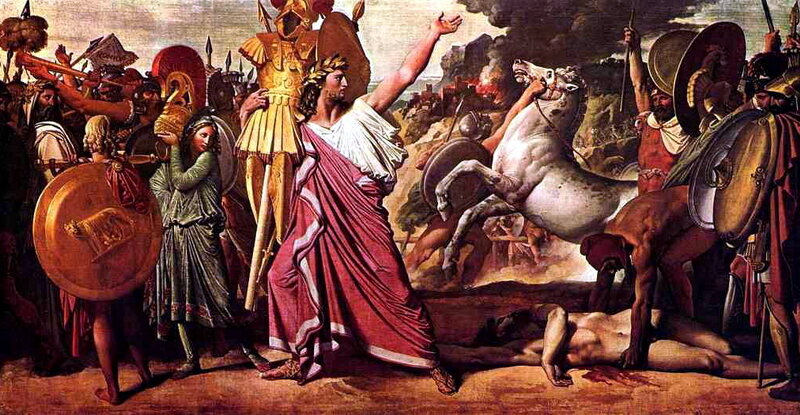
When we talk about Rome in the monarchic age, we refer to that historical period that goes from 753 B.C. (the year of the foundation of Rome) to 509 B.C. (year of the expulsion of Tarquin the Superb, the last king).
Historians divide the history of Rome into three great ages:
- Royal age since 753 B.C. (year of foundation) to 509 B.C. (year of the expulsion of the last king, Tarquinius the Superb);
- Republican age from 509 B.C. to 27 B.C., the year in which the Senate of Rome conferred on Octavian full powers and the title of Augustus;
- Imperial age from 27 B.C. to 476 A.D., the year of the deposition of Romulus Augustulus, the last Roman emperor of the West.
Rome in the Monarchic Age
The first form of government in Rome was the monarchy. According to tradition, this lasted two and a half centuries: from 753 BC, the year of the foundation of Rome, to 509 BC, the year in which King Tarquin the Superb was expelled from Rome.
In this period seven kings would have ruled. This is an unlikely number, because two and a half centuries are too many for only seven kings. There were therefore other kings, of whom no memory has been preserved. Read here Seven kings of Rome between history and legend.
Rome in the monarchic age: the political order
The king of Rome was the highest religious office in the city (he was a high priest); he commanded the army; he administered justice (he was the supreme judge of the people). If the king pronounced death sentences, however, the citizen could appeal to the curious rallies and refer to their judgment.
In the functions of government, including the legislative and judicial powers, the king was flanked by two assemblies: the senate and the rallies.
The senate was made up of members of the aristocracy chosen by the king; they were consulted for decisions on both foreign and domestic policy; the senate also had to approve or reject the sovereign's legislative proposals and the deliberations of the curious rallies. At the king's death, ten senators chose a new candidate and proposed him to the curious rallies.
The curious rallies were made up of citizens who were part of the 30 curias (distribution of the population); each curia was made up of 10 gentes (noble groups); it had to provide the army of Rome with 100 infantrymen (one centuria) and 10 knights, plus a senator for each gens (the senators were thus 300, according to the reform of Servio Tullio).
The curious rallies met in the assembly; they declared war; they appointed the king and approved the proposed laws and ratified the death sentences.
Rome in the monarchy: the social classes
During the monarchic period two social classes were created, that of the patricians and that of the plebeians.
The richest families belonged to the class of the patricians, organized in gentes, that is in groups of families that recognized themselves as descendants of a common ancestor, true or mythical; they bore the same surname .
The plebeian class, on the other hand, included the multitude (plebs) of the poorest citizens, including small country owners, workers, wage-earners, merchants and city artisans. In addition to the patricians and the plebeians, there were also clients in the service of the patricians, slaves and the freed.
Rome in the monarchy: religion
The Romans were polytheistic. The cults of the different deities were entrusted to the priestly colleges. The most important of these was the College of Pontiffs, held by the Pontiff Maximus. In the monarchic age, the Pontiff Maximus coincided with the king; he presided over the ceremonies, established the feasts and recorded the historical facts (Annales).
Then there were the College of the Salii (which presided over the cult of Mars); the College of the Vestals (which officiated the cult of Vesta); the College of the Wishes, which had the task of interpreting the will of the gods from the observation of the flight of birds and the bowels of sacrificed animals; the College of the Feziali (in case of conflict, they asked for reparation of the wrongs suffered by Rome; in case of refusal they declared war, throwing a spear into enemy territory).
Among the gods, the three most important were Jupiter, Mars and Quirinus. Great importance was also given to the family gods, the Lari and the Penati.