Some people have a wide range of shoulders, others, such as Flex Wheeler and Kevin Levron, have incredibly massive delta muscles, and some of the professional bodybuilders have an impressive range of shoulders, while others, such as Ronnie Coleman and Marcus Roel, have incredibly massive delta muscles. Rarely do any of these qualities come from both athletes, as powerful deltoids are not available for New Year's Eve or as a gift from a neighbor. Maybe something can be laid down on a genetic level, but without the hard work in the hall they would hardly have achieved any noticeable results. In this article, Jay Cutler shares the secrets of building huge shoulders.
Shoulder training plan
Even before I started rocking, I had a clear plan. Working on the construction site taught me that if you want to build something, you first need to know exactly what you want to do, and then patiently perform them in a given sequence. My plan, when it comes to bodybuilding, consists of three points.
Claim 1: Foundation
Initially, I dreamed of building a powerful figure, so I avoided paying special attention to certain parts of the body. Instead, I simply did heavy exercises with a barbell and dumbbells aimed at increasing strength and muscle mass in general.
Claim 2: superstructure
As soon as I gained weight, I started to form my body, paying attention to the development of individual muscles.
Claim 3: Finishing
It's the stage I'm at right now trying to hone my muscles to perfection. However, keep in mind that this is not a fundamentally new point, but rather a combination of the first two.
It is usually believed that it is impossible to work on the "mass" and the relief at the same time, because both training styles are diametrically opposed. I do not agree with this statement. From the first day I took up the barbell and dumbbells, I tried to work with maximum weights.
As a result, in two and a half years of training I have weighed 45 kilos! By the way, it proved the maximum effectiveness of free weights, which I still adhere to. But more importantly, I realized that if these exercises were so useful in the implementation of point one, they may be just as necessary in dealing with issues related to point two. In other words, if basic exercises make muscles grow in general, they can also cause the growth of individual muscles.
It didn't take me too long to come to what is called an ideal training philosophy that combines basic and isolated exercises, using only free weights and my knowledge of how a single muscle functions. I am well aware that in order to improve muscle detail, it is necessary to work on simulators. However, I have to sacrifice muscle density, and I am not happy with that. Machines inhibit the development of muscles, especially shoulders. Of course, you can use them to pump up individual bundles of deltoid muscles, but when you look at the side of your shoulders, your shoulders won't look brutal or massive. Yes, and remember how the great champions built up their "mass"? Lee Haynie had truly monstrous breasts, but he wasn't even close to any simulators. The same goes for Arnold, and what kind of biceps and breasts he had! Outstanding musculature can only be built up through hard training, working with free weights, so that additional effort is spent on maintaining muscle balance. This is my philosophy for all muscle groups. Of course, this mode of training requires much more than just hiring a coach who will look after you sitting on the seat of the trainer. Only the guys who "smell the gunpowder" are able to understand how hard it is to train with free weights.
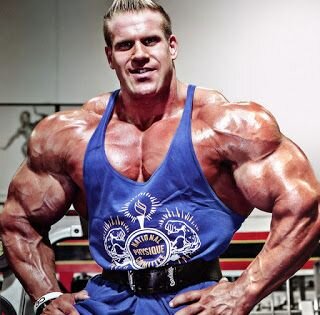
Jay Cutler's divorce
Exercises
My training complex usually starts with a power movement followed by a grinding exercise, then I perform the power movement again, and then I go back to the isolation exercise. The combination of basic and isolating exercises performed with free weights allows me not to sacrifice either "mass" or detailing.
Somewhere till the middle of 1999 I trained shoulders simultaneously with trapezoidal muscles, but now I have sharply inflated intensity, and consequently I have passed on two-time classes, pumping shoulders in the morning, and trapezes - in the evening. Try to check my training scheme on yourself and see what happens.
Exercise 1: Dumbbell swings in the sides while sitting
In my "basic exercise - isolating exercise" training scheme, the only exception is shoulder work. Since shoulders are a complex muscle group, they need a comprehensive warm-up, so I am changing the sequence of exercises, starting with the insulating movement. I start with the dumbbell swings to the side of the seat, reaching the so-called pre-exhaustion of the muscles before moving on to heavy presses. By pumping the mass as a whole, you will inevitably increase the "mass" of individual muscle groups, which will ultimately improve the separation between the individual parts of a muscle.
After three or four warm-up approaches of the dumbbell swings, I take a couple of heavy dumbbells and do with them three or four more approaches of 8 -12 repetitions. I try to work in the "explosive" style, reaching the point of "failure" in every set. People have a hard time believing this: "In the explosive style? Mani over the sides?" And this is actually true. And not just swinging, but everything in general. Look at how I rock biceps with a barbell - all the same, but it does not mean that I can not bring biceps to complete exhaustion. I simply don't believe in repetition at a slow pace - you won't grow up with it. Try to sit down in slow motion. It is unlikely that you will get something good. Raising the weight in the explosive style, you are able to work with more solid weights, which will set the correspondingly greater stress to the muscles.
In addition, swinging quickly, we can load muscle fibers, which can not be used in the work, training in a slow motion. Explosive style is what makes me successful throughout my career. I've never been hurt, all the effort I put into training was one hundred percent muscle, not joint or ligament. Well, as long as it works for me, it shouldn't be neglected by others.
However, God forbid you to rock in the explosive style, making mistakes in terms of technology! Personally, I do not allow myself to twist dumbbells or use the force of inertia in the swings across the sides of the movement. In addition, I try to lower the dumbbells under control - this is also the rule of the game called "explosive equipment". I want to note that I try to lower the weight under control at the expense of my shoulders' muscles, not trapezes. Exercise 2: Press dumbbell sitting.
Here I try to reach the maximum amplitude of the movement, pushing the dumbbells all the way up. Note: at the top, they should not touch each other, but reach the point where my hands would be, if I raised the barbell instead of dumbbells. In the lower position, I lower the dumbbells lower than I could lower the barbell. With one side of the dumbbell dumbbells hit the side bunches of the shoulders. In this exercise, as in the previous one, I do 3-4 approaches of 8-12 repetitions. Each approach is until "failure".
Exercise 3: Dumbbell diving face down on the inclined bench
I lie face down on the bench with my hands hanging down, grabbing a couple of dumbbells and lifting the dumbbells up in an arc across the sides. I don't turn the dumbbells around and don't make any other crawls to avoid a clear technique. Here again, there are 3-4 approaches, 8-12 repetitions each.
Exercise 4: Wave dumbbells in front of you sitting
I'll tell you right away it's a very hard move. I do it first with one hand and then with the other. Having made the body stable, I throw the dumbbell up so that it moves slightly inwards and rises to eye level. The exercise is focused on the front bundles of shoulder muscles. Standard 3-4 approaches are 8-12 repetitions each.
Exercise 5: Scarves with a barbell standing
In this exercise, I'm bombing with very large weights: 180 to 220 kilos. There are three approaches, 8-12 repetitions in total. This exercise is the best for working through trapezoidal muscles (they are located just below the neck between the shoulders and back muscles). I take the barbell neck with a rather wide grip - on the shoulder width, or even wider, and pulling the shell up, doing as if shrugging shoulders. I try to pull the barbell as high as possible, doing it all in an explosive style, so that the trapezes get tired before they "call" for help from the shoulders.
Exercise 6: Shrugs with a barbell behind your back
You may not be able to do this exercise the first time because it is technically difficult to do. But it's worth it, because shrugging your shoulders with the bar behind your back is a great way to work through the middle of your back plus your trapeze. As you may have already guessed, here I also have three approaches to 8 - 12 repetitions.
It may seem unusual to some, but thanks to them, Jay Cutler managed to win Arnold Classic, Champions' Night and a number of other tournaments, and at the same time received a lot of flattering comments about how he significantly improved the size and shape of his shoulders. So there's no better exercise for him - the company guarantees it! Of course, it is possible that his shoulders would grow from normal training, but what good would it do if he had the best?