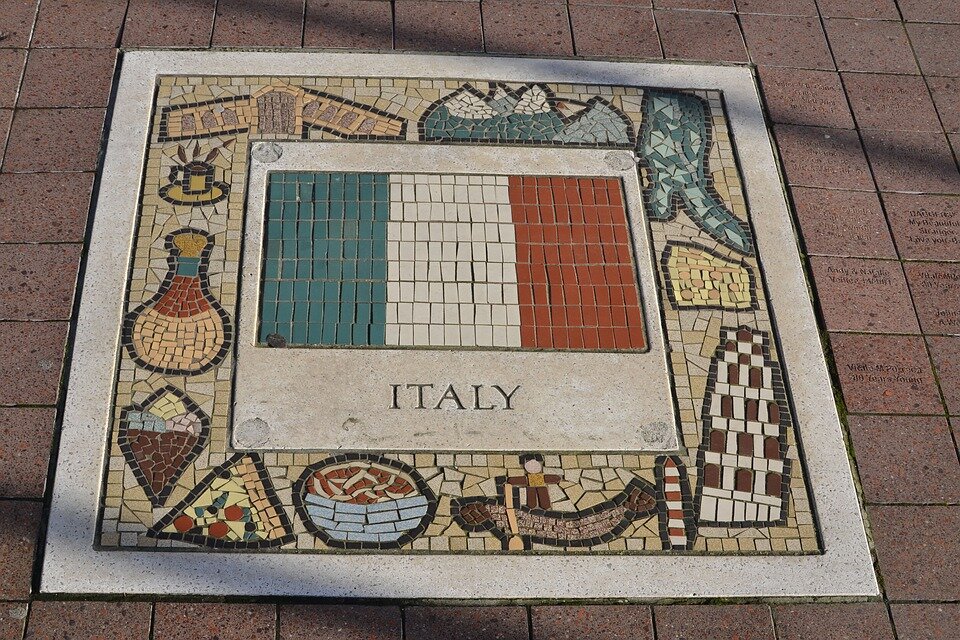
The state in the south of Europe. It borders Switzerland and Austria in the north, Slovenia in the east and France in the northwest. It is washed by the Adriatic Sea in the east, the Ionian Sea and the Mediterranean Sea in the south, the Tyrrhenian Sea, the Ligurian Sea and the Mediterranean Sea in the west. Italy also owns the islands of Elba, Sicily and Sardinia and several small islands.
Two independent states, San Marino and the Vatican, are located on the territory of the Apennine peninsula and are completely surrounded by Italy. The area of the country is 301302 km2. More than half of the territory of the country is located on the Apennine peninsula. In the north of the country are located the Italian Alps, where the highest point of the country - Mount Monte Cervino (4478 m).
- Geographically, Italy is located between 47 05' and 35 29' North latitude and between 6 37' and 18 31' East longitude.
- Italy is located in the Mediterranean basin and includes the Apennine Peninsula, the Padana Plain, the southern slopes of the Alps, the islands of Sicily, Sardinia and a number of small islands.
- The total area of Italy is 301,230 square kilometers (land - 294,020 square kilometers, water - 7,210 square kilometers. km) with a length from north to south 1170 km, the largest distance from east to west in the middle part of 230 km, so that boots are not small!
- Mountains occupy 35%, hills 42%, plains 23% of the total area.
- The length of the coastline is 7122 km.
- The highest point of the country is the Mont Blanc mountain, in Italian Monte-Bianco (4807 meters). However, in the Alps, there are many peaks from 2000 to 4000 meters high, and in the Apennines Mountains, there are mountains up to 2000 meters high. There are also many volcanoes in Italy, some of which are active: Vesuvius, Etna, Stromboli, Vulcono.
- The river network is mainly developed in the northern part of the country. The biggest river in Italy is the Po (682 km). Most of the other rivers are mountainous, unnavigable, and their channels are fenced off by dams. And some rivers dry up so much in the summer months that they are able to be crossed by any person, as any other stream.
- The largest lake is Garda (390 sq. km), but there are also several other large lakes: Como, Lago Maggiore. All of them are also in the north.
- In Italy, there are some minerals, so that a considerable part of raw materials for industrial needs is imported. There are small reserves of molybdenum, mercury, manganese, zinc, bauxite, sulfur, uranium ore and natural gas. Quite a lot of construction material, such as marble and crushed stone. Hydropower resources are significant.
Italy has external land borders with France (488 km), Switzerland (740 km), Austria (430 km), Slovenia (232 km), and internal borders with the state of San Marino (39 km), and the city-state of the Vatican (3.2 km), located inside Rome. The total length of the land borders is 1932.2 km.
Italy, in the form of a boot, is immediately striking on the map. It is located between the Adriatic, Ionian, Ligurian and Tyrrhenian Seas, each of which is part of the Mediterranean Sea. The islands of Elbe, Sardinia, Ischia, Capri, Sicily and the Aeolian Islands are located at a great distance from the mainland. Mountains dominate the Italian topography and form its land borders from Genoa to Trieste. The Italian ridge is formed by the Apennines, stretching from Genoa down to almost Sicily. The Po Valley in the northeast forms the largest lowland, where the most densely populated industrial areas are located. Thanks to three active volcanoes - Stromboli in the Liparskie Islands, Vesuvius near Naples and Etne in Sicily - the country sometimes experiences tremors and earthquakes, the strongest of which were recorded in 1908 and 1980. Unfortunately, the natural beauty of Italy is subject to destruction and industrial pollution, especially in large cities and along the coast.
A couple of millennia of human activity and the Italian love of hunting have contributed to the destruction of many species of animals that existed only in Italy. Brown bears or lynx are seldom seen in Italy, and wolves, marmots, chamois and deer are becoming less and less common in the alpine regions. Mouflons, wild boars and wild cats can be found in Sardinia, and birds: falcons, hawks and golden eagles have also become rare and have to hide from hunters and poachers.
The Italian climate changes from north to south and from lowlands to mountain tops. Winters in the Alps are long and severe, with snowfall as early as mid-September. In the northern regions, winters are usually frosty and summers are hot, but the climate becomes milder to the south. Sirocco, the hot and humid African wind that blows in the southern regions of the country, is the cause of at least a couple of terrible hot weeks in the summer