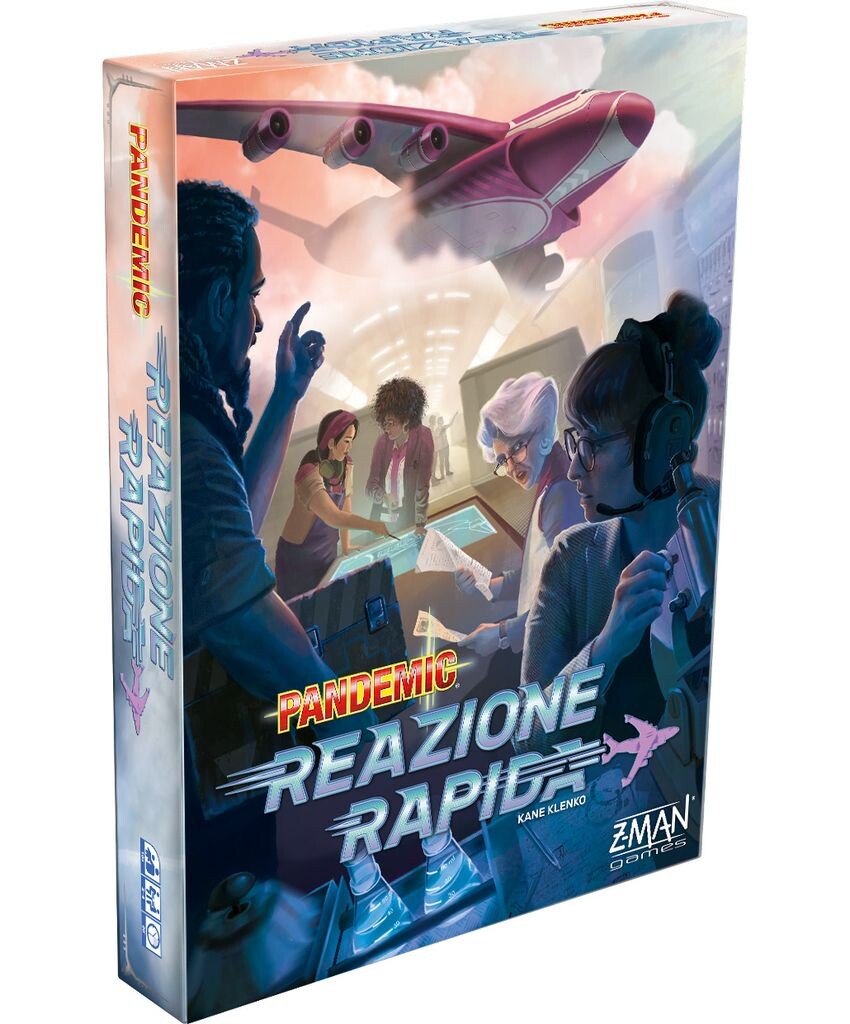
Pandemic: when you just say this word, you can't help but think about the enormous success of the game, especially in the legagy version.
That is, let's take a nice collaborative game and put it in a legagy perspective, where the game extends to multiple sessions...
After the original, after the legagys and after the various historical locations (Iberia, Rome), collaborative games where the need to speak and coordinate is evident, here is Pandemic: Rapid Reaction, that is, let's put the real time into Pandemic!
The setting (and ambition) is always the same: to save the world from the various humanitarian crises that develop in the different cities of the world: but now we will have the hourglass that will affect the choices to be made during the game, which from anguished (in its classic version) goes to feverish and anguished ...
Game a little dependent on the language, brought home from Asmodee Italy, allows 4 players, for a mere twenty minutes, to try to distribute the necessary aid in the various cities that require it, using a phantom jet, all to the sound of roll and re-roll of dice.
MATERIALS
In the box, of the usual format of the line, we find a scoreboard, which this time does not represent the whole world (or a part of it), but the cockpit of the airplane, with 5 rooms for the production of life-saving resources, a room for the accumulation of waste and the hold for the storage of crates, to be parachuted in cities in humanitarian crisis.
The outline of the board shows the route that the plane must take, touching the various cities grouped by continent.
In the 5 rooms for the production of resources (energy, food, water, vaccines and first aid medicines) we will find a series of lodgings for dice, grouped according to different numbers, which will allow us to produce one, two or three crates of that resource, depending on how many dice were used.
The waste room has a path made of 11 steps, which allows you to keep under control the waste accumulated from the production of resources: for their treatment is also provided here a part where to house the dice.
In the hold, in addition to the lodging of the die to make the delivery, there can be a maximum of 9 crates.
To move from one room to another, the doors must be used.
The resource crates are represented by coloured cubes, 4 for each type of resource.
Then there are the city cards, in which, for each of the cities on the board, is expressed the humanitarian crisis in the form of how many and which cases of resources you need to provide.
The engine of the game are the dice, 24 in the 4 colors of the players, which are special dice: on the 5 sides are represented the 5 resources, while the sixth side has the symbol of an aircraft.
Some of these symbols are simple, while sometimes they can have a coloured background.
Each player will be provided with a token, of the same translucent melange colour as the dice, with an action summary card and with a character card, which provides an explanation of their game bonus.
Then we have the humanitarian crisis cards, which will only be used in the advanced version of the game.
The equipment ends with the outline of the plane, the marks slag, the tokens unit of time (purple) and the hourglass from 2 minutes.
THE RULES
As anticipated, the game is a collaborative in time, so you need to learn the rules well before you start playing.
Once you have placed the materials on the board and distributed the identities of the players, which provide different game bonuses, for the initial game you choose 5 crisis cards and reveal three (the others are placed covered on the board), placing them on the corresponding slot at the edges of the board.
3 time tokens are placed on the dashboard.
Each player places his token in the place indicated by the character card, while the plane is placed on a randomly drawn city among the crisis cards left out of the game.
We are therefore ready to go: you choose the first player and turn the hourglass.
On their turn each player rolls their 5 dice and has the opportunity, during the turn to re-roll as many as they want up to 2 times.
He can use any dice value to move between rooms, while the airplane symbol is used to advance the plane along the way.
The dice with the symbols of the various resources can be used in the corresponding rooms, to accumulate the boxes of resources, following the rule of the minimum number of dice on the dashboard.
You can then decide to use the dice placed, turning them into crates that will be put in the hold.
In this case, the dice used are raised and the level of waste is advanced on the basis of how many values with a colored background are found: after which the dice return to their rightful owners.
You can also use the dice in the slag room to decrease the level of slag: in this case they must all have different values.
In order to finally meet the demands of the city in crisis, it is necessary that the plane is positioned exactly on the city, that the player's token is in the hold and that it uses an air symbol to be able to parachute the crates, which must be delivered all in a single throw.
When you satisfy a city, you recover a time token.
When the hourglass time ends, the game stops for a moment (but it is not allowed to use this time to plan the strategy), because a new city card is revealed (if there are still some).
If there are still time tokens, you discard a token and continue the game by turning the hourglass again (you start again from the player who was playing): in the chaos in which there are no more tokens, you have lost the game.
Even if the level of waste reaches the maximum of the path, the game is lost.
If all the city cards have been resolved, the players have won.
Once the initial level is exceeded, the game increases in difficulty simply by increasing the number of city cards, both those revealed at the start of the game and those to be placed covered on the dashboard.
For experienced players you can use the crisis cards, which add difficulty to the game (with immediate effects, linked to the turn, or with new cases of resources to be delivered to the city in crisis nearest).
In the heroic version you use all the city cards... but it's a mission impossible!
ENTERPRISES
The game has an important component of motorbike frenzy, but perhaps less than other games in real time, so stay away from the players who exceed in thinking.
Of course, when it's not your turn you need to have an idea of what you'll have to do, but it's also true that the game scenario changes rapidly, so you also need to be able to change your mind on the fly, especially after you roll the dice.
The group strategy must therefore blend in with what the turn player is doing.
In general, the most complicated thing is to feed the creation of the right resources, considering what is the next city you want to meet.
But don't try hard to use all your dice. Sometimes you have to give up completely to carry out their turn, precisely because of an unfortunate roll: better to move to the next player.
You must therefore use the time in the most profitable way, perhaps starting to move to rooms that will be good for the resources of the next city or trying to lower the level of waste or, again, taking care of moving the plane.
You play all together and together you can outline the tactics to follow, but when it's your turn you need to think and act with your own head, to optimize the time.
In this sense, the game does not fear the flaw that many collaborative games have: those for which there is a player (the best or simply the strongest character) who decides what to do for everyone.
This does not mean that a good dose of coordination is absolutely not necessary!
Since these are rollable dice and card fishing, the game is not exempt from the bizarre goddess blindfolded, but, especially playing with low difficulty levels and the possibility of two re-rolls (four for the analyst), you do not have the impression that you lose or win by luck / bad luck: these considerations come good when the victory (or defeat) happens to the thread of wool.
For lovers of the genre, the game is very interesting, because it has been able to combine a mechanics so appreciated (we get together to save the world) with real time, which is also used and appreciated.