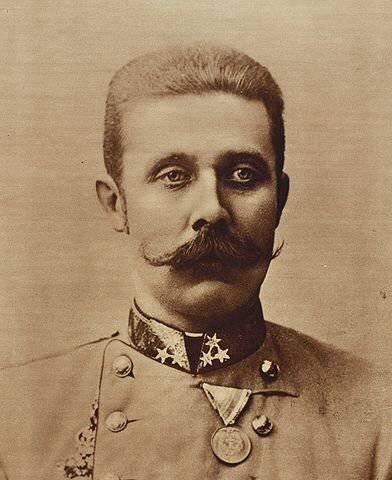
The attack in Sarajevo was the casus belli, or the occasion, or the pretext, for the outbreak of the First World War.
Gavrilo Princip and the Sarajevo attack on Francesco Ferdinando
On June 28, 1914, the Bosnian student of Serbian nationality, Gavrilo Princip, killed Archduke Franz Ferdinand, heir to the throne of the Austro-Hungarian Empire, and his wife Sofia Chotek, with two gunshots, while they were crossing the streets of Sarajevo, the capital of Bosnia, annexed to the Empire in 1908, in an uncovered car. Both Serbia and Russia were unsuccessfully opposed to the annexation.
The attacker and his accomplices were part of an organization that fought for the independence of Bosnia from the Habsburg Empire and had its operational base in Serbia.
Political causes of the Sarajevo attack
June 28th was the day of the anniversary oJf the Serbian defeat against the Ottomans in 1389. The Ottomans had heavily defeated the Serbian army, ending their domination of the Balkans and creating the conditions for Serbia's annexation to the Ottoman Empire.
June 28th was therefore a particularly important date for Serbian nationalists.
The official visit of Archduke Franz Ferdinand to Sarajevo on that date could have been seen as a provocation for those who wanted Bosnia to be reunited with Serbia. The archduke, however, did not want to cancel the visit.
Instead, the conspirators of the Serbian ultra-nationalist secret group "Black Hand" - actually operated by the Serbian secret services - had armed some young members of the organization with grenades and guns and had sent them to Sarajevo, to attack the life of the archduke.
They considered Francesco Ferdinando's plans for a stronger recognition of the Slavic component of the Empire to be dangerous. These projects, if implemented, would have made the hypothesis of a union of "all Serbs" in the Kingdom of Serbia less attractive.
The assassination of Archduke Franz Ferdinand
On the morning of June 28, 1914, the streets of Sarajevo were used for a procession of cars, including that of the archduke.
Serbian Nedeljko Cabrinovic managed to throw a grenade at the Archduke's car. However, the bomb bounced off the lowered top of the car and exploded on the one that followed it; its explosion wounded two escort officers, about twenty spectators and, slightly, Countess Sofia.
Francesco Ferdinando insisted on being taken to the hospital to visit the two wounded officers. The driver, forced to continue on an improvised route at the time, made a mistake and was forced to slow down to take a step back, at the level of the Latin Bridge. It was 11 a.m.
Fatality wanted Gavrilo Princip to be right there, armed with a gun. He approached the imperial car and fired twice from close range.
Sofia, hit in the abdomen, fell over her husband and died a few moments later. Shortly afterwards, Franz Ferdinand began to leak blood from his mouth and panting; the bullet had hit him in the neck, where he was not protected by the bulletproof vest, and had crossed his jugular and trachea. At 11:30 a medical examiner certified the death of the royal couple.
Ultimatum and declarations of war
On 23 July, three weeks after the attack, Austria-Hungary sent a very harsh ultimatum to Serbia, in which it requested, among other things, the cessation of all anti-Austrian propaganda, the arrest of some people, and the participation of Austrian representatives in the investigation of the principals.
The Serbian government accepted the ultimatum, except for the clause that provided for the participation of Austrian officials in the investigation of the perpetrators of the attack.
The Austrian government judged the response insufficient and declared war on Serbia on 28 July.
This step provoked a chain reaction which, in little more than a week, led to the outbreak of the First World War.