The times when the releases were almost only in conjunction with Essen, Lucca and Play are now a distant memory and, although many titles are still concentrated there for various reasons, now every month new titles come out, even very interesting.
Among the releases of September we find precisely Second Chance (1-6 players, 10-15 minutes) created by Uwe Rosenberg, author famous for Agricola, Patchwork, Le Havre, La Festa per Odino, Cottage Garden and many other titles. The game arrives completely in Italian thanks to MS Editions.
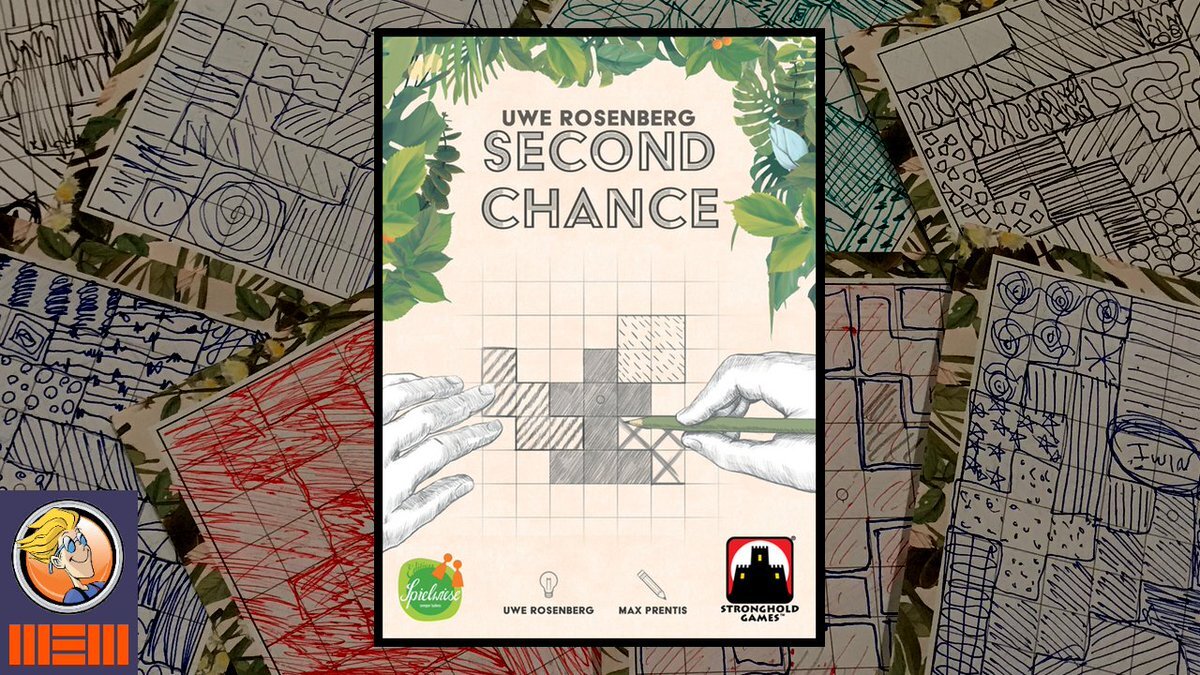
Don't be fooled by the box, which could make you look like a Roll&Write: in reality there is no shadow of dice and it is a "draw&write" like the famous Welcome To. This means not only that the shapes to be drawn are the same for everyone, but also that you can make a certain planning, because the cards with the various shapes are in known and limited number.
In these lines I usually talk about the setting but... well, this is basically an abstract one, like Level 9 or the Tetris, so... Place polymers side by side in the smartest way and fill your grid as much as you can, also taking into account the shapes that have already come out.
THE BOX
The very compact package (18×12 cm) contains a block of 100 double-sided sheets (i.e. 200 cards), 13 initial cards, 40 card cards and 3 cards of various shapes and relative quantities. We also find a small bag with 6 pencils and a regulation that is in a front/back page, full of examples and illustrations.
HOW TO PLAY
At the beginning of the game each player receives a sheet, where there is a grid of 9×9 squares, and two cards from the initial deck: each of these cards has a different figure, which occupies 8 squares and that must be placed so that at least one of the squares is the middle one. At this point all the initial cards can be put away and the deck of 40 cards is shuffled.
At each turn two cards will be turned over from the deck in the middle of the table, common to all. Each card in the deck represents a geometric figure composed of 1-7 squares (most are 4-5 squares). The distribution of these figures is uneven, but it is still a public figure and the repilogative cards show how many figures of each type are present in the deck. As can be seen from the photos, those with fewer squares are more common.
Of the two cards drawn each player will choose only one to draw, orienting it as he prefers and, if desired, also mirroring it. Each piece drawn must have a different hatching from the neighboring ones (which is useful to identify the shapes inserted, but also bloody beautiful in terms of aesthetics.
If, however, it is not able to make any of the forms stand out, then the "second chance" will come into play, which gives the name to the game: the player will draw a single card and if he fails to draw even that piece will be out of the game. If he does, he continues to do so normally, eventually facing other "second chances".
When the last player is eliminated the game ends and you determine the winner, but it may not be the last one out of the game. In fact, to determine who won you look at the number of spaces available and the winner is, of course, who has less. The order of exit will be viewed only as a criterion for play-off.
In fact, a player may have played 3-4 turns less, but have always placed larger figures and have therefore better covered their sheet.
SOLITAIRE MODE
Sad and quite useless... requires you to play three games alone with no chance of the "second chance". After three games if you are left with 10 gaps or less (adding those of the three sheets) the game is won.
FINAL CONSIDERATIONS
Some might mistakenly see Second Chance as a game of luck, but it's not so... indeed, it's a title in which planning wisely is crucial. In fact, it is clear that the more you go forward and the more difficult it becomes to insert new pieces, but the key thing is to choose well the piece and place it wisely in view of what still has to come out, while trying to cover the best possible surface.
Overall, it's a very nice game with the right balance between strategy and evaluation on the spot, without ever being heavy or slow. In general it is a game that I would recommend to all lovers of puzzle games and Tetris and to those who loved Patchwork (and this also runs well in 2) or its various multiplayer incarnations.
In this case of course the feeling is still completely different from the games listed above and we find ourselves with something that, probably because of its being reduced to the quintessence of Tetris, is very fresh despite the author has recycled the idea of polymers in a grid (wow, Rosenberg who resumes one of his mechanics to make more games, I'm really surprised ... if you did not understand I'm ironic).
The duration of a game is about 15-20 minutes and is therefore very quick and easily tabulable, also because the setup is literally null and the explanation does not take more than two minutes. This is a very important thing for me.
Just the simplicity of the rules makes it very suitable for introducing to the board game friends and family who are out of this world.
To this we add towards the end of the game that thrill of risk given by turning the cards of the turn (which now the pieces begin to stay tight and we look forward to specific forms) and even more so our "second chance": turning that card contains all the thrills of gambling (but without any of the contraindications). ;)
The graphics are extremely minimal and consequently have a very elegant appearance. I really appreciated the fact that the graphic style of the title is substantially neutral, because in a way makes us protagonists. The end result, if you devote a little 'attention, could end up in a nice square and it's fun to invent different fillings ... at least if like me you are people who like to do scribbles and draw various textures on squared sheets. After a game a friend of mine went to look for the colored gel ballpoint to make a second game more "colorful".
The scalability is great and the title runs very well from 2 to 6 players with no significant differences. Instead, if played alone really loses its meaning: the version to a player looks like a kind of solitaire with cards, but takes away a lot of time (3 games are 30-45 minutes) and is not very interesting. It looks like a variant put there by Rosenberg, angry at the last one just to put that 1-6 on the box.
In money we are in front of a title very easy to play, which makes you think the right, playable with anyone, explainable in 2 minutes and cheap.