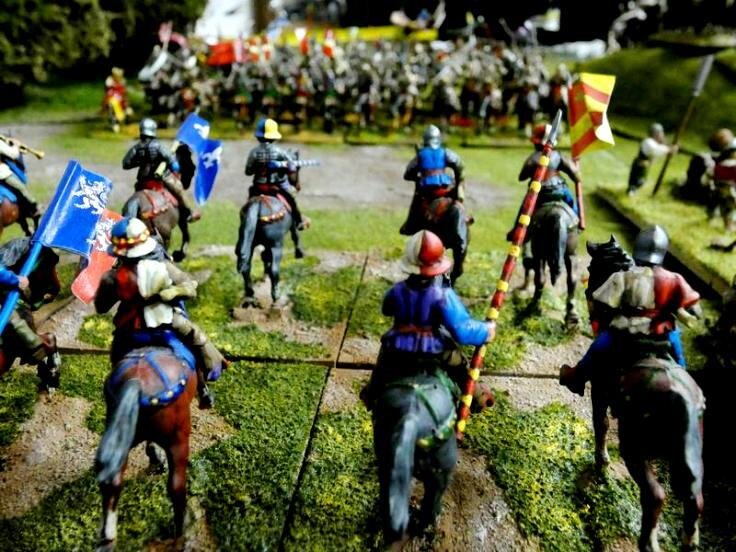
The wars of Italy include that period of Italian history that goes from the descent into Italy of the French king Charles VIII (1494) to the peace of Cateau-Cambrésis (1559), which sanctioned the Spanish rule over much of the peninsula.
This long period (1494-1559) marks a tormented phase of Italian history, marked by political and economic decline, in which a large part of the peninsula loses its independence (which will regain only in the nineteenth century, with the Risorgimento).
The wars of Italy: the descent of Charles VIII
Lorenzo de' Medici had died in 1492; his death put an end to the policy of balance, which for forty years had maintained peace between the Italian lordships and, at the same time, prevented the unification of the peninsula since it was based on a strict principle: each State undertook not to expand; if someone had done so, all the others would have intervened in defense of the territory attacked to restore the previous conditions. When Lorenzo died, however, this policy quickly degenerated.
In that same year, in fact, Ludovico il Moro usurped the seigniory of Milan, taking it away from his nephew, son-in-law of the King of Naples. Fearing that the latter would intervene in favor of the legitimate heir, he proposed to the King of France, Charles VIII of Valois, to drive out Aragon from Naples and to take back the throne that had once belonged to his cousins of Anjou. To convince him, he guaranteed him the passage through all the cities of the peninsula. The other lordships confirmed that they were happy to inflict a blow on the Aragonese, who were becoming too rich and powerful.
But as soon as Charles VIII was installed on the throne of Naples, all the Lordships turned against him. The alliance, proposed by Venice, met with the approval of Pope Alexander VI, Ludovico il Moro (Lord of Milan), Florence, Emperor Maximilian of Austria and the King of Spain Ferdinand the Catholic. The coalition clashed with the French in Fornovo sul Taro (1495), near the city of Parma. Charles VIII, although not defeated, was forced to flee to France, where he died in 1498.
The wars of Italy: the descent of Louis XII
Charles VIII was succeeded by his cousin Louis XII (1498-1514), who resumed the French expansionist policy in the peninsula.
Louis XII was related to the Visconti dynasty, which Ludovico il Moro had ousted from the Duchy of Milan. He then decided to claim possession of Lombardy, but before going down to Italy he prepared the ground well: in Venice, he granted Cremona and the neighboring territories; to the Swiss the County of Bellinzona (corresponding to the Canton Ticino); to Cesare Borgia the Romagna. In this way it was easy for Louis XII to defeat Ludovico il Moro (in 1500), capture him and send him to France (where he would have died in 1508).
The next objective for the King of France was the conquest of the Kingdom of Naples. In 1500 he stipulated with the King of Spain Ferdinand the Catholic, the Treaty of Granada, which provided for the partition of the Kingdom of Naples: France would be the responsibility of Campania and Abruzzo, Spain, Calabria, and Puglia.
When the king of Naples Frederick III (1496-1501) learned of the agreement to his detriment, he abdicated in favor of the king of France, obtaining in exchange the Duchy of Anjou.
This move caused the agreement between France and Spain to be broken, and they went to war. France, defeated by Spanish troops, was forced to sign the armistice of Lyon (1504), which sanctioned the division of Italy into two zones of influence: French in the north, Spanish in the south.
The wars of Italy: the League of Cambrai against Venice
Venice was still the only one to exercise the function of economic and military power. An Anti-Venetian League was formed at that time, the League of Cambrai (1508) including Pope Julius II (who was its promoter), the King of France Louis XII, Emperor Maximilian of Habsburg, the King of Spain Ferdinand the Catholic. Venice suffered a severe defeat in the battle of Agnadello (1509); it lost most of the mainland and the ports it owned in Romagna, Polesine, and Puglia.
To be continued in the next part - https://zen.yandex.ru/profile/editor/id/5d66a25aecfb8000acd87749/5d9399c979c26e00af4108dd/edit