Windows that fill large surfaces, as well as translucent walls are called stained glass.
Stained glass is used in public buildings in order to maximize the internal space and enrich it with light.
The bearing element of stained glass is a metal frame of the lower and upper strapping, racks (impost), crossbars (mullions). Frame elements are made of steel profiles, corners, channels, I-beams, rectangular pipes or aluminum profiles. For glazing, a large-size (3.5 x 4.5 m) showcase glass with a thickness of up to 8 mm is used, fixed in bindings or aluminum shtapikah gaskets made of frost-resistant rubber.
Stained-glass Windows arrange built-in and attached. External glazing can be vertical and inclined (no more than 10-15% of the vertical). Superelevation designs must meet the requirements of sufficient thermal insulation, air tightness and strength.
Stained glass construction is provided on the front side of the building.
Suspended ceiling.
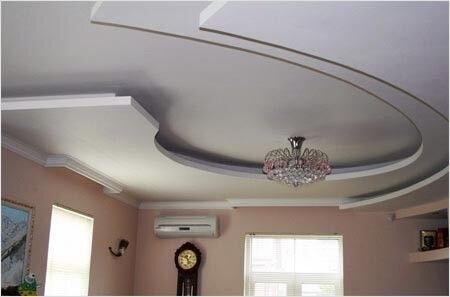
Suspended ceiling-decorative and finishing screen fixed to the ceiling of the building. In the modern interior of public buildings suspended ceilings contribute to the solution of both architectural and functional and technological problems.
Suspended ceiling designs allow you to create a variety of interior solutions, open wide possibilities of transformation of the internal space, placement of various functional elements (lamps, speakers, etc.), they are also easy to operate and easily repaired and updated. In the space between a ceiling plane of the ceiling and the plane of the supporting structure of ceiling are freely engineering networks, communications, ventilation and air-conditioning etc. it is also Possible placement of special fire fighting and cooling systems.
Suspended ceilings have the following functions: acoustic (sound-absorbing suspended ceilings); architectural and decorative (decorative ceilings); fire retardant, insulation, etc. Usually, the ceilings have not one, but several functions.
Acoustic suspended ceilings provide absorption and attenuation of sound energy. The necessary acoustics of the room is provided by the use of sound-absorbing facial elements. The lighting function of suspended ceilings is determined by the architectural and artistic solution of lighting.
In the design of suspended ceilings rationality of solutions is achieved by:
- economy (use of inexpensive materials, simple installation);
- functionality (ensuring physical and technical requirements: sound insulation, sound absorption, thermal insulation, fire protection and moisture resistance);
- aesthetics (different pattern, different material of suspended ceilings).
Ceiling metal panels are made of aluminum alloys with filling the inner cavity with sound-absorbing material, with different options of paint and perforation, which creates a variety of design possibilities. These products can be used in swimming pools, saunas, winter gardens, etc.Good hygienic properties allow them to be used for hospitals, laboratories, kitchens.
The hidden part of the suspended ceiling is a supporting structure by which its front surface is attached to the ceiling of the building.
In the cinema building, suspended ceilings are used in the auditorium to hide the coating plates, arrange lighting equipment, arrange ventilation.
The design of the suspended ceiling consists of load-bearing elements in the form of suspensions and load-bearing blocks. The suspension is made of steel 10 mm, fixed in the seams between the panels in increments of 1.5 m. to the bottom of the suspension welded bearing blocks consisting of corners 40x40 mm. to the bearing blocks are attached guide blocks of I-beam aluminum profile, in increments depending on the used suspended ceiling plates.