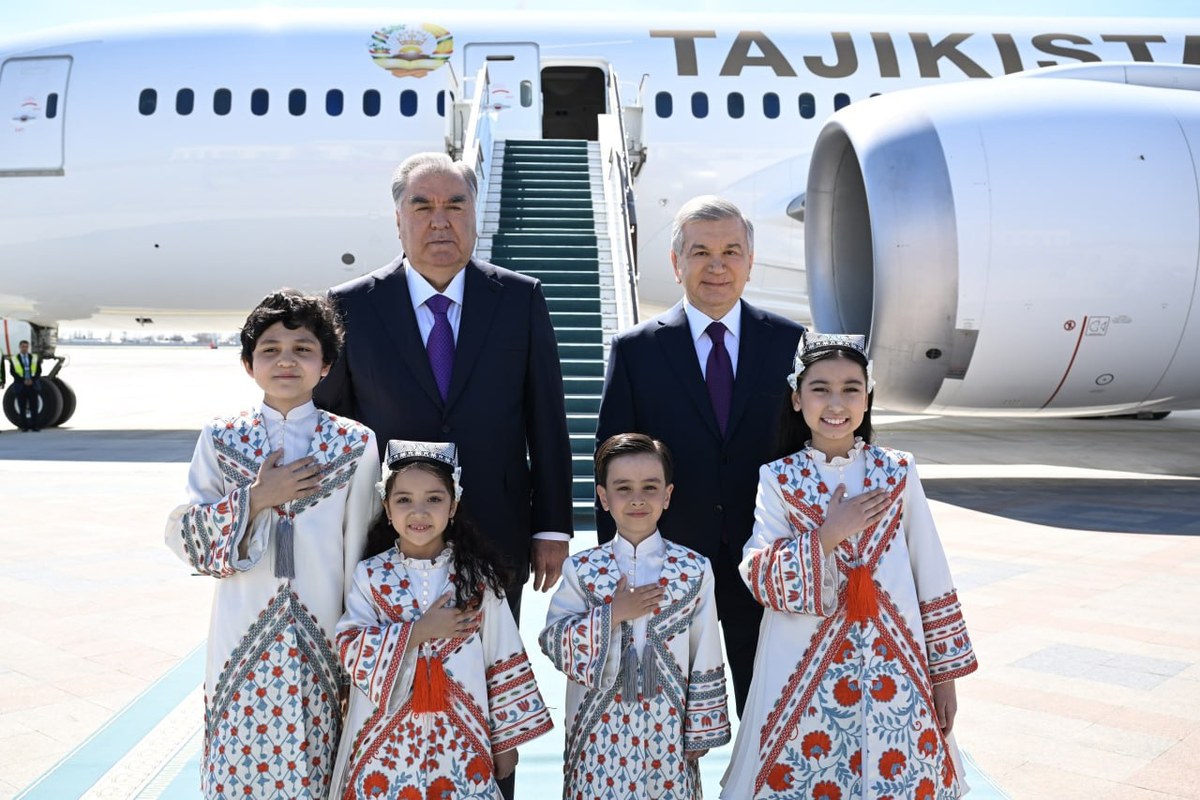
On March 26–27, President of Tajikistan Emomali Rahmon paid a state visit to the Republic of Uzbekistan. As part of the visit, a Business Forum, a joint exhibition of products, Days of Tajik Culture, and an artistic program titled “Evening of Friendship” were held with the participation of the heads of state of Tajikistan and Uzbekistan. Following the regional trade forum between Tajikistan and Uzbekistan, more than 20 new cooperation documents were signed.
The leaders of the two countries also took part in the ceremony launching 10 joint projects. The sides agreed to increase mutual trade turnover to $2 billion by 2030.
In addition, following negotiations in a narrow format at the Tashkent residence “Kuksaray,” the leaders of the two countries agreed to intensify cooperation in the field of security.
During the visit, President of Tajikistan Emomali Rahmon, together with President Shavkat Mirziyoyev, visited the historical monuments of Bukhara. They familiarized themselves with the Ark Fortress complex, Poi Kalon, and Lyabi-Khauz.
The Ark Fortress, the ancient citadel of Bukhara, served as the residence of rulers for nearly 1,500 years. Its first structures date back to the 4th–3rd centuries BC, while its current appearance was largely formed in the 16th century. Previously, it was a “city within a city,” including palaces, administrative buildings, and an armory. It was noted that in the Middle Ages, great thinkers such as Rudaki, Ibn Sina (Avicenna), and later Omar Khayyam lived and worked here.
The Poi Kalon complex aroused great interest as one of the most majestic and famous architectural ensembles of Bukhara. It includes the famous 45.6-meter minaret built in 1127, the congregational mosque constructed in 1514 and capable of accommodating 12,000 people, as well as the Mir Arab Madrasah, considered one of the most influential educational institutions in the Islamic world. The 288 domed galleries surrounding the mosque courtyard, hundreds of columns, and unique acoustics give the complex a special grandeur.
The Lyabi-Khauz ensemble is one of the few preserved medieval squares in Bukhara, in the center of which lies an ancient hauz (pond). For centuries, city residents came here for recreation, communication, and trade. The complex includes the Kukeldash Madrasah, the Nadir Divan-Begi Madrasah, and thekhanaqa.
The Tajik leader was provided with detailed information about the features of the architectural style, as well as the meaning of the patterns and symbols.
These historical sites, which tell the story of Bukhara’s rich history, its role on the Great Silk Road, and its enormous contribution to the development of science and culture, left a deep impression on the Tajik delegation.