The TMS software market has expanded considerably in recent years. Faced with this plethora of options, road haulage companies sometimes struggle to distinguish truly essential features from mere marketing gimmicks. Yet, certain functional components form the foundation of a high-performing TMS and directly impact return on investment.
Here are the five features that transport management software must absolutely integrate to meet the specific needs of road transport companies.
1. Route planning and optimization
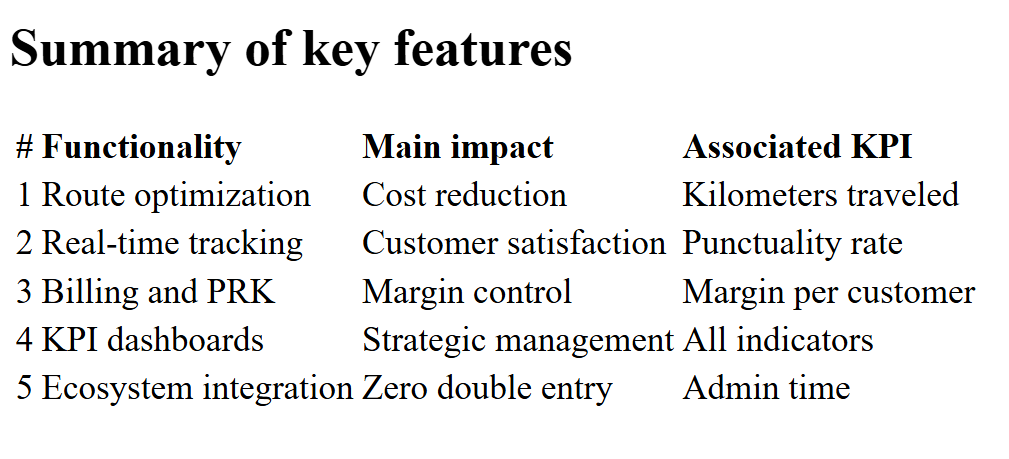
This is the functional heart of any TMS worthy of the name. Planning consists of organizing transport orders while taking into account multiple constraints: vehicle capacities in weight and volume, driver availability and regulatory driving times, customer time windows, urban traffic restrictions.
A good optimization algorithm doesn't just calculate the shortest route. It incorporates the overall economic dimension by minimizing the total cost of the route : fuel, tolls, driver time, and vehicle wear and tear. According to Capgemini, automated optimization reduces the number of kilometers traveled compared to manual planning, even by an experienced operator.
For full truckload carriers, the challenge lies in consolidating orders and reducing empty mileage. For courier and distribution companies, it's about intelligently scheduling delivery points and precisely managing delivery slots.
2. Real-time tracking and complete traceability
Visibility into ongoing operations has become an essential requirement. Monitoring relies on GPS geolocation combined with information from drivers' mobile devices.
The operator can instantly view the position of each vehicle, compare actual progress to the planned schedule, and detect delays as soon as they occur. In case of unforeseen events (breakdown, traffic jam, order change), the reaction is immediate.
The customer accesses a portal or receives automatic notifications about the status of their deliveries. This level of transparency, which has become the norm in B2C thanks to e-commerce, is now becoming essential in B2B professional transport.
3. Billing and cost price management
Transport invoicing is notoriously complex: multiple pricing structures exist depending on the customer, distance, type of goods, and various surcharges. A high-performance TMS fully automates this process, from the initial quote to the invoice issuance.
Beyond customer billing, calculating the cost per kilometer (CPK) is a strategic indicator. It incorporates all direct and indirect costs: fuel, tolls, depreciation, driver salary, and insurance. This detailed visibility allows for the identification of unprofitable customers or routes and the adjustment of commercial policy.
4. Dashboards and KPIs for Management
Managing a transport business without performance indicators is like driving a truck at night without headlights. A TMS must provide clear and up-to-date KPIs: load factor, on-time performance, cost per kilometer, percentage of empty kilometers, and profit margin per customer.
These indicators must be accessible as visual dashboards with filtering options by period, agency, client, and type of transport. Without reliable KPIs, decisions remain based on intuition. With a TMS, they are based on objective data.
5. Integration with the existing ecosystem
A TMS never operates in silos. It must communicate with accounting, the FMS for fleet management, mobility solutions for drivers, customer platforms for automatic order reception, and freight exchanges.
The quality of APIs and connectors determines the fluidity of data exchange. A TMS that requires duplicate data entry or CSV exports loses much of its added value. Solutions that are part of an integrated software ecosystem offer a considerable advantage. Sinari's modular approach enables native communication between TMS, FMS, and embedded systems without the need for a third-party interface.
Expected return on investment
The gains generated by a well-utilized Transport Management System (TMS) are documented by field feedback and industry studies. On average, carriers observe a 10 to 15% reduction in kilometers traveled, a 15 to 25 point improvement in load factor, and a 30 to 50% decrease in empty trips.
From an administrative standpoint, automating invoicing and eliminating duplicate data entry frees up several hours per week for the operations team. This newfound time can be reinvested in sales optimization and customer relations.
How to choose a suitable musculoskeletal treatment for your business
Not all businesses have the same needs. A regional SME with 20 vehicles doesn't have the same requirements as a multi-site group with 500 tractors. The choice must take into account size, specific activities (courier services, full truckloads, refrigerated transport), and growth trajectory.
The key is to verify that these five functional building blocks are solidly implemented. A publisher specializing in road transport, with French-speaking support and on-the-ground knowledge, will often make a difference compared to general-purpose solutions.
FAQ: TMS transport features
Does a TMS replace the operator?
No. The TMS automates repetitive tasks and provides data to inform decisions. Human expertise remains essential for managing unforeseen events and customer relationships.
How long does it take to deploy a TMS?
Allow 2 to 6 months depending on the complexity of your organization and the quality of your initial data. Team training is a key step to success.
What ROI can be expected from a TMS?
A well-implemented TMS pays for itself in less than 12 months. The main gains are: a 10-15% reduction in kilometers traveled, a 15-25% improvement in load factor, and a 30-50% reduction in empty trips.
Can you test a TMS before committing?
Most vendors offer customized demos using your own data. Don't hesitate to request a real-world test and contact existing clients in the road transport industry.