Из свежих исследований, пост будет на английском (оригинал), но вкратце изложу:
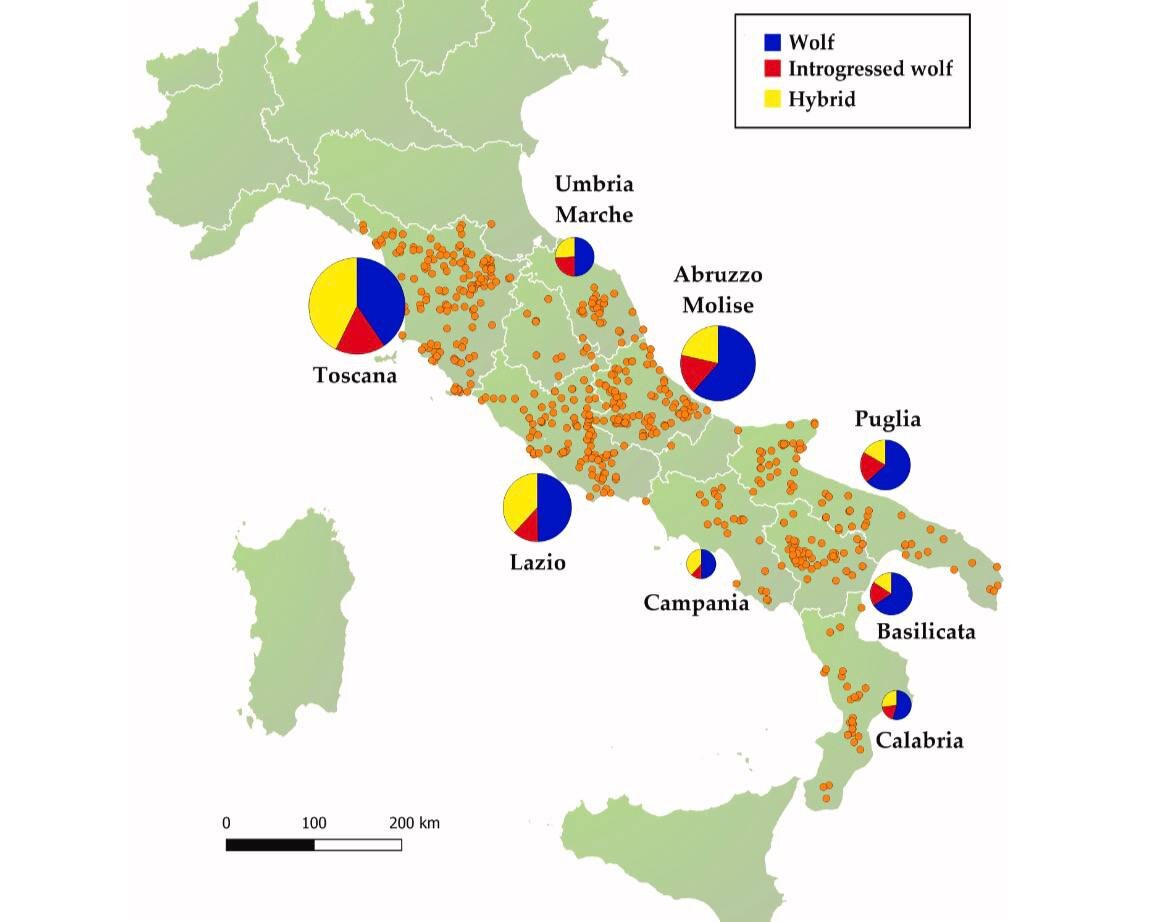
С периода 2020-24 годов canis lupus italicus по Апеннинскому полуострову еще больше измельчал в связи с непрерывным скрещиванием с бродячими собаками, которых множат те же люди.
Кто там утверждал, как хорошо живут популяции в Европе, будучи истребленными на корню?
Исследование доступно по ключевым данным, не грузится здесь.
Genetic evidence reveals extensive wolf-dog hybridisation in peninsular Italy: warnings against ineffective management
Rita Lorenzini, Antonella Pizzarelli, Lorenzo Attili, Massimo Biagetti, Carla Sebastiani,Paolo Ciucci
Highlights
•
Wolf-dog hybridisation (WDH) is a relevant and emerging threat for European wolves.
•
Using tissue samples from 774 wolves we assessed WDH in peninsular Italy, 2020–2024.
•
Peninsular Italian wolves suffer from widespread (46.7 %), ongoing dog introgression.
•
Persistent lack of management will likely cause complete admixture (genetic swamping).
•
The genetic integrity of wolves is crucial to assess their conservation status.
Abstract
Wolf-dog hybridisation (WDH) - a form of anthropogenic introgressive hybridisation - may have occasionally occurred since the times of domestication. More recently, however, despite the ongoing recovery of wolf populations in Europe, the high number of domestic dogs along with marginal ecological conditions may pose increased risks to their genetic integrity. Accordingly, WDH is currently recognised among the highest threats to European wolves, with potential cascading effects through socio-ecological systems. Based on high quality DNA from tissues of 748 wolves retrieved dead from 2020 to 2024, alongside 26 additional samples from 1993 to 2003, we assessed WDH in the peninsular Italian wolf population. Using 23 autosomal STR loci and 5 Y-linked loci for males, we detected a high proportion (46.7 %) of wolves admixed with dogs, 29.5 % of which recent hybrids and 17.2 % older backcross generations. While most of the original hybridisation events likely took place some 9–16 years ago, a few first-generation hybrids in our sample indicate that WDH is currently ongoing. This seriously threatens the genetic integrity not only of the Italian wolf population, but also of the neighbouring wolf populations through dispersal events. The situation we present, which has not been previously reported for any wolf population worldwide, serves as a cautionary example of the potential dynamics of WDH in human-dominated landscapes should the issue remain persistently unaddressed. They also highlight the importance of considering the genetic constituency of wolf populations when evaluating their conservation status, especially in light of the recent downgrading of their protection status across Europe.
1. Introduction
Unlike natural hybridisation, which is a source of diversity and evolutionary novelty (Abbott et al., 2016), human-induced hybridisation (i.e., anthropogenic hybridisation, Allendorf et al., 2001) has become increasingly recognised as a threat to biodiversity (Mallet, 2005). Anthropogenic hybridisation can lead to the loss of genetic integrity and coadapted gene complexes, the spread of maladaptive traits, and outbreeding depression. These effects may contribute to biodiversity loss and, in cases of widespread introgression, could result in genomic extinction through genetic swamping (Allendorf et al., 2001). The interbreeding of domestic species with their wild counterparts represents a significant example of anthropogenic hybridisation (Todesco et al., 2016). Domesticated forms have been artificially selected for a range of morphological, physiological, and behavioural traits that benefit humans, such as tameness and increased productivity. However, these traits can be disruptive if they introgress into the populations of their wild ancestors (Wilkins et al., 2014).