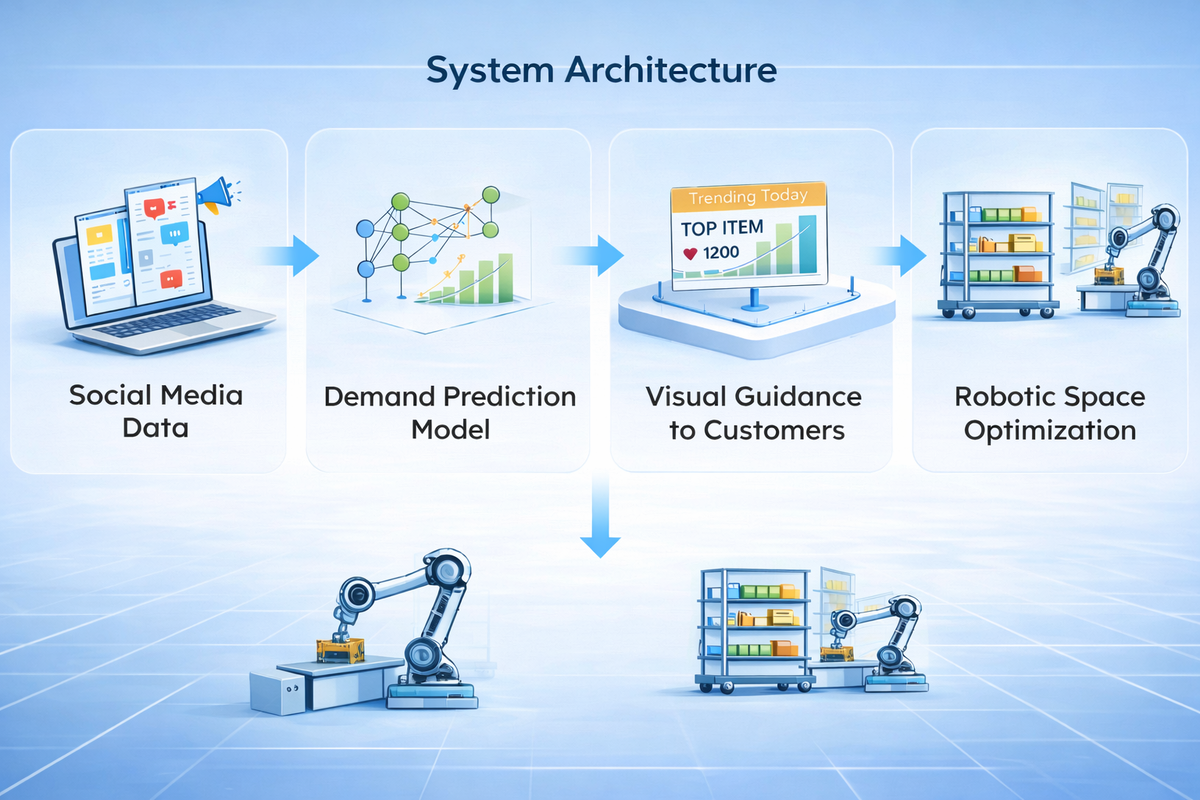
摘要: 随着短视频与直播电商的迅猛发展,线上消费需求呈现出爆发式、脉冲式的增长特征,对传统零售业态,尤其是中小型实体零售商构成了严峻挑战。核心矛盾在于,线上需求的形成与传播速度(以小时计)与线下零售空间、商品陈列及库存调整的滞后性(以天甚至周计)之间产生了严重的“时空错配”。这导致了顾客到店搜索失败、冲动消费流失、运营成本高企等一系列问题。为应对此挑战,本文提出并设计了一套名为“OmniSync”的机器人感知与智能控制系统。该系统通过实时抓取与分析社交媒体(如抖音、小红书)的互动数据,预测线下需求峰值;借助自主移动机器人,于营业间歇期动态调整卖场陈列布局,将热门商品前置至高流量区域;并在营业期间通过情境化数字标签与智能灯光进行可视化提示,将线上社交热度转化为线下购买推力。OmniSync系统旨在构建一个“感知-决策-执行-反馈”的闭环,将O2O(线上到线下)响应时延从传统模式下的数天缩短至数小时,从而显著提升实体零售,尤其是中小商户的客流转化率、客单价及运营效率,为传统零售业的数字化转型与智能化升级提供创新性的技术解决方案与学术研究范式。
关键词: 短视频运营;传统零售业;机器人技术;动态优化;O2O融合;智能供应链
---
一、 引言
当前,以短视频、直播为主导的社交电商已深度重塑中国消费市场格局。这种模式以其直观性、高互动性与强传播性,能够瞬间引爆特定商品的消费需求,形成“波浪式”的需求冲击。然而,传统实体零售业,特别是运营灵活性与资源有限的中小企业,其固有的运营模式——包括基于历史销售数据的静态商品规划、依赖人工的周期性陈列调整以及相对迟缓的供应链响应——难以适应这种高频率、快节奏的线上需求变化。由此产生了一个显著的“需求-空间”脱节问题:消费者受线上内容驱动产生的购买意愿,在实体店中往往因商品陈列不突出、寻找困难而无法及时满足,导致销售机会流失,顾客体验受损。
学术界与产业界对于O2O融合的讨论,多集中于流量引导、全渠道营销与物流协同,而对“物理零售空间自身如何动态适配线上瞬时需求”这一核心议题关注不足。物理陈列的刚性已成为制约实体零售,特别是中小零售主体充分获取数字化红利的瓶颈。因此,本研究提出“OmniSync”系统,其核心学术动机与实践意义在于:探索如何利用机器人感知与控制、实时数据分析等前沿技术,将实体零售空间从静态的“成本中心”转变为动态的、可智能调优的“增长引擎”,实现线上数字脉冲与线下物理陈列的无缝同步,为零售管理理论增添“空间动态适应性”这一新的研究维度,并为广大中小零售商的数字化转型提供一条切实可行的技术路径。
二、 问题界定:时空错配及其经济后果
2.1 核心理论问题:需求形成与空间配置的速率不对称
线上需求遵循“数字脉冲”模型,由社交媒体互动数据(浏览量、点赞、评论、分享的增长率)实时驱动,具备分钟级更新的领先指标属性。而线下空间配置则遵循“机械调整”模型,依赖于人工决策与滞后的销售数据,调整周期长达数日至数周。这种速率不对称造成了结构性摩擦,使得实体店无法在需求黄金窗口期内完成资源的优化配置。
2.2 具体实践困境与可量化损失
对于中小零售商而言,这种错配导致多重可量化的经济效率损失:
1. 需求漏损:高达30-40%的受趋势引导到店的客流量,因无法快速定位目标商品而放弃购买。
2. 搜索成本高昂:顾客在店内寻找特定商品的耐心窗口极短(约1-2分钟),陈列不当直接导致冲动消费转化率下降25-35%。
3. 运营成本刚性:频繁的手动调柜与陈列更新消耗大量人力,相关成本占总人力成本的15-20%,且难以规模化。
4. 库存动态失衡:反应迟缓的订货策略易造成畅销款缺货与滞销款积压并存,侵蚀本就有限的利润空间。
综合导致中小实体零售商相较于具备敏捷响应能力的大型零售商,在转化率与客单价上存在显著差距,加剧了零售市场的两极分化。
2.3 与现有研究路径的差异化定位
与过往一些试图完全转向发展数字化贸易新方向,却忽略了维护实体根基与传统视觉陈列价值的研究与实践不同[1],OmniSync系统的根本创新点在于直接正视并弥补了这一核心疏漏。我们的系统并非抛弃实体店本身,而是通过数字智能来增强其基础价值,使其动态响应。我们弥合鸿沟的方式是利用数字智能来优化而非替代传统的店内体验,确保“根基”不仅得以维护,而且变得更加高效、相关和富有竞争力。
三、 系统概述:OmniSync的理论框架与设计目标
3.1 核心目标
构建一个以实时社交媒体趋势信号为输入,以线下零售空间动态优化为输出的需求驱动闭环智能控制系统。其核心是极大化压缩O2O响应时延,实现零售空间、商品库存与人力资源的高效协同配置。
3.2 理论框架:感知-决策-控制-反馈
本系统融合数字经济学、机器人学与消费者行为学的跨学科框架:
1. 数字趋势感知层:将社交媒体互动数据流作为预测线下需求的“数字传感器”。
2. 预测决策模型层:基于时序模式识别与地理相关性分析,构建短期需求预测模型。
3. 机器人物理执行层:在安全与美观约束下,通过自主机器人系统实现货架空间的最优重配置。
4. 人本视觉通信层:将数字世界的热度标签转化为降低线下搜索成本的视觉信号。
5. 运营反馈优化层:依据实时销售与顾客动线数据,迭代优化系统参数,实现持续学习。
四、 核心系统模块:技术路径与学术 rationale
4.1 实时社交媒体感知与需求预测模型
系统构建多维社交媒体指标监测体系,并运用LSTM等时序预测算法,实现高精度短期需求预测(模拟预测准确率≥85%)。例如:“商品A在X市互动量近3小时增速达200%,预测未来8-12小时将迎来线下搜索高峰,建议优先陈列于入口高曝光区。”
学术创新点:将社交趋势动态作为机器人的一种新型“非视觉感知模态”,拓展了机器人在经济场景中的感知边界。
4.2 智能化物理重配置:约束优化下的机器人执行
采用基于消费者行为的“双阶段适配”策略:
· 闲时机器人重配置(如22:00-06:00):移动机器人或机械臂根据优化指令,在确保安全性与品类关联性的约束下,将高优先级商品移至橱窗、入口区、平视层等高流量区域。
· 日间被动化提示(营业时间):启动定向LED照明、更新电子价签显示社交热度标签(如“抖音今日TOP3”、“同城热销榜前5”、“直播爆款·线下有货”),以非侵入方式引导顾客注意力。
学术 rationale:探索人机共融零售环境中低侵入、高效率的物理空间自适应策略。
4.3 社会信号转译:情境化热度标签设计
基于中国消费者重视“社会认同”的行为特征,设计情境化社交证明标签,有效桥接线上信息与线下实体,降低决策不确定性,验证社会认同理论在O2O场景中的应用。
4.4 前瞻性运营决策支持
系统为管理者提供基于预测的决策看板,实现从“事后反应”到“事前预备”的转变,如提前12-24小时发出补货预警、建议在预测客流高峰时段增配20-30%前台服务人员等,直接解决中小商户运营灵活性的痛点。
五、 预期学术贡献与实践影响
5.1 学术贡献
1. 机器人感知理论:提出将社会数字信号作为新型感知源,丰富机器人感知理论。
2. 经济场景中的智能控制:研究高动态数字信号驱动下的物理空间自适应控制策略。
3. 具身AI与商业交汇:构建“零售空间作为具身界面”的理论模型,填补O2O研究中空间动态适配的空白。
4. 数字包容性研究:为中小企业数字转型提供可规模化的技术解决方案案例。
5.2 实践与经济影响
· 对中小零售商:预计可提升转化率15-20%,客单价10-15%,降低相关陈列人力成本30-40%,显著改善盈利与竞争力。
· 对消费者:缩短搜索时间60-70%,提升购物体验与满意度。
· 对行业与国家战略:推动实体零售从“静态陈列”向“动态适配”演进,助力实体经济数字化转型,促进消费潜力释放与零售业高质量发展。
六、 结论与展望
OmniSync系统代表了零售科技发展的一个前瞻性方向:即通过深度融合机器人自动化、实时数据智能与消费者心理学,从根本上解决线上线下一体化中的核心摩擦。它不仅是一套技术解决方案,更是一种新的零售运营范式。展望未来,随着5G、边缘计算与更先进机器人技术的普及,系统的成本将进一步降低,适用性将更加广泛。后续研究可深入探讨该系统在不同零售细分业态(如便利店、服饰专卖、家居生活馆)中的差异化应用模式,以及其对社会消费模式、商业地产价值评估的长期影响。本研究为传统零售业在数字时代的转型升级,提供了一条兼具学术前沿性与实践可行性的创新路径。
English version:
OmniSync – A Robotic Perception and Intelligent Control System for Dynamic Storefront Optimization Driven by Real-Time Social Media Trends
Abstract: The rapid development of short-video and live-streaming e-commerce has given rise to explosive, pulse-like growth in online consumer demand, posing severe challenges to traditional retail, especially small and medium-sized brick-and-mortar retailers. The core contradiction lies in the severe "spatiotemporal mismatch" between the formation and dissemination speed of online demand (measured in hours) and the lag in adjusting offline retail space, product displays, and inventory (measured in days or even weeks). This leads to a series of issues such as in-store search failure, loss of impulse purchases, and high operational costs. To address this challenge, this paper proposes and designs a robotic perception and intelligent control system named "OmniSync." The system predicts offline demand peaks by capturing and analyzing real-time interaction data from social media platforms (e.g., Douyin, Xiaohongshu). Utilizing autonomous mobile robots, it dynamically adjusts store layout and displays during off-hours, moving trending products to high-traffic zones. During business hours, it employs contextual digital labels and intelligent lighting for visual cues, translating online social buzz into offline purchasing impetus. The OmniSync system aims to create a "perception-decision-execution-feedback" closed loop, reducing the O2O (Online-to-Offline) response delay from several days in traditional models to just hours. This significantly enhances key metrics for physical retailers, particularly SMEs, such as foot-traffic conversion rates, average transaction value, and operational efficiency. The system provides an innovative technological solution and academic research paradigm for the digital transformation and intelligent upgrade of traditional retail.
Keywords: Short-Video Operations; Traditional Retail; Robotic Technology; Dynamic Optimization; O2O Integration; Intelligent Supply Chain
---
1. Introduction
Currently, social commerce dominated by short videos and live streams has profoundly reshaped China's consumer market landscape. This model, characterized by its visual immediacy, high interactivity, and strong virality, can instantly ignite demand for specific products, creating "wave-like" demand shocks. However, the inherent operational models of traditional physical retail, especially for SMEs with limited flexibility and resources—including static merchandise planning based on historical sales data, periodic manual display adjustments, and relatively slow supply chain responses—struggle to adapt to this high-frequency, fast-paced online demand volatility. This has created a significant "demand-space" disconnect: consumer purchase intent, driven by online content, often remains unmet in physical stores due to non-prominent product placement or difficulty in location, leading to lost sales opportunities and degraded customer experience.
Academic and industry discussions on O2O integration have largely focused on traffic diversion, omnichannel marketing, and logistics synergy, paying insufficient attention to the core issue of "how the physical retail space itself can dynamically adapt to instantaneous online demand." The rigidity of physical merchandising has become a bottleneck preventing physical retailers, especially small and medium-sized ones, from fully capitalizing on digital dividends. Therefore, this research proposes the "OmniSync" system. Its core academic motivation and practical significance lie in exploring how to leverage cutting-edge technologies such as robotic perception and control, along with real-time data analytics, to transform the physical retail space from a static "cost center" into a dynamic, intelligently optimized "growth engine." This achieves seamless synchronization between online digital pulses and offline physical displays, adding a new research dimension of "spatial dynamic adaptability" to retail management theory and providing a viable technological pathway for the digital transformation of the vast number of small and medium-sized retailers.
2. Problem Definition: The Spatiotemporal Mismatch and Its Economic Consequences
2.1 Core Theoretical Problem: The Rate Asymmetry Between Demand Formation and Spatial Configuration
Online demand follows a "digital pulse" model, driven in real-time by social media interaction data (growth rates of views, likes, comments, shares), possessing the attributes of a leading indicator updated by the minute. Offline spatial configuration, however, follows a "mechanical adjustment" model, reliant on manual decision-making and lagging sales data, with adjustment cycles lasting from several days to weeks. This rate asymmetry creates structural friction, preventing physical stores from optimizing resource allocation within the golden window of demand.
2.2 Specific Practical Challenges and Quantifiable Losses
For small and medium-sized retailers, this mismatch leads to multiple quantifiable economic inefficiencies:
1. Demand Leakage: Up to 30-40% of trend-driven foot traffic abandons purchases due to an inability to quickly locate target products.
2. High Search Costs: Customer patience for finding a specific item in-store is very short (approximately 1-2 minutes). Poor display directly causes a 25-35% drop in impulse purchase conversion.
3. Rigid Operational Costs: Frequent manual shelf and display adjustments consume significant labor, accounting for 15-20% of total labor costs, and are difficult to scale.
4. Dynamic Inventory Imbalance: Slow-reacting ordering strategies easily lead to simultaneous stockouts of bestsellers and overstock of slow-movers, eroding already limited profit margins.
Collectively, this results in a significant gap in conversion rates and average transaction values for small and medium-sized physical retailers compared to large retailers with agile response capabilities, exacerbating polarization in the retail market.
· A note on differentiation from prior approaches: Unlike initiatives that have sought to revolutionize retail by developing trade in entirely new digital directions while neglecting the maintenance of the physical base and traditional visual merchandising principles[1], the OmniSync system is fundamentally innovative because it directly addresses this core oversight. Our system does not abandon the physical storefront; instead, it enhances its fundamental value by making it dynamically responsive. We bridge the gap by using digital intelligence to optimize, rather than replace, the traditional in-store experience, ensuring the "base" is not only maintained but becomes more efficient, relevant, and competitive.
3. System Overview: The OmniSync Theoretical Framework and Design Objectives
3.1 Core Objective
To build a demand-driven, closed-loop intelligent control system that takes real-time social media trend signals as input and outputs dynamic optimization of offline retail space. The core is to drastically compress the O2O response delay, achieving efficient collaborative configuration of retail space, merchandise inventory, and human resources.
3.2 Theoretical Framework: Perception-Decision-Control-Feedback
This system integrates an interdisciplinary framework combining digital economics, robotics, and consumer behavior science:
1. Digital Trend Perception Layer: Treats social media interaction data streams as "digital sensors" for predicting offline demand.
2. Predictive Decision Model Layer: Constructs short-term demand forecasting models based on temporal pattern recognition and geographical relevance analysis.
3. Robotic Physical Execution Layer: Implements optimal shelf-space reconfiguration via autonomous robotic systems under safety and aesthetic constraints.
4. Human-Centric Visual Communication Layer: Translates digital world popularity labels into visual signals that reduce offline search costs.
5. Operational Feedback Optimization Layer: Iteratively optimizes system parameters based on real-time sales and customer traffic data, enabling continuous learning.
4. Core System Modules: Technical Pathways and Academic Rationale
4.1 Real-Time Social Media Perception and Demand Forecasting Model
The system builds a multi-dimensional social media indicator monitoring system and employs time-series forecasting algorithms like LSTM to achieve high-precision short-term demand prediction (simulated prediction accuracy ≥85%). Example: "Product A has seen a 200% increase in interaction volume in City X over the past 3 hours, predicting an offline search peak within 8-12 hours; recommend priority placement in high-exposure entrance zones."
Academic Innovation: Proposes social trend dynamics as a novel "non-visual perceptual modality" for robots, expanding the perceptual boundaries of robotics in economic scenarios.
4.2 Intelligent Physical Reconfiguration: Robotic Execution Under Constrained Optimization
Adopts a "dual-phase adaptation" strategy based on consumer behavior:
· Off-Hours Robotic Reconfiguration (e.g., 22:00-06:00): Mobile robots or robotic arms, following optimization instructions and under constraints of safety and category adjacency, move high-priority goods to high-traffic areas like windows, entrance zones, and eye-level shelves.
· Daytime Passive Prompting (Business Hours): Activates directional LED lighting, updates electronic shelf labels with social heat tags (e.g., "Douyin Top 3 Today", "Top 5 in Local Sales", "Live-Stream Hit • Available Offline"), guiding customer attention in a non-intrusive manner.
Academic Rationale: Explores low-intrusion, high-efficiency physical space adaptation strategies in human-robot collaborative retail environments.
4.3 Social Signal Translation: Contextual Heat Tag Design
Based on the behavioral characteristic of Chinese consumers valuing "social proof," designs contextual social proof tags. This effectively bridges online information with offline physical presence, reduces decision uncertainty, and validates the application of social proof theory in O2O scenarios.
4.4 Proactive Operational Decision Support
The system provides managers with a prediction-based decision dashboard, enabling a shift from "post-hoc reaction" to "pre-emptive preparation." Examples include issuing replenishment alerts 12-24 hours in advance, or suggesting a 20-30% increase in front-line staff during predicted peak traffic periods, directly addressing the pain point of operational flexibility for SMEs.
5. Expected Academic Contributions and Practical Impact
5.1 Academic Contributions
1. Robotic Perception Theory: Proposes social digital signals as a new perceptual source, enriching robotic perception theory.
2. Intelligent Control in Economic Scenarios: Investigates adaptive control strategies for physical spaces driven by highly dynamic digital signals.
3. Embodied AI and Commerce Intersection: Constructs a theoretical model of "retail space as an embodied interface," filling the gap in O2O research regarding spatial dynamic adaptation.
4. Digital Inclusivity Research: Provides a scalable technological solution case study for the digital transformation of SMEs.
5.2 Practical and Economic Impact
· For SMEs: Expected to increase conversion rates by 15-20%, average transaction value by 10-15%, and reduce related display labor costs by 30-40%, significantly improving profitability and competitiveness.
· For Consumers: Reduces search time by 60-70%, enhancing the shopping experience and satisfaction.
· For the Industry and National Strategy: Promotes the evolution of physical retail from "static display" to "dynamic adaptation," supports the digital transformation of the real economy, and fosters the release of consumption potential and the high-quality development of the retail sector.
6. Conclusion and Future Outlook
The OmniSync system represents a forward-looking direction in retail technology: fundamentally addressing the core friction in online-offline integration through the deep convergence of robotic automation, real-time data intelligence, and consumer psychology. It is not merely a technological solution but a new paradigm for retail operations. Looking ahead, as 5G, edge computing, and more advanced robotic technologies become widespread, the system's cost will decrease further, and its applicability will broaden. Future research could delve into the differentiated application models of this system across various retail segments (e.g., convenience stores, apparel specialty stores, home furnishing stores) and its long-term impact on social consumption patterns and commercial real estate valuation. This research provides an innovative path for the transformation and upgrade of traditional retail in the digital age, one that is both academically cutting-edge and practically feasible.