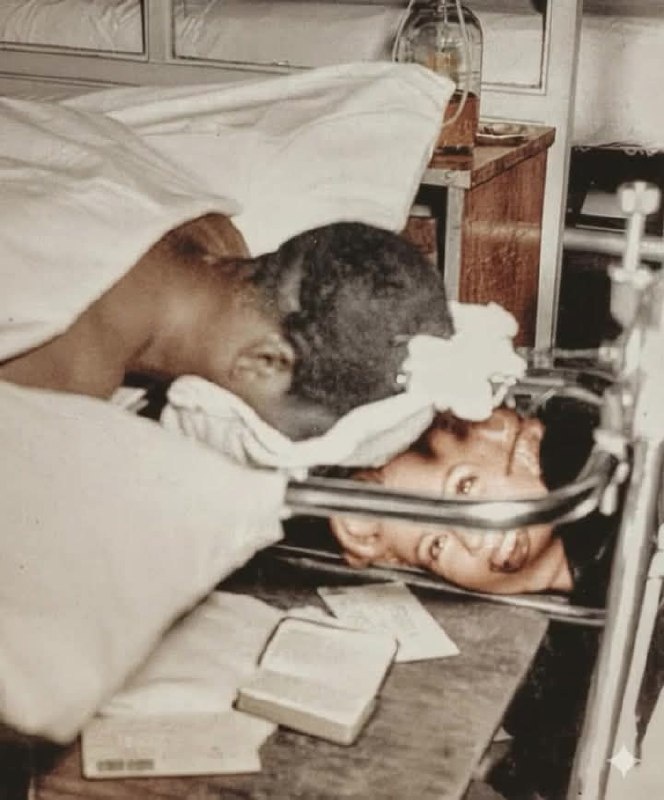
It is said that in 1954, in a military hospital in Japan, a young American soldier lay motionless on a stretcher—his back broken, his face turned downward.
He couldn’t sit up. He couldn’t even turn his head. All he could see was the floor, the cold edge of the bed, and a worn pillow that kept him company more than anyone else. His days were filled with silence, the sharp smell of disinfectant, and hours that seemed endless.
Until she walked into the room.
Marilyn Monroe.
She was touring to visit American troops, moving through wards heavy with wounds and exhaustion—bringing with her a light that seemed out of place in such surroundings. A warm breath in a space built of bandages and pain.
When she reached that soldier, she understood immediately: he couldn’t see her. At all. He couldn’t lift himself, couldn’t turn around, couldn’t “take part” like the others. He couldn’t even look at the face of the most famous woman in the room.
But Marilyn didn’t make it awkward. She didn’t ask for help. She didn’t look for a camera or a sensational headline. She simply knelt down, leaned forward, and gently slipped her face beneath the stretcher—so that she appeared upside down, right in his field of vision.
And there she was.
He smiled.
And she smiled back.
For a few seconds, pain loosened its grip. The war was no longer the war. The hospital was no longer just a hospital. That young man was no longer “patient number who-knows-what.” He was simply a person—truly seen by another human being.
No applause. No rehearsed joke. No carefully constructed pose.
Just a simple and deeply human truth:
If someone cannot rise to see you—
you lower yourself so they can see you.
The photograph said to have come from that moment does not show a diva.
It shows something rarer:
a quiet empathy, strong enough to change the air in the room.
Because sometimes true greatness isn’t under the spotlight—
it’s in the willingness to kneel down and lift someone’s spirit, even if only for an instant.