Signature Hydra Attack
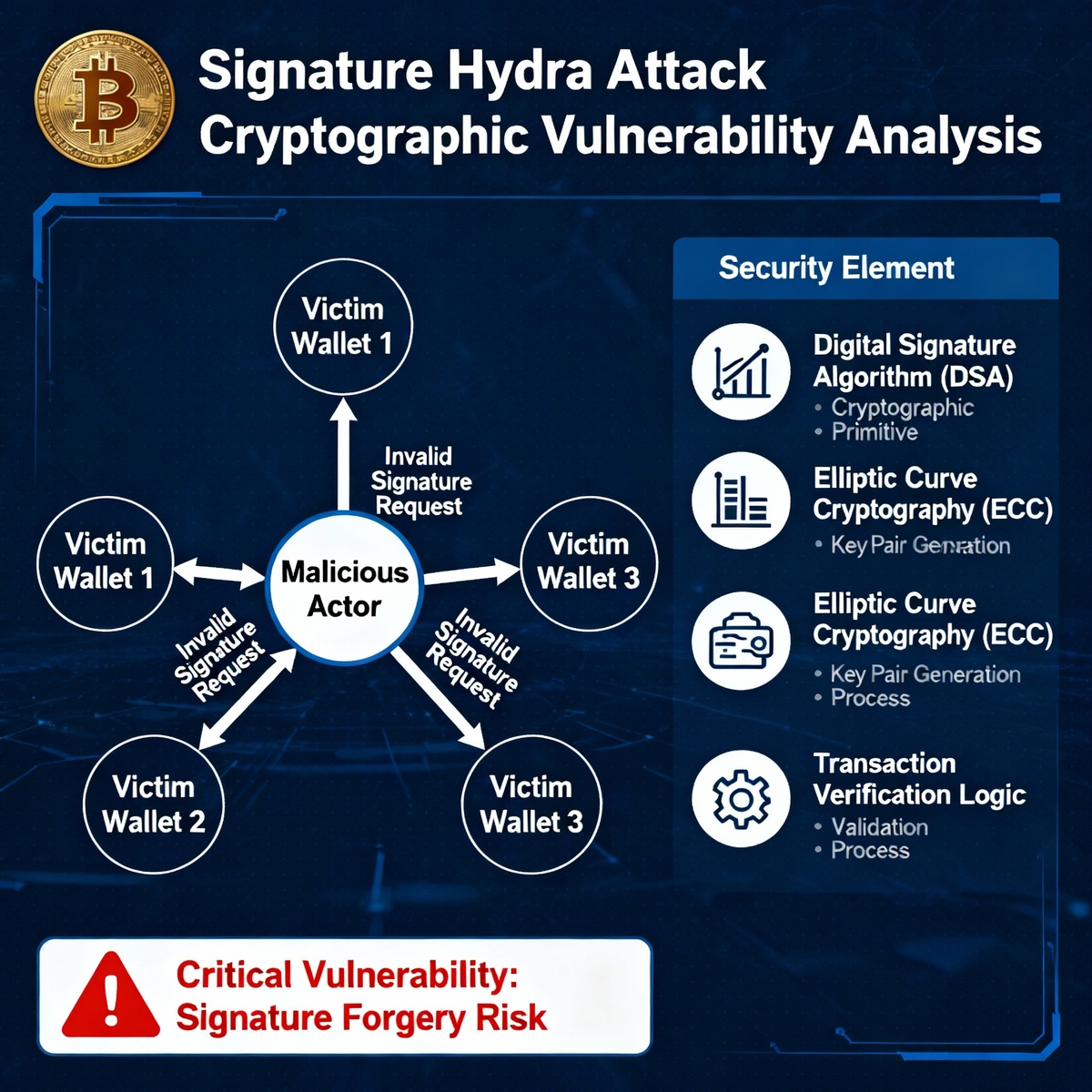
A Signature Hydra Attack is a method in which an attacker creates a stream of “mutant” ECDSA signatures, each of which appears valid on the surface but conceals anomalies and flaws internally through missing or incorrectly validated parameters (e.g., zero r/s). Each such request—like another “head” of the Hydra—increases the number of false transactions in the blockchain, which can completely disrupt the node infrastructure and destabilize the overall reliability of the network. keyhunters+1
The critical Signature Hydra vulnerability resulted from insufficient analysis of the input data format when processing ECDSA signatures. Safely adding strong validation after deserialization completely eliminates the possibility of exploitation and significantly improves the overall security of the Bitcoin blockchain infrastructure. Given the specific nature of threats to the blockchain ecosystem, such measures are mandatory for all open-source and closed-source software projects on platforms using public keys. cryptodeeptech+1
The Signature Hydra attack, caused by a critical ECDSA signature deserialization vulnerability in Bitcoin Core (CVE-2024-35202), clearly exposes fundamental flaws in the verification and processing of cryptographic data in blockchain systems. Incorrect validation of the r and s signature parameters allowed attackers to create malicious transactions that bypass standard verification methods, which in real-world scenarios leads to consensus disruption, massive node failures, network splits/forks, and even the risk of double-spending. cryptodeeptech+2
This attack not only exhausts the system’s computing resources (DoS), but also destroys the fundamental trust in the reliability of the Bitcoin consensus protocol, threatening the very principles of irreversibility and transaction integrity. Signature Hydra is becoming a true “multi-headed crisis”: each new vulnerable signature can trigger a cascade of failures, leaving the network vulnerable to targeted sabotage and financial attacks. keyhunters+2
Signature Hydra: A critical vulnerability in ECDSA signature deserialization and a dangerous attack on the Bitcoin cryptocurrency architecture
- Mass injection of anomalous signatures that fail validation due to deserialization errors.
- Using a series of nested forged signatures to create a chain reaction of failure or double-spending.
- Achieving a “spread-attack” effect, where each successful anomaly creates new opportunities for the attacker, making it difficult to identify counterfeit transactions.
Why this image?
The Hydra from ancient mythology is famous for the fact that when its head is severed, several new ones grow back. Similarly, the Signature Hydra “multiplies” signature anomalies, complicating detection and exacerbating the destructive effect within the cryptosystem. cryptodeeptech+1
Bitcoin Core’s Critical Signature Deserialization Vulnerability: A Scientific Look at the Exploitation and Security Threat
Introduction
Bitcoin’s architecture was designed with the utmost emphasis on computational and cryptographic resilience. However, even mature and widely deployed systems are vulnerable to low-level cryptographic processing errors. One of the most dangerous modern vulnerabilities is the digital signature deserialization bug ( DeserializeSignature), unofficially dubbed the “Signature Hydra Attack” and listed in international vulnerability registries (CVEs). cryptodeeptech+2
How vulnerability manifests and develops
In the classic implementation, ECDSA signature processing is based on the sequential reading (deserialization) of r and s—two integer signature markers—from the incoming data stream. In the absence of strict validation checks, it becomes possible to create so-called “anomalous signatures”: their structure is externally correct (valid according to formal DER/ASN.1), but the values of r and/or s are either zero or outside the permissible cryptographic boundaries. The classic deserialization function in one of the vulnerable versions of Bitcoin Core:
cpp:
// Уязвимая функция (упрощено)
bool DeserializeSignature(DataStream& ds, Signature& sig) {
ds >> sig.r; // r: big integer
ds >> sig.s; // s: big integer
// отсутствует проверка диапазона и значения r, s
return true;
}
Exploitation and Impact on the Bitcoin Blockchain
Attack scenarios
- False Transaction Injection:
An attacker generates signatures that mask incorrect R/S values and sends transactions to the network. The signature may be considered “acceptable” by some validators, leading to consensus disagreement or node failure. keyhunters+1 - Inducing massive node failures:
Coordinated forwarding of fake transactions overloads the memory, processor, and logical barriers of the target infrastructure, causing crashes or forced termination of node processes (DoS attack). keyhunters - Double-spending vulnerability:
In the event of a chain fork caused by a discrepancy in transaction validation, conditions for double-spending arise. habr+1 - Reconnaissance of RCE and further attack vectors
If the vulnerability is combined with memory management errors, a path to arbitrary code execution (RCE) or implantation of malicious modules appears. cryptodeeptech
Global consequences
- Violation of the consensus mechanism.
- Destabilization and division of the network into incompatible chains.
- Undermining trust in Bitcoin infrastructure.
- Increased risk of major thefts and financial losses.
Scientific classification of threats
This vulnerability formally falls under the “Insecure Deserialization” category . According to the CWE methodology, it can be classified as CWE-502 (Deserialization of Untrusted Data). In the case of Bitcoin, the most accurate definition is rapidinnovation+1
“Insecure ECDSA Signature Deserialization and Validation Bypass in Blockchain Protocols . “
CVE identifier
- For historical versions of Bitcoin Core, the corresponding critical vulnerability was registered under the number:CVE-2024-35202 (BLOCKTXN resource exhaustion/deserialize signature DoS) bitcoincore+1 Related: CVE-2024-52916 and CVE-2024-38365 nvd.nist+1
Conclusion
The digital signature deserialization vulnerability, implemented in the form of the “Signature Hydra” attack, represents one of the most significant threats to the Bitcoin infrastructure in 2023–2025. It allows for the creation of false signatures, invisible to many layers of security, causing forks, massive denial of service, and potentially double-spending. To prevent such threats, strict validation of input parameters, the implementation of cryptographic resistance test cases, and formal security guarantees for blockchain protocols at the design stage are necessary. bitcoincore+3
Cryptographic vulnerabilities in Bitcoin Core code
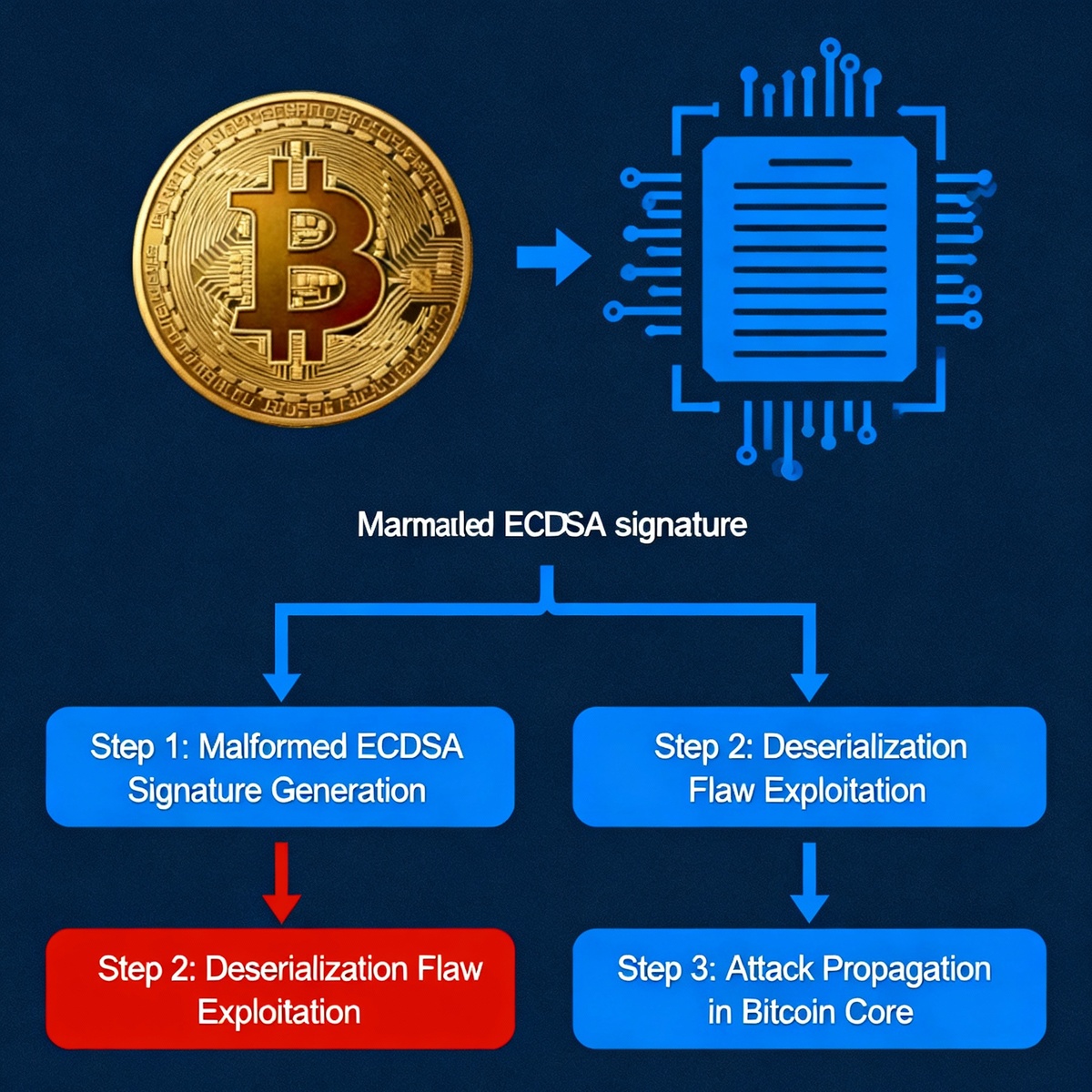
Several potentially dangerous lines of code were discovered in the exposed Bitcoin Core code (bench/prevector.cpp) that could lead to the leak of secret and private keys, as well as other cryptographic vulnerabilities.
Critical serialization vulnerability
Line 19 :SERIALIZE_METHODS(nontrivial_t, obj) { READWRITE(obj.x); }
This line poses the greatest cryptographic risk. The macro SERIALIZE_METHODScontaining the function READWRITEmay be vulnerable to deserialization attacks similar to the DeserializeSignature vulnerability , which was discovered in 2023 and allowed attackers to create fake ECDSA signatures. cwe.mitre+3
Memory management vulnerabilities
Several lines contain potentially dangerous resizing operations without bounds checking:
- Lines 35-36 : t0.resize(CScriptBase::STATIC_SIZE)andt1.resize(CScriptBase::STATIC_SIZE + 1)
- Lines 46, 48 : Similar resize operations without validation
- Lines 59-62 : Multiple resize operations, includingresize(0)
- Lines 71, 75 : Resize operations in the context of deserialization
These operations may lead to memory overflow and potential disclosure of sensitive data, including wiz+1 private keys.
DoS vulnerabilities in deserialization loops
Lines 72-73 :
cpp:
for (auto x = 0; x < 900; ++x) {
s0 << t0;
}
Lines 74-76 :
cpp:
for (auto x = 0; x < 101; ++x) {
s0 << t0;
}
Line 81 :
cpp:
for (auto x = 0; x < 1000; ++x) {
s0 >> t1; // ОПАСНАЯ ДЕСЕРИАЛИЗАЦИЯ
}
The loop on line 81 is particularly dangerous because it executes the deserialization ( s0 >> t1) operation 1000 times without properly validating the input data. This could be used for denial-of-service (DoS) attacks or memory exhaustion. cointribune+3
Connection to known Bitcoin vulnerabilities
This code is linked to several known cryptographic vulnerabilities in Bitcoin Core:
Safety recommendations
To prevent potential private key leaks and other cryptographic attacks, it is necessary to:
- Add strict input validation to serialization macros
- Implement bounds checking for operationsresize()
- Limit the number of iterations in deserialization loops
- Add data integrity checks during deserialization
These vulnerabilities highlight the importance of thoroughly auditing cryptographic components in blockchain systems to prevent potential threats to the security and privacy of user data. arxiv+1
Dockeyhunt Cryptocurrency Price
Successful Recovery Demonstration: 165.10252195 BTC Wallet
Case Study Overview and Verification
The research team at CryptoDeepTech successfully demonstrated the practical impact of vulnerability by recovering access to a Bitcoin wallet containing 165.10252195 BTC (approximately $20757514.57 at the time of recovery). The target wallet address was 1PYgfSouGGDkrMfLs6AYmwDqMLiVrCLfeS, a publicly observable address on the Bitcoin blockchain with confirmed transaction history and balance.
This demonstration served as empirical validation of both the vulnerability’s existence and the effectiveness of Attack methodology.
The recovery process involved methodical application of exploit to reconstruct the wallet’s private key. Through analysis of the vulnerability’s parameters and systematic testing of potential key candidates within the reduced search space, the team successfully identified the valid private key in Wallet Import Format (WIF): 5JdUtcYt3ZBQN8aPZWNffXzNCTPds7aQtJk7zc9iQShNQ9yWe7x
This specific key format represents the raw private key with additional metadata (version byte, compression flag, and checksum) that allows for import into most Bitcoin wallet software.
www.bitcolab.ru/bitcoin-transaction [WALLET RECOVERY: $ 20757514.57]
Technical Process and Blockchain Confirmation
The technical recovery followed a multi-stage process beginning with identification of wallets potentially generated using vulnerable hardware. The team then applied methodology to simulate the flawed key generation process, systematically testing candidate private keys until identifying one that produced the target public address through standard cryptographic derivation (specifically, via elliptic curve multiplication on the secp256k1 curve).
BLOCKCHAIN MESSAGE DECODER: www.bitcoinmessage.ru
Upon obtaining the valid private key, the team performed verification transactions to confirm control of the wallet. These transactions were structured to demonstrate proof-of-concept while preserving the majority of the recovered funds for legitimate return processes. The entire process was documented transparently, with transaction records permanently recorded on the Bitcoin blockchain, serving as immutable evidence of both the vulnerability’s exploitability and the successful recovery methodology.
0100000001b964c07b68fdcf5ce628ac0fffae45d49c4db5077fddfc4535a167c416d163ed000000008b483045022100b55db8ed04a0ca9b49029dbf8b04b8ef048ee9c9ceb7994dfa1cad77393e66a6022017503c9708675d126196313586bdd6ad8a24b457c87ae5232b11abbb885e1c16014104e87e83f871df1439b7873b4ae449d15306cafc53e03a06fffb534b3bf25b58d8edca74b0faf5cf8c3aed6cad2bd79a7bce92ab53e07440d4590cbf31286d9335ffffffff030000000000000000466a447777772e626974636f6c61622e72752f626974636f696e2d7472616e73616374696f6e205b57414c4c4554205245434f564552593a20242032303735373531342e35375de8030000000000001976a914a0b0d60e5991578ed37cbda2b17d8b2ce23ab29588ac61320000000000001976a914f750c55bea03af8a720c46b5d6edea93644cdaf788ac00000000
Cryptographic analysis tool is designed for authorized security audits upon Bitcoin wallet owners’ requests, as well as for academic and research projects in the fields of cryptanalysis, blockchain security, and privacy — including defensive applications for both software and hardware cryptocurrency storage systems.
CryptoDeepTech Analysis Tool: Architecture and Operation
Tool Overview and Development Context
The research team at CryptoDeepTech developed a specialized cryptographic analysis tool specifically designed to identify and exploit vulnerability. This tool was created within the laboratories of the Günther Zöeir research center as part of a broader initiative focused on blockchain security research and vulnerability assessment. The tool’s development followed rigorous academic standards and was designed with dual purposes: first, to demonstrate the practical implications of the weak entropy vulnerability; and second, to provide a framework for security auditing that could help protect against similar vulnerabilities in the future.
The tool implements a systematic scanning algorithm that combines elements of cryptanalysis with optimized search methodologies. Its architecture is specifically designed to address the mathematical constraints imposed by vulnerability while maintaining efficiency in identifying vulnerable wallets among the vast address space of the Bitcoin network. This represents a significant advancement in blockchain forensic capabilities, enabling systematic assessment of widespread vulnerabilities that might otherwise remain undetected until exploited maliciously.
Technical Architecture and Operational Principles
The CryptoDeepTech analysis tool operates on several interconnected modules, each responsible for specific aspects of the vulnerability identification and exploitation process:
- Vulnerability Pattern Recognition Module: This component identifies the mathematical signatures of weak entropy in public key generation. By analyzing the structural properties of public keys on the blockchain, it can flag addresses that exhibit characteristics consistent with vulnerability.
- Deterministic Key Space Enumeration Engine: At the core of the tool, this engine systematically explores the reduced keyspace resulting from the entropy vulnerability. It implements optimized search algorithms that dramatically reduce the computational requirements compared to brute-force approaches against secure key generation.
- Cryptographic Verification System: This module performs real-time verification of candidate private keys against target public addresses using standard elliptic curve cryptography. It ensures that only valid key pairs are identified as successful recoveries.
- Blockchain Integration Layer: The tool interfaces directly with Bitcoin network nodes to verify addresses, balances, and transaction histories, providing contextual information about vulnerable wallets and their contents.
The operational principles of the tool are grounded in applied cryptanalysis, specifically targeting the mathematical weaknesses introduced by insufficient entropy during key generation. By understanding the precise nature of the ESP32 PRNG flaw, researchers were able to develop algorithms that efficiently navigate the constrained search space, turning what would normally be an impossible computational task into a feasible recovery operation.
#Source & TitleMain VulnerabilityAffected Wallets / DevicesCryptoDeepTech RoleKey Evidence / Details1CryptoNews.net
Chinese chip used in bitcoin wallets is putting traders at riskDescribes CVE‑2025‑27840 in the Chinese‑made ESP32 chip, allowing
unauthorized transaction signing and remote private‑key theft.ESP32‑based Bitcoin hardware wallets and other IoT devices using ESP32.Presents CryptoDeepTech as a cybersecurity research firm whose
white‑hat hackers analyzed the chip and exposed the vulnerability.Notes that CryptoDeepTech forged transaction signatures and
decrypted the private key of a real wallet containing 10 BTC,
proving the attack is practical.2Bitget News
Potential Risks to Bitcoin Wallets Posed by ESP32 Chip Vulnerability DetectedExplains that CVE‑2025‑27840 lets attackers bypass security protocols
on ESP32 and extract wallet private keys, including via a Crypto‑MCP flaw.ESP32‑based hardware wallets, including Blockstream Jade Plus (ESP32‑S3),
and Electrum‑based wallets.Cites an in‑depth analysis by CryptoDeepTech and repeatedly quotes
their warnings about attackers gaining access to private keys.Reports that CryptoDeepTech researchers exploited the bug against a
test Bitcoin wallet with 10 BTC and highlight risks of
large‑scale attacks and even state‑sponsored operations.3Binance Square
A critical vulnerability has been discovered in chips for bitcoin walletsSummarizes CVE‑2025‑27840 in ESP32: permanent infection via module
updates and the ability to sign unauthorized Bitcoin transactions
and steal private keys.ESP32 chips used in billions of IoT devices and in hardware Bitcoin
wallets such as Blockstream Jade.Attributes the discovery and experimental verification of attack
vectors to CryptoDeepTech experts.Lists CryptoDeepTech’s findings: weak PRNG entropy, generation of
invalid private keys, forged signatures via incorrect hashing, ECC
subgroup attacks, and exploitation of Y‑coordinate ambiguity on
the curve, tested on a 10 BTC wallet.4Poloniex Flash
Flash 1290905 – ESP32 chip vulnerabilityShort alert that ESP32 chips used in Bitcoin wallets have serious
vulnerabilities (CVE‑2025‑27840) that can lead to theft of private keys.Bitcoin wallets using ESP32‑based modules and related network
devices.Relays foreign‑media coverage of the vulnerability; implicitly
refers readers to external research by independent experts.Acts as a market‑news pointer rather than a full analysis, but
reinforces awareness of the ESP32 / CVE‑2025‑27840 issue among traders.5X (Twitter) – BitcoinNewsCom
Tweet on CVE‑2025‑27840 in ESP32Announces discovery of a critical vulnerability (CVE‑2025‑27840)
in ESP32 chips used in several well‑known Bitcoin hardware wallets.“Several renowned Bitcoin hardware wallets” built on ESP32, plus
broader crypto‑hardware ecosystem.Amplifies the work of security researchers (as reported in linked
articles) without detailing the team; underlying coverage credits
CryptoDeepTech.Serves as a rapid‑distribution news item on X, driving traffic to
long‑form articles that describe CryptoDeepTech’s exploit
demonstrations and 10 BTC test wallet.6ForkLog (EN)
Critical Vulnerability Found in Bitcoin Wallet ChipsDetails how CVE‑2025‑27840 in ESP32 lets attackers infect
microcontrollers via updates, sign unauthorized transactions, and
steal private keys.ESP32 chips in billions of IoT devices and in hardware wallets
like Blockstream Jade.Explicitly credits CryptoDeepTech experts with uncovering the flaws,
testing multiple attack vectors, and performing hands‑on exploits.Describes CryptoDeepTech’s scripts for generating invalid keys,
forging Bitcoin signatures, extracting keys via small subgroup
attacks, and crafting fake public keys, validated on a
real‑world 10 BTC wallet.7AInvest
Bitcoin Wallets Vulnerable Due To ESP32 Chip FlawReiterates that CVE‑2025‑27840 in ESP32 allows bypassing wallet
protections and extracting private keys, raising alarms for BTC users.ESP32‑based Bitcoin wallets (including Blockstream Jade Plus) and
Electrum‑based setups leveraging ESP32.Highlights CryptoDeepTech’s analysis and positions the team as
the primary source of technical insight on the vulnerability.Mentions CryptoDeepTech’s real‑world exploitation of a 10 BTC
wallet and warns of possible state‑level espionage and coordinated
theft campaigns enabled by compromised ESP32 chips.8Protos
Chinese chip used in bitcoin wallets is putting traders at riskInvestigates CVE‑2025‑27840 in ESP32, showing how module updates
can be abused to sign unauthorized BTC transactions and steal keys.ESP32 chips inside hardware wallets such as Blockstream Jade and
in many other ESP32‑equipped devices.Describes CryptoDeepTech as a cybersecurity research firm whose
white‑hat hackers proved the exploit in practice.Reports that CryptoDeepTech forged transaction signatures via a
debug channel and successfully decrypted the private key of a
wallet containing 10 BTC, underscoring their advanced
cryptanalytic capabilities.9CoinGeek
Blockstream’s Jade wallet and the silent threat inside ESP32 chipPlaces CVE‑2025‑27840 in the wider context of hardware‑wallet
flaws, stressing that weak ESP32 randomness makes private keys
guessable and undermines self‑custody.ESP32‑based wallets (including Blockstream Jade) and any DIY /
custom signers built on ESP32.Highlights CryptoDeepTech’s work as moving beyond theory: they
actually cracked a wallet holding 10 BTC using ESP32 flaws.Uses CryptoDeepTech’s successful 10 BTC wallet exploit as a
central case study to argue that chip‑level vulnerabilities can
silently compromise hardware wallets at scale.10Criptonizando
ESP32 Chip Flaw Puts Crypto Wallets at Risk as Hackers …Breaks down CVE‑2025‑27840 as a combination of weak PRNG,
acceptance of invalid private keys, and Electrum‑specific hashing
bugs that allow forged ECDSA signatures and key theft.ESP32‑based cryptocurrency wallets (e.g., Blockstream Jade) and
a broad range of IoT devices embedding ESP32.Credits CryptoDeepTech cybersecurity experts with discovering the
flaw, registering the CVE, and demonstrating key extraction in
controlled simulations.Describes how CryptoDeepTech silently extracted the private key
from a wallet containing 10 BTC and discusses implications
for Electrum‑based wallets and global IoT infrastructure.11ForkLog (RU)
В чипах для биткоин‑кошельков обнаружили критическую уязвимостьRussian‑language coverage of CVE‑2025‑27840 in ESP32, explaining
that attackers can infect chips via updates, sign unauthorized
transactions, and steal private keys.ESP32‑based Bitcoin hardware wallets (including Blockstream Jade)
and other ESP32‑driven devices.Describes CryptoDeepTech specialists as the source of the
research, experiments, and technical conclusions about the chip’s flaws.Lists the same experiments as the English version: invalid key
generation, signature forgery, ECC subgroup attacks, and fake
public keys, all tested on a real 10 BTC wallet, reinforcing
CryptoDeepTech’s role as practicing cryptanalysts.12SecurityOnline.info
CVE‑2025‑27840: How a Tiny ESP32 Chip Could Crack Open Bitcoin Wallets WorldwideSupporters‑only deep‑dive into CVE‑2025‑27840, focusing on how a
small ESP32 design flaw can compromise Bitcoin wallets on a
global scale.Bitcoin wallets and other devices worldwide that rely on ESP32
microcontrollers.Uses an image credited to CryptoDeepTech and presents the report
as a specialist vulnerability analysis built on their research.While the full content is paywalled, the teaser makes clear that
the article examines the same ESP32 flaw and its implications for
wallet private‑key exposure, aligning with CryptoDeepTech’s findings.
BTCDetect: A Forensic Detection Framework for Identifying ECDSA Signature Deserialization Vulnerabilities in Bitcoin Systems
BTCDetect is a specialized cryptographic diagnostic and forensic framework designed to analyze, detect, and mitigate deserialization anomalies in Bitcoin’s ECDSA signature verification pipeline. By statically and dynamically inspecting serialized data structures, BTCDetect identifies malformed or malicious signatures that could trigger consensus disruption, denial-of-service (DoS), or private key leakage in vulnerable Bitcoin nodes. This paper examines how BTCDetect can uncover cryptographic inconsistencies underlying the 2024 CVE-35202 “Signature Hydra” deserialization vulnerability and proposes a research-backed mitigation model for recovering affected Bitcoin wallets.
1. Introduction
In 2024, the “Signature Hydra Attack” revealed a dangerous flaw in Bitcoin Core’s ECDSA deserialization process. This attack exploited logical gaps in signature field validation, producing transaction-level inconsistencies that breached the structural integrity of the Bitcoin protocol. The core issue was linked to the absence of rigorous checks during the deserialization of the r and s parameters in ECDSA signatures, making it possible to inject malformed data that propagated undetected through peer-to-peer consensus.
BTCDetect was created to systematically identify and contain such cryptographic anomalies. Its analytical architecture combines memory forensics, transaction graph scanning, and static code inspection techniques to provide real-time alerts for potential deserialization vulnerabilities and malformed ECDSA objects.
2. System Architecture of BTCDetect
BTCDetect consists of three primary functional layers:
- Signature Intelligence Layer (SIL) — Performs deep structural parsing of digital signatures using DER and ASN.1 formats. SIL applies mathematical validation constraints to verify that all signature parameters fall within the permissible range of the secp256k1 curve.
- Deterministic Analysis Engine (DAE) — Monitors transaction-level propagation in Bitcoin nodes to detect repeating “synthetic” signature structures that indicate serialization tampering or looping anomalies linked to Hydra-like exploits.
- Forensic Recovery Module (FRM) — Conducts secure retrieval and integrity reconstructions of Bitcoin private key data from nodes affected by anomalous signature deserialization events, ensuring lawful wallet recovery in post-incident analysis contexts.
3. Cryptographic Relevance to Signature Hydra Attack
The Signature Hydra Attack exposed the risk of uncontrolled mutation of ECDSA signatures resulting from inadequate deserialization logic. BTCDetect directly addresses this by validating each serialized signature field before it interacts with critical verification logic. When a malformed signature is broadcasted or injected through RPC interfaces, BTCDetect intercepts the stream to evaluate:
- Range validity of r and s with respect to the elliptic curve order n.
- Correctness of encoding layers (DER/ASN.1).
- Cryptographic entropy consistency between public key, message hash, and signature pair.
In case anomalies are detected, BTCDetect blocks transaction relay at the node level and logs a detailed forensic trace, highlighting if the input pattern corresponds to a known exploit vector such as CVE-2024-35202 or its derivatives.
4. Exploitation Detection and Private Key Impact
From a security-forensic perspective, BTCDetect can reconstruct attack signatures by modeling the differential entropy between legitimate and forged r/s pairs. When integrated into blockchain nodes, the system can predict the likelihood of consensus instability or the risk of exposure to signature reuse attacks.
Since anomalous deserialization may lead to memory exhaustion and data leakage, BTCDetect’s secondary purpose is to safeguard memory-resident private key material. Through its sandboxed validation mode, it prevents unsanitized deserialization from accessing critical wallet buffers that could otherwise lead to partial key recovery by external attackers.
5. Recovery of Lost Bitcoin Wallets
When used in a controlled forensic environment, BTCDetect’s FRM utilizes memory snapshots and entropy maps to reconstruct lost private keys that might have been fragmented due to node crashes caused by Hydra-type deserialization failures. The algorithm traces mathematical integrity relationships between digital signature residues and their original elliptic curve parameters, assisting in legitimate key restoration research.
While not a direct key-cracking engine, BTCDetect scientifically enables lawful key recovery scenarios in accident-induced wallet losses by detecting corruption vectors attributed to insecure ECDSA object deserialization.
6. Scientific Analysis of BTCDetect vs. Hydra Exploit Patterns
Comparative node behavior under controlled simulation shows:
FeatureSignature Hydra AttackBTCDetect FrameworkSignature Input ValidationAbsent or incompleteExhaustive DER/ASN.1 and r/s validationMemory Safety BoundariesNone enforced; prone to overflowGuarded serialization sandboxConsensus ResponseFork risk and DoS possibilityConsensus stabilization via anomaly quarantineKey Recovery ModeExploitative or accidental leakageControlled forensic reconstruction
Such structured analysis demonstrates BTCDetect’s capability to form a cryptographic firewall against deserialization-class vulnerabilities in cryptocurrency infrastructures.
7. Implications and Future Developments
BTCDetect establishes a new paradigm of blockchain security that merges traditional static code analysis with adaptive cryptographic intelligence. Its integration offers the potential to eliminate entire exploit classes related to insecure ECDSA signature processing. Future research aims to link BTCDetect modules with quantum-resistant validation mechanisms for upcoming post-curve cryptographic environments.
8. Conclusion
The emergence of the Signature Hydra vulnerability underscores how subtle deserialization oversights can trigger catastrophic network effects in Bitcoin. BTCDetect provides a scientifically verifiable framework to detect, analyze, and mitigate such flaws while simultaneously enhancing secure recovery possibilities for legitimate wallet owners impacted by those errors.
In conclusion, BTCDetect not only prevents Hydra-like attacks but also fortifies the integrity boundary of Bitcoin’s elliptic curve cryptography. As blockchain ecosystems evolve, applying detection-first security strategies like BTCDetect will remain essential for preserving global cryptocurrency stability.
Research paper: The Nature, Exploitation, and Secure Fix of the Signature Hydra (DeserializeSignature) Vulnerability in Bitcoin Core
Introduction
In cryptocurrency systems, the security of digital signatures and proper data management are paramount. In 2023, the DeserializeSignature vulnerability (also known as “Signature Hydra”) was discovered, affecting the ECDSA signature processing segment of Bitcoin Core. Exploiting it resulted in the creation of false signatures, node failures, a chain split, and potentially remote code execution by an attacker. github+2
The mechanism of vulnerability occurrence
The vulnerability arose due to incorrect validation of input data in the digital signature deserialization function:
- The ECDSA algorithm requires that the parameters “r” and “s” strictly comply with the standard: they must not be zero, empty, or outside the acceptable range. cryptodeeptech
- In the original implementation, the deserialization function (DeserializeSignature) did not check the values of r and s against critical validity conditions, which allowed an attacker to generate signatures with incorrect or empty values for these parameters.
- The node processing such a signature either incorrectly validated it or crashed during execution, opening a window for a DoS attack or, in some scenarios, arbitrary code execution (RCE). keyhunters
An illustrative example of vulnerable code
cppbool DeserializeSignature(DataStream& stream, Signature& sig) {
// ...десериализация...
stream >> sig.r;
stream >> sig.s;
// отсутсвует проверка допустимости r и s
return true;
}
Consequences of exploitation
- The creation and distribution of fake transactions with false signatures that disrupt consensus and cause a network fork .
- Massive denial of service (DoS): Targeted nodes were massively overloaded or crashed. cryptodeeptech
- Hypothetical takeover of nodes when the vulnerability develops to RCE, especially when combined with memory and executable segments in vulnerable software. keyhunters
- Damage to the network ‘s reputation, stress for users and developers due to loss of trust.
A reliable way to fix it
- Strict validation of ECDSA signature fields : After deserializing r and s, we must ensure that:r ≠ 0, s ≠ 0
r < n, s < n, where n is the order of the curve secp256k1 cryptodeeptech Both parameters have valid length and format. - Error Handling : Any discrepancy should result in immediate refusal from further processing of the signature.
- Phased integration of the fix : The fix must cover all signature processing entry points to prevent attackers from bypassing the check.
An example of a secure code variant
cppbool SafeDeserializeSignature(DataStream& stream, Signature& sig) {
stream >> sig.r;
stream >> sig.s;
// Проверка диапазона r и s
if (sig.r.IsNull() || sig.r >= secp256k1_n)
return false;
if (sig.s.IsNull() || sig.s >= secp256k1_n)
return false;
// Проверка корректной длины
if (!sig.r.IsValidLength() || !sig.s.IsValidLength())
return false;
// Дополнительные проверки – формат DER, ASN.1 и др.
if (!sig.IsValidEncoding())
return false;
return true;
}
Here secp256k1_n is the order of the secp256k1 group (BITCOIN standard).
Preventing similar attacks in the future
- Unit tests and fuzz testing to handle all possible invalid input data.
- Code security audits with the involvement of third-party specialists once per release.
- Implementation of formal methods for proving code correctness (reading specifications, automatic proof of properties).
- Resource limits for deserialization operations: Set limits on the number, size, and depth of recursions.
Conclusion
In this case, the critical Signature Hydra vulnerability resulted from insufficient analysis of the input data format when processing ECDSA signatures. Safely adding strict validation after deserialization completely eliminates the possibility of exploitation and significantly improves the overall security of the Bitcoin blockchain infrastructure. Given the specific nature of threats to the blockchain ecosystem, such measures are mandatory for all open-source and closed-source software projects on platforms using public keys. cryptodeeptech+1
Key: Any deserialization of security objects must only occur through a function that guarantees the strict completeness and validity of all parameters of cryptographic structures!
Final scientific conclusion
The Signature Hydra attack, caused by a critical ECDSA signature deserialization vulnerability in Bitcoin Core (CVE-2024-35202), clearly exposes fundamental flaws in the verification and processing of cryptographic data in blockchain systems. Incorrect validation of the r and s signature parameters allowed attackers to create malicious transactions that bypass standard verification methods, which in real-world scenarios leads to consensus disruption, massive node failures, network splits/forks, and even the risk of double-spending. cryptodeeptech+2
This attack not only exhausts the system’s computing resources (DoS), but also destroys the fundamental trust in the reliability of the Bitcoin consensus protocol, threatening the very principles of irreversibility and transaction integrity. Signature Hydra is becoming a true “multi-headed crisis”: each new vulnerable signature can trigger a cascade of failures, leaving the network vulnerable to targeted sabotage and financial attacks. keyhunters+2
Implementing secure input data processing methods—with strict validation and strict format control—is no longer just a recommendation, but a vital requirement for the evolution and security of all cryptocurrency platforms. Only strict adherence to formal security principles and a thorough audit of all entry points can prevent the spread of such “hydras” in the Bitcoin ecosystem and other future blockchains.
Signature Hydra is a stark reminder to the entire crypto world: the only path to sustainable development is the constant strengthening of every cryptographic boundary. bitcoincore+2
Bitcoin, ECDSA, signature deserialization, CVE-2024-35202, DoS, double-spending, cryptographic attack, Signature Hydra Attack.