#️⃣#️⃣#️⃣ O’Connor Grammar 🗣️❓
Questions in English: how word order really works
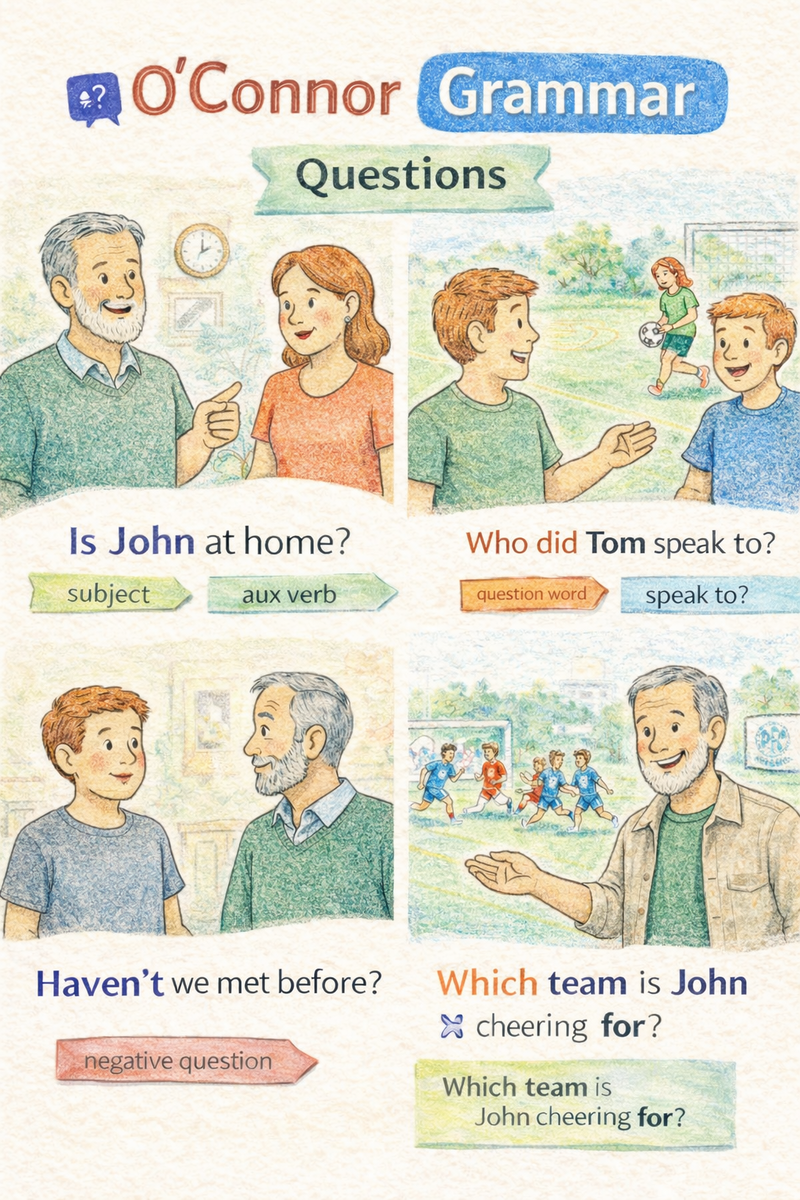
#️⃣ Today we continue our O’Connor Grammar series and focus on questions in English. At first glance they look simple, but word order, auxiliary verbs, and special question words can easily confuse learners. Let’s clear everything up step by step — with the O’Connor family, of course 😉👨👩👧👦
#️⃣ A. Word order in questions 🔄
In most English questions, the subject comes after the first verb (usually an auxiliary verb).
#️⃣✔️ Statement → Question: 1️⃣ John is at home. → Is John at home?
2️⃣ Sarah has finished cooking. → Has Sarah finished cooking?
3️⃣ Alex will study tonight. → Will Alex study tonight?
В английских вопросах подлежащее обычно стоит после первого (вспомогательного) глагола.
#️⃣ B. Questions in the Present and Past Simple 🕰️
In Present Simple, we use do / does.
In Past Simple, we use did.
#️⃣ Examples with the O’Connors: 1️⃣ Do Tom and Lily argue every morning?
Том и Лили ссорятся каждое утро?
2️⃣ Does Sarah work late on Fridays?
Сара работает допоздна по пятницам?
3️⃣ Did John miss the train yesterday?
Джон вчера опоздал на поезд?
#️⃣⚠️ Important rule
We do NOT use do / does / did if who / what is the subject of the question.
#️⃣ Compare: 1️⃣ Who did Alex call? (Alex = subject)
2️⃣ Who called Alex? (Who = subject)
Если who / what — подлежащее, вспомогательный глагол не нужен.
#️⃣ C. Questions with who / what / which / where 🌍
When a question ends with a preposition, it usually goes at the end.
#️⃣ Examples: 1️⃣ Where is Lily from?
Откуда Лили?
2️⃣ Who did Tom speak to after training?
С кем Том говорил после тренировки?
3️⃣ Which team is John cheering for this season? ⚽
За какую команду Джон болеет в этом сезоне?
#️⃣ In formal English, we can move the preposition: 1️⃣ To whom did Sarah speak at the conference?
С кем Сара говорила на конференции?
#️⃣ D. Negative questions 🤔❗
Negative questions are often used to: 1️⃣ show surprise 😲
2️⃣ check if we agree 🤝
3️⃣ make suggestions 💡
#️⃣ Examples: 1️⃣ Didn’t Alex pass his exam?
Разве Алекс не сдал экзамен?
2️⃣ Haven’t we met before? John asked the neighbour.
Мы разве раньше не встречались? — спросил Джон соседа.
#️⃣⚠️ Be careful with answers: 1️⃣ “Don’t you like football?”
— Yes (I like it)
— No (I don’t like it)
В английском yes/no относится к смыслу, а не к форме вопроса.
#️⃣ E. Why + negative questions 💬
We often use Why don’t…? / Why wasn’t…? to ask politely or make suggestions.
#️⃣ Examples: 1️⃣ Why don’t we watch a movie together? Lily suggested. 🎬
Почему бы нам не посмотреть фильм вместе?
2️⃣ Why wasn’t Tom at wrestling practice yesterday?
Почему Тома не было вчера на тренировке?
#️⃣ 🎯 Mini-practice
#️⃣Try turning these statements into questions: 1️⃣ John is working late.
2️⃣ Sarah cooked dinner yesterday.
3️⃣ Alex called someone.
#️⃣👉 Tip
When forming questions, always ask yourself:
Who is the subject — and do I need an auxiliary verb?
❕❕❕Now also on other social media platforms.
https://dzen.ru/id/5f5248405bef7c0b8eef8d13
https://max.ru/join/xOe15CQ-etxrdTNEwVFRP6dmSxzMQK9hVoWFX1tsTUk
https://vk.com/myenglishwithoconnors
https://t.me/myenglishgrammarinuse