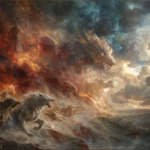
Ragnarök: When Even Gods Fall – Unveiling the Norse Apocalypse
Ragnarök: When Even Gods Fall – Unveiling the Norse Apocalypse
Imagine, if you will, a prophecy whispered through the winds of time, a fate so grand and terrible that even the mightiest deities could not escape its iron grip. It is a story not just of destruction, but of an inescapable cycle, a cosmic inevitability that looms over all existence. This, my dear readers, is the tale of Ragnarök. 🌬️
In the frigid, mystical realms of Norse mythology, where gods like Odin, Thor, and Frey held sway, the notion of an ultimate demise was not merely a fantastical concept, but a foreseen event. One *might say* that the very fabric of their reality was woven with the threads of this impending doom, a forewarning of the «Twilight of the Gods.»
The signs of Ragnarök, it was foretold, would begin with a relentless winter, known as Fimbulwinter, lasting for three years without respite. This prolonged season of bitter cold and darkness would, *in some respects*, erode the bonds between humanity, leading to an age of unparalleled strife and moral decay. Brothers would fight brothers; fathers would turn on their children. Truly, the world would be ripe for its grand undoing.
Following this desolate period, the cosmos would witness the breaking of all chains. The monstrous wolf Fenrir, whose jaws were destined to swallow Odin himself, would finally break free from his magical bonds. His sibling, the colossal Midgard Serpent Jörmungandr, would thrash violently in the sea, causing immense tidal waves and poisoning the skies with its venom. It is *quite clear* that these primordial beasts were not just creatures of myth, but living embodiments of chaos unleashed.
From the fiery realm of Muspelheim, the giant Surtur would lead his legions, his sword blazing brighter than the sun, prepared to set the world ablaze. And from the depths, Loki, the cunning trickster god, would steer Naglfar, a ship crafted from the nails of the dead, carrying an army of giants and the spirits of the dishonored. This procession of destruction would, *evidently*, be an army like no other, marching towards its fateful confrontation.
The great war horn, Gjallarhorn, would then sound its mournful, resonating call, echoing across all nine worlds, signaling the gods to muster their forces on the plain of Vígríðr. Odin, the Allfather, would lead the Æsir, along with the valiant Einherjar—chosen warriors from Valhalla—into a conflict of monumental scale. Thor, the thunderer, would face his ancient nemesis, Jörmungandr, in a duel that *many scholars describe* as one of legend.
The battles would be fierce, tragic, and ultimately, conclusive. Odin would fall to Fenrir’s ravenous maw, a truly devastating loss for the divine realm. Thor, though vanquishing the Midgard Serpent, would succumb to its venom after taking but nine steps. Frey would meet his end against Surtur, having given up his magical sword. Heimdall, the vigilant guardian of Bifrost, would slay Loki, but *sadly*, die in the process. The rainbow bridge, Bifrost, itself would shatter under the weight of the encroaching fire giants. 🔥
As the gods and monsters fell, Surtur would unleash his cataclysmic flames, consuming the entire world in an inferno that would cleanse all life. The earth would sink into the primordial sea, and *it can be argued* that this fiery deluge represented not just an end, but a purification. The old order, the old world, would be utterly obliterated.
Yet, Ragnarök is not just a tale of absolute despair. From the ashes of the old, a new, green world would emerge from the receding waters. A handful of gods, including Odin’s sons Víðarr and Váli, Thor’s sons Móði and Magni, and Baldr and Höðr (reborn from the underworld), would survive to inherit this rejuvenated earth. Two humans, Líf and Lífþrasir, sheltered deep within the world tree Yggdrasil, would also endure, destined to repopulate the new world. This cycle of destruction and rebirth, *many believe*, offers a profound meditation on renewal.
Ragnarök, therefore, isn’t simply a story about an apocalypse. It’s a powerful narrative about inevitability, courage in the face of doom, and the eternal promise of renewal. It reminds us that even when all seems lost, there is always the potential for a fresh start, a verdant new beginning from the remnants of the past. It *seems rather evident* that these ancient Norse tales still resonate deeply within our modern understanding of cycles, fate, and hope. 🌍✨
If you’re fascinated by such grand sagas and wish to delve deeper into the rich tapestry of global myths and legends, we invite you to join our growing community! For more captivating stories and insights, find us on Telegram: https://t.me/Miphiuy. Come, let’s explore the wonders of ancient wisdom together.