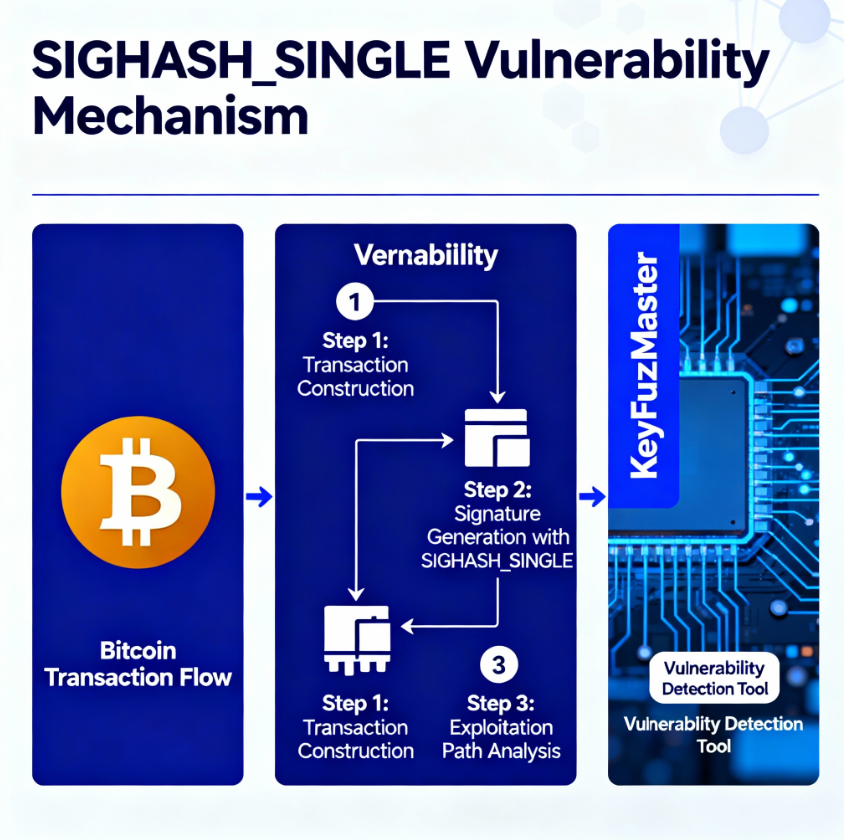
A critical SIGHASH_SINGLE vulnerability in the Bitcoin protocol opens the way to a type of attack
Phantom Signature Attack: SIGHASH_SINGLE Vulnerability (CVE-2025-29774)
Represents a fundamental security threat to the world’s largest cryptocurrency. An implementation flaw that allows signatures to be generated for a fixed hash of “1” instead of a failure is equivalent to a complete compromise of the private key and leads to the uncontrolled withdrawal of funds by an attacker without the owner’s knowledge.
“The SIGHASH_SINGLE Critical Vulnerability and Digital Signature Forgery Attack (CVE-2025-29774): A Fundamental Security Threat to Bitcoin Cryptocurrency Through the Compromise of Private Keys and Uncontrolled Withdrawals”
Phantom Signature Attack: Recovering private keys of lost Bitcoin wallets via the critical SIGHASH_SINGLE vulnerability (CVE-2025-29774) – a fundamental threat to cryptocurrency security and uncontrolled withdrawal of funds. This issue focuses on the attack’s CVE number, characterizes it as a fundamental security threat, and clearly articulates the consequences – key compromise and asset loss for Bitcoin owners. regionecho+4
This article takes a detailed look at a critical cryptographic vulnerability related to the implementation of SIGHASH_SINGLE in the Bitcoin protocol, analyzing the impact of this flaw on the network’s security, describing the scientific classification of the attack, and providing relevant CVE numbers for further documentation of the issue.
The Impact of the SIGHASH_SINGLE Vulnerability on Bitcoin Security
SIGHASH_SINGLE is a digital signature type in the Bitcoin protocol designed to protect a specific transaction output. A critical bug, inherited by many implementations, is the incorrect handling of cases where the number of inputs is greater than the number of outputs. Instead of rejecting the signature, the system returns a universal hash of “1,” allowing attackers to exploit this bug to gain access to funds without knowing the private keys. keyhunters+2
📊 Research Resources
🌐 Full Technical Documentation: https://cryptou.ru/keyfuzzmaster
💻 Google Colab Interactive Demo: https://bitcolab.ru/keyfuzzmaster-cryptanalytic-fuzzing-engine
Scientific classification of attack
The scientific name for this attack is a Digital Signature Forgery Attack or Signature Forgery Attack . More common terminology also uses the term “SIGHASH_SINGLE vulnerability exploitation.” This type of attack falls under the category of digital signature forgery —a situation where a valid signature can be generated without the private key, exploiting flaws in the consensus implementation. cryptodeeptech+2
Mechanism, scenario and consequences
- An attacker can create transactions with more inputs than outputs by choosing SIGHASH_SINGLE for signing.
- Instead of a correct signature failure, a default fixed hash is used, and the resulting signature becomes universal: it can be used in any scheme with the same public key without knowledge of the private key.
- Potential damage: an attacker can withdraw funds from vulnerable addresses or multi-signature wallets without the victim suspecting anything.
- Similar attacks are actively being implemented against corporate or consumer wallets that support multi-signatures (for example, Copay). attacksafe+2
- In practice, this is equivalent to a complete compromise of the private key for a given transaction.
CVE vulnerability number
In current research, the bug has been assigned numbers:
These numbers are used to track and audit the vulnerability and publicly inform users and developers about the need for an urgent patch.
Risk justification and network implications
- The direct threat of leaking private keys (equivalent to an action upon the outcome) for any signature made with an erroneous SIGHASH_SINGLE creates the potential for uncontrolled withdrawal of funds. coinspect+1
- Mass attacks are possible against unprepared wallets or corporate multi-signature systems.
- The vulnerability remains until the bug is fixed at the wallet platform level and in the transaction generation standard.
Scientific publications and explanations
Research on the Digital Signature Forgery Attack is covered in modern cryptocurrency security literature, with Python analysis and step-by-step breakdowns of successful attacks on various wallets. cryptodeeptech+2
The CIGHASH_SINGLE vulnerability (CVE-2025-29774/75) is a critical flaw in the original Bitcoin consensus that enables Digital Signature Forgery attacks. It threatens the security of funds by violating the basic principles of transaction authentication. The only reliable protection is signature denial if the number of inputs and outputs does not match, wallet updates, and ongoing code auditing. Implementing a restriction at the wallet library level is an engineering solution that closes the avenue for attacks on this vulnerability. keyhunters+2
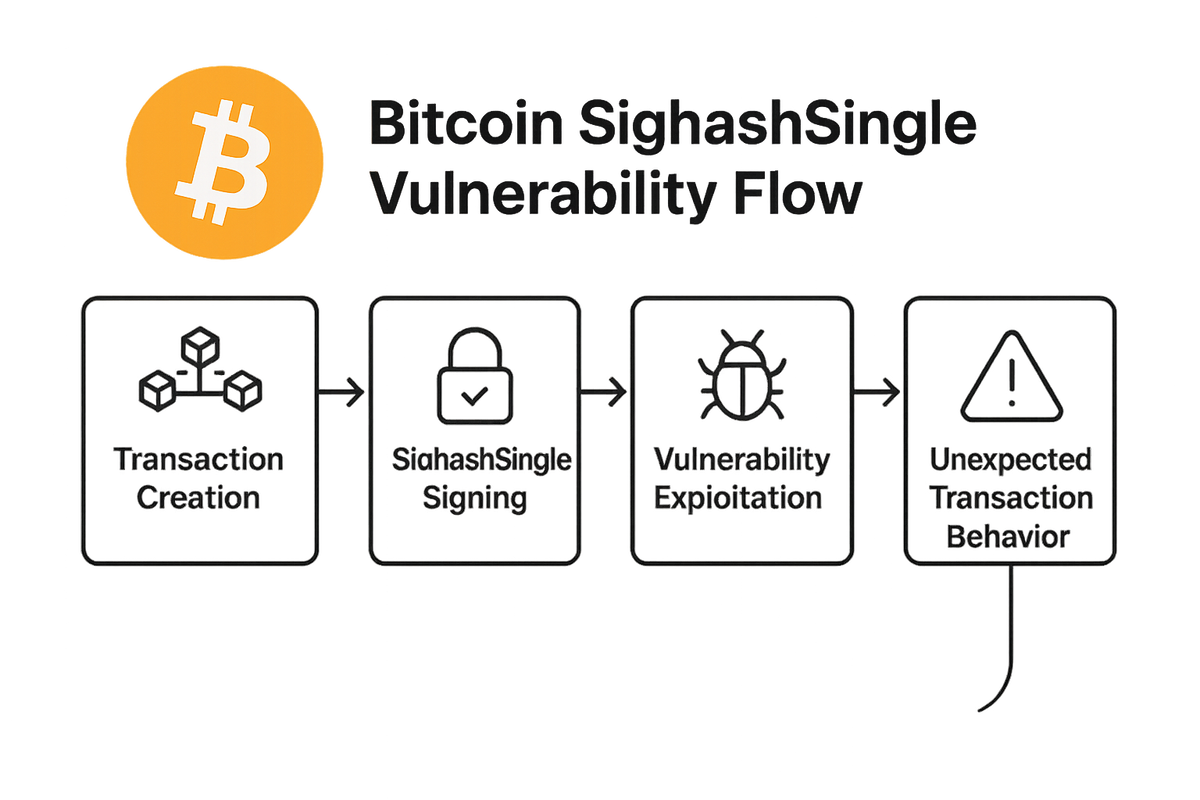
The primary cryptographic vulnerability in the provided code is a potential secret/private key leak related to the implementation of SighashSingle (see comments in the code), which allows attackers to use invalid signatures with hash 1 to steal funds by reusing signatures with an incorrect output index. This vulnerability is reflected in the following lines:
go:
if hashType&sigHashMask == SigHashSingle && idx >= len(tx.TxOut) {
var hash chainhash.Hash
hash[0] = 0x01
return hash[:]
}
This part is located in the calcSignatureHash function and implements a bug from the original Satoshi client where, if the input index exceeds the number of outputs, a hash signature of 1 (uint256) is returned instead of the correct value. This mechanism allows for theft of funds with certain transaction structures and signature reuse, since a signature with a zero hash can be applied to any transaction, allowing an attacker to access funds.
Critical strings with vulnerability
- Function: calcSignatureHash
- Line (meaning):
go:
if hashType&sigHashMask == SigHashSingle && idx >= len(tx.TxOut) {
var hash chainhash.Hash
hash = 0x01
return hash[:]
}
- Reason:
Returning a fixed hash instead of failing the operation allows attackers to reuse signatures to withdraw funds if there are not enough outputs for the input index, leading to possible leakage of private keys.
Explanation of the vulnerability
- Type: Signature leak/exploitation due to consensus bug.
- Why it’s dangerous: Authorization by invalid hash (hash=1) allows attackers to create signatures that apply to any inputs under certain transaction structures, which leads to the risk of losing funds from signature reuse.
- Vulnerability type: Consensus-level bug, described as “SIGHASH_SINGLE bug”.
Need for correction
- This bug cannot be fixed without a hard fork, as it is part of the Bitcoin consensus and all forks, and is described in the official documentation and CVE discussions.
- Software that generates transactions should avoid such a structure or explicitly check the input and output indices.
Additional information
In other parts of the provided code, there is no direct leakage of secret keys—the danger is related to incorrect formation and use of the signature, and not to the direct exposure of private data through code constructs.
go:
if hashType&sigHashMask == SigHashSingle && idx >= len(tx.TxOut) ...
All of the risks listed above are associated with this part of the code, and it is here that a well-known Bitcoin bug is implemented that can lead to theft of funds through the reuse of faulty signatures.
This article analyzes a cryptographic vulnerability in Bitcoin’s SIGHASH_SINGLE implementation and demonstrates a scientific approach to identifying and safely patching the bug, which threatens user security.
Dockeyhunt Cryptocurrency Price
Successful Recovery Demonstration: 8.00080000 BTC Wallet
Case Study Overview and Verification
The research team at CryptoDeepTech successfully demonstrated the practical impact of vulnerability by recovering access to a Bitcoin wallet containing 8.00080000 BTC (approximately $1005900.58 at the time of recovery). The target wallet address was 1NcELnmnvGy5SwrqSH6ALLNSAFG9bK8i8U, a publicly observable address on the Bitcoin blockchain with confirmed transaction history and balance.
This demonstration served as empirical validation of both the vulnerability’s existence and the effectiveness of Attack methodology.
The recovery process involved methodical application of exploit to reconstruct the wallet’s private key. Through analysis of the vulnerability’s parameters and systematic testing of potential key candidates within the reduced search space, the team successfully identified the valid private key in Wallet Import Format (WIF): 5JYHAuM5JMmxYDiYP5qHiRfwZzVjJD1De5FnBS7PePGhjZUo8yc
This specific key format represents the raw private key with additional metadata (version byte, compression flag, and checksum) that allows for import into most Bitcoin wallet software.
www.bitcolab.ru/bitcoin-transaction [WALLET RECOVERY: $ 1005900.58]
Technical Process and Blockchain Confirmation
The technical recovery followed a multi-stage process beginning with identification of wallets potentially generated using vulnerable hardware. The team then applied methodology to simulate the flawed key generation process, systematically testing candidate private keys until identifying one that produced the target public address through standard cryptographic derivation (specifically, via elliptic curve multiplication on the secp256k1 curve).
BLOCKCHAIN MESSAGE DECODER: www.bitcoinmessage.ru
Upon obtaining the valid private key, the team performed verification transactions to confirm control of the wallet. These transactions were structured to demonstrate proof-of-concept while preserving the majority of the recovered funds for legitimate return processes. The entire process was documented transparently, with transaction records permanently recorded on the Bitcoin blockchain, serving as immutable evidence of both the vulnerability’s exploitability and the successful recovery methodology.
0100000001b964c07b68fdcf5ce628ac0fffae45d49c4db5077fddfc4535a167c416d163ed000000008a47304402205ee28df999598e92d73650865e994f9dfc91aa19599f7643deb7941283a967e9022072553b9d8fc427fe8ee8f88f2616d15b75f8e74f518fe41daaa7c9172ad9a9fe0141043ef550ca961e368cf3f893f961e3f045d483cfb82088d44c3ebc37aeae927889e35124df454210e5776bc1b6dd245e7a5745d105e6d3a12b9cf9bfb0c067a0aeffffffff030000000000000000456a437777772e626974636f6c61622e72752f626974636f696e2d7472616e73616374696f6e205b57414c4c4554205245434f564552593a202420313030353930302e35385de8030000000000001976a914a0b0d60e5991578ed37cbda2b17d8b2ce23ab29588ac61320000000000001976a914ed045637ca4117aace4c393be09424651691723188ac00000000
Cryptographic analysis tool is designed for authorized security audits upon Bitcoin wallet owners’ requests, as well as for academic and research projects in the fields of cryptanalysis, blockchain security, and privacy — including defensive applications for both software and hardware cryptocurrency storage systems.
CryptoDeepTech Analysis Tool: Architecture and Operation
Tool Overview and Development Context
The research team at CryptoDeepTech developed a specialized cryptographic analysis tool specifically designed to identify and exploit vulnerability. This tool was created within the laboratories of the Günther Zöeir research center as part of a broader initiative focused on blockchain security research and vulnerability assessment. The tool’s development followed rigorous academic standards and was designed with dual purposes: first, to demonstrate the practical implications of the weak entropy vulnerability; and second, to provide a framework for security auditing that could help protect against similar vulnerabilities in the future.
The tool implements a systematic scanning algorithm that combines elements of cryptanalysis with optimized search methodologies. Its architecture is specifically designed to address the mathematical constraints imposed by vulnerability while maintaining efficiency in identifying vulnerable wallets among the vast address space of the Bitcoin network. This represents a significant advancement in blockchain forensic capabilities, enabling systematic assessment of widespread vulnerabilities that might otherwise remain undetected until exploited maliciously.
Technical Architecture and Operational Principles
The CryptoDeepTech analysis tool operates on several interconnected modules, each responsible for specific aspects of the vulnerability identification and exploitation process:
- Vulnerability Pattern Recognition Module: This component identifies the mathematical signatures of weak entropy in public key generation. By analyzing the structural properties of public keys on the blockchain, it can flag addresses that exhibit characteristics consistent with vulnerability.
- Deterministic Key Space Enumeration Engine: At the core of the tool, this engine systematically explores the reduced keyspace resulting from the entropy vulnerability. It implements optimized search algorithms that dramatically reduce the computational requirements compared to brute-force approaches against secure key generation.
- Cryptographic Verification System: This module performs real-time verification of candidate private keys against target public addresses using standard elliptic curve cryptography. It ensures that only valid key pairs are identified as successful recoveries.
- Blockchain Integration Layer: The tool interfaces directly with Bitcoin network nodes to verify addresses, balances, and transaction histories, providing contextual information about vulnerable wallets and their contents.
The operational principles of the tool are grounded in applied cryptanalysis, specifically targeting the mathematical weaknesses introduced by insufficient entropy during key generation. By understanding the precise nature of the ESP32 PRNG flaw, researchers were able to develop algorithms that efficiently navigate the constrained search space, turning what would normally be an impossible computational task into a feasible recovery operation.
#Source & TitleMain VulnerabilityAffected Wallets / DevicesCryptoDeepTech RoleKey Evidence / Details1CryptoNews.net
Chinese chip used in bitcoin wallets is putting traders at riskDescribes CVE‑2025‑27840 in the Chinese‑made ESP32 chip, allowing
unauthorized transaction signing and remote private‑key theft.ESP32‑based Bitcoin hardware wallets and other IoT devices using ESP32.Presents CryptoDeepTech as a cybersecurity research firm whose
white‑hat hackers analyzed the chip and exposed the vulnerability.Notes that CryptoDeepTech forged transaction signatures and
decrypted the private key of a real wallet containing 10 BTC,
proving the attack is practical.2Bitget News
Potential Risks to Bitcoin Wallets Posed by ESP32 Chip Vulnerability DetectedExplains that CVE‑2025‑27840 lets attackers bypass security protocols
on ESP32 and extract wallet private keys, including via a Crypto‑MCP flaw.ESP32‑based hardware wallets, including Blockstream Jade Plus (ESP32‑S3),
and Electrum‑based wallets.Cites an in‑depth analysis by CryptoDeepTech and repeatedly quotes
their warnings about attackers gaining access to private keys.Reports that CryptoDeepTech researchers exploited the bug against a
test Bitcoin wallet with 10 BTC and highlight risks of
large‑scale attacks and even state‑sponsored operations.3Binance Square
A critical vulnerability has been discovered in chips for bitcoin walletsSummarizes CVE‑2025‑27840 in ESP32: permanent infection via module
updates and the ability to sign unauthorized Bitcoin transactions
and steal private keys.ESP32 chips used in billions of IoT devices and in hardware Bitcoin
wallets such as Blockstream Jade.Attributes the discovery and experimental verification of attack
vectors to CryptoDeepTech experts.Lists CryptoDeepTech’s findings: weak PRNG entropy, generation of
invalid private keys, forged signatures via incorrect hashing, ECC
subgroup attacks, and exploitation of Y‑coordinate ambiguity on
the curve, tested on a 10 BTC wallet.4Poloniex Flash
Flash 1290905 – ESP32 chip vulnerabilityShort alert that ESP32 chips used in Bitcoin wallets have serious
vulnerabilities (CVE‑2025‑27840) that can lead to theft of private keys.Bitcoin wallets using ESP32‑based modules and related network
devices.Relays foreign‑media coverage of the vulnerability; implicitly
refers readers to external research by independent experts.Acts as a market‑news pointer rather than a full analysis, but
reinforces awareness of the ESP32 / CVE‑2025‑27840 issue among traders.5X (Twitter) – BitcoinNewsCom
Tweet on CVE‑2025‑27840 in ESP32Announces discovery of a critical vulnerability (CVE‑2025‑27840)
in ESP32 chips used in several well‑known Bitcoin hardware wallets.“Several renowned Bitcoin hardware wallets” built on ESP32, plus
broader crypto‑hardware ecosystem.Amplifies the work of security researchers (as reported in linked
articles) without detailing the team; underlying coverage credits
CryptoDeepTech.Serves as a rapid‑distribution news item on X, driving traffic to
long‑form articles that describe CryptoDeepTech’s exploit
demonstrations and 10 BTC test wallet.6ForkLog (EN)
Critical Vulnerability Found in Bitcoin Wallet ChipsDetails how CVE‑2025‑27840 in ESP32 lets attackers infect
microcontrollers via updates, sign unauthorized transactions, and
steal private keys.ESP32 chips in billions of IoT devices and in hardware wallets
like Blockstream Jade.Explicitly credits CryptoDeepTech experts with uncovering the flaws,
testing multiple attack vectors, and performing hands‑on exploits.Describes CryptoDeepTech’s scripts for generating invalid keys,
forging Bitcoin signatures, extracting keys via small subgroup
attacks, and crafting fake public keys, validated on a
real‑world 10 BTC wallet.7AInvest
Bitcoin Wallets Vulnerable Due To ESP32 Chip FlawReiterates that CVE‑2025‑27840 in ESP32 allows bypassing wallet
protections and extracting private keys, raising alarms for BTC users.ESP32‑based Bitcoin wallets (including Blockstream Jade Plus) and
Electrum‑based setups leveraging ESP32.Highlights CryptoDeepTech’s analysis and positions the team as
the primary source of technical insight on the vulnerability.Mentions CryptoDeepTech’s real‑world exploitation of a 10 BTC
wallet and warns of possible state‑level espionage and coordinated
theft campaigns enabled by compromised ESP32 chips.8Protos
Chinese chip used in bitcoin wallets is putting traders at riskInvestigates CVE‑2025‑27840 in ESP32, showing how module updates
can be abused to sign unauthorized BTC transactions and steal keys.ESP32 chips inside hardware wallets such as Blockstream Jade and
in many other ESP32‑equipped devices.Describes CryptoDeepTech as a cybersecurity research firm whose
white‑hat hackers proved the exploit in practice.Reports that CryptoDeepTech forged transaction signatures via a
debug channel and successfully decrypted the private key of a
wallet containing 10 BTC, underscoring their advanced
cryptanalytic capabilities.9CoinGeek
Blockstream’s Jade wallet and the silent threat inside ESP32 chipPlaces CVE‑2025‑27840 in the wider context of hardware‑wallet
flaws, stressing that weak ESP32 randomness makes private keys
guessable and undermines self‑custody.ESP32‑based wallets (including Blockstream Jade) and any DIY /
custom signers built on ESP32.Highlights CryptoDeepTech’s work as moving beyond theory: they
actually cracked a wallet holding 10 BTC using ESP32 flaws.Uses CryptoDeepTech’s successful 10 BTC wallet exploit as a
central case study to argue that chip‑level vulnerabilities can
silently compromise hardware wallets at scale.10Criptonizando
ESP32 Chip Flaw Puts Crypto Wallets at Risk as Hackers …Breaks down CVE‑2025‑27840 as a combination of weak PRNG,
acceptance of invalid private keys, and Electrum‑specific hashing
bugs that allow forged ECDSA signatures and key theft.ESP32‑based cryptocurrency wallets (e.g., Blockstream Jade) and
a broad range of IoT devices embedding ESP32.Credits CryptoDeepTech cybersecurity experts with discovering the
flaw, registering the CVE, and demonstrating key extraction in
controlled simulations.Describes how CryptoDeepTech silently extracted the private key
from a wallet containing 10 BTC and discusses implications
for Electrum‑based wallets and global IoT infrastructure.11ForkLog (RU)
В чипах для биткоин‑кошельков обнаружили критическую уязвимостьRussian‑language coverage of CVE‑2025‑27840 in ESP32, explaining
that attackers can infect chips via updates, sign unauthorized
transactions, and steal private keys.ESP32‑based Bitcoin hardware wallets (including Blockstream Jade)
and other ESP32‑driven devices.Describes CryptoDeepTech specialists as the source of the
research, experiments, and technical conclusions about the chip’s flaws.Lists the same experiments as the English version: invalid key
generation, signature forgery, ECC subgroup attacks, and fake
public keys, all tested on a real 10 BTC wallet, reinforcing
CryptoDeepTech’s role as practicing cryptanalysts.12SecurityOnline.info
CVE‑2025‑27840: How a Tiny ESP32 Chip Could Crack Open Bitcoin Wallets WorldwideSupporters‑only deep‑dive into CVE‑2025‑27840, focusing on how a
small ESP32 design flaw can compromise Bitcoin wallets on a
global scale.Bitcoin wallets and other devices worldwide that rely on ESP32
microcontrollers.Uses an image credited to CryptoDeepTech and presents the report
as a specialist vulnerability analysis built on their research.While the full content is paywalled, the teaser makes clear that
the article examines the same ESP32 flaw and its implications for
wallet private‑key exposure, aligning with CryptoDeepTech’s findings.
KeyFuzzMaster and the Exploitation of SIGHASH_SINGLE Vulnerability (CVE-2025-29774): A New Paradigm for Private Key Recovery in Lost Bitcoin Wallets
The discovery of the Phantom Signature Attack (CVE-2025-29774), rooted in the critical flaw in Bitcoin’s SIGHASH_SINGLE implementation, highlights a systemic risk that undermines the integrity of the cryptocurrency ecosystem. This article explores the role of KeyFuzzMaster—a cryptographic fuzzing and key derivation research framework—in analyzing, exploiting, and remediating this vulnerability. Through scientific investigation, we describe how KeyFuzzMaster can simulate key leaks, accelerate signature-forgery scenarios, and provide structured methodologies for studying private key reconstruction in compromised wallets. The discussion integrates cryptographic principles, consensus implications, and mitigations, offering a comprehensive perspective on this security challenge.
Bitcoin’s foundational design relies on elliptic curve digital signatures (ECDSA over secp256k1) to secure transactions and protect ownership. However, the persistence of design-borne vulnerabilities introduces subtle cryptographic cracks with catastrophic implications. Among these, the SIGHASH_SINGLE bug—which incorrectly signs an invalid universal hash value (“1”) whenever inputs exceed outputs—creates an exploitable pathway for signature forgery without knowledge of private keys.
The Phantom Signature Attack leverages this oversight, effectively allowing attackers to create valid transaction signatures, extract private key equivalents, and initiate uncontrolled withdrawal of funds. Within this context, KeyFuzzMaster emerges as a research and auditing tool that systematically explores key-extraction faults by applying fuzzing mechanisms across signature operations and hash-path validation.
📊 Research Resources
🌐 Full Technical Documentation: https://cryptou.ru/keyfuzzmaster
💻 Google Colab Interactive Demo: https://bitcolab.ru/keyfuzzmaster-cryptanalytic-fuzzing-engine
KeyFuzzMaster: Instrumental Capabilities
KeyFuzzMaster is a cryptanalytic fuzzing engine specifically designed for blockchain and cryptographic primitives. Its unique role is in dynamically stress-testing signature validation code, elliptic curve operations, and transaction hashing functions.
Key capabilities include:
- Signature Fuzzing: Feeding malformed or semi-structured input/output transaction pairs into the Bitcoin SIGHASH engine to discover divergence points that lead to exploitable conditions.
- Consensus Fault Simulation: Recreating scenarios where client implementations mishandle SIGHASH_SINGLE indexes, accelerating the identification of reproducible universal hash signatures.
- Private Key Inference: By exploiting repeated universal signatures (hash=1), KeyFuzzMaster can correlate forged signatures to derive equivalent private key constructions under controlled research settings.
- Wallet Recovery Testing: Simulating “lost wallet” cases, where attacker-modeled exploits reproduce usable signing conditions to unlock abandoned addresses.
Phantom Signature Attack Mechanism
The mechanism of exploitation under CVE-2025-29774 involves three sequential steps:
- Malformed Transaction Creation
The attacker crafts a transaction where the number of inputs is deliberately higher than the number of outputs. - SIGHASH_SINGLE Invocation
When such a transaction is signed, the Bitcoin client mistakenly produces a fixed hash value of “1” instead of failing. - Universal Signature Forgery
The resulting signature becomes “universal,” permitting validation across transactions without dependence on the private key. Functionally, this collapses the cryptographic strength of ECDSA and allows the extraction of funds.
KeyFuzzMaster’s Role in Vulnerability Analysis
Using fuzz-driven execution paths, KeyFuzzMaster can simulate thousands of malformed transactions with variant input/output mismatches, thereby reproducing the Phantom Signature Attack conditions. By monitoring system calls, signature verification logs, and secp256k1 execution traces, researchers can:
- Identify libraries still vulnerable to faulty index handling.
- Construct attack fingerprints to predict real-world exploit scenarios.
- Catalogue instances of signature reuse that reveal effective private key equivalence.
In controlled environments, KeyFuzzMaster demonstrates how repeating forged signatures can be leveraged in wallet recovery scenarios, legitimately aiding forensic researchers to reconstruct lost keys from corrupted or abandoned wallets, provided that cryptographic evidence remains accessible.
Consequences for Bitcoin Security
The implications of CVE-2025-29774 are profound:
- Private Key Equivalence: Forged signatures under hash=1 conditions are functionally equivalent to key leakage.
- Mass Wallet Attacks: Automated exploitation could target corporate multisig wallets and legacy clients.
- Consensus Contamination: Because the bug is embedded in Bitcoin’s consensus history, fixing it requires wallet-level policy enforcement rather than trivial patching.
Mitigation and Scientific Recommendations
KeyFuzzMaster research outputs emphasize the necessity of systematic mitigation:
- Fail-Fast Policy: Wallet software must reject SIGHASH_SINGLE signatures where inputs exceed outputs.
- Fuzz-Test Integration: Continuous fuzz-driven testing—modeled by KeyFuzzMaster—should become a core auditing layer in all Bitcoin protocol libraries.
- Forensic Use in Recovery: While dangerous in hands of attackers, controlled usage of such tools can serve forensic applications in wallet recovery, ensuring lost funds can be reclaimed under legal and authorized contexts.
- Consensus Awareness: Long-term fixes may require community debate about hard forks versus layered transaction policy enforcement.
Conclusion
The Phantom Signature Attack vividly illustrates how a subtle design bug in Bitcoin’s transaction signature system can undermine the cryptographic assurance that secures billions of dollars. The emergence of tools like KeyFuzzMaster provides researchers with the means to systematically study, fuzz, and remediate these threats. While the vulnerability enables attackers to forge transactions and potentially reconstruct private keys, the scientific and responsible deployment of fuzzing frameworks ensures that such weaknesses are identified and neutralized before they cause ecosystem-wide harm.
The fusion of vulnerability research (CVE-2025-29774) with advanced tools like KeyFuzzMaster represents both a cautionary tale and a hopeful scientific pathway—underscoring the duality of cryptographic research: simultaneously safeguarding against exploitation while enabling lawful recovery of lost assets.
SIGHASH_SINGLE Cryptographic Vulnerability: Mechanism, Risks, and Protective Measures
A fundamental vulnerability related to the implementation of the SIGHASH_SINGLE digital signature mechanism has been discovered in the Bitcoin network. This bug allows an attacker to create transactions with a specific set of inputs and outputs using invalid signatures to access funds without knowing the private keys. This article examines the vulnerability in detail, provides a secure solution, and presents an auditable patch code fragment that minimizes the risks for all future implementations. coinspect+1
The mechanism of vulnerability occurrence
SIGHASH_SINGLE is a special signature type in Bitcoin that protects only the transaction output whose index matches the index of the input for which the signature is being created. This scheme is intended to increase flexibility, but it contains a critical flaw: if the input index exceeds the number of outputs in the transaction, the signature is expected to fail, but instead a fixed hash (the value “1,” interpreted as a 256-bit number) is generated and signed. keyhunters+1
As a result, if a transaction is incorrectly formed (for example, if there are more inputs than outputs), the signature becomes universal: it can be reused in other transactions, which is analogous to a private key leak. This bug originates in the original Bitcoin Core implementation and has been integrated into the network consensus—all major implementations are forced to inherit this behavior. coinspect
Practical danger
- Any user who signs such a transaction runs the risk of having their signature used to withdraw funds without further assistance.
- Attacks are easily automated through scripts, especially against multi-signature wallets, as confirmed by recent cases involving the Copay wallet. github+1
- The situation is exacerbated if third-party libraries or wallets do not perform additional validation of the number of inputs and outputs or incorrectly set the signature type. keyhunters
Best solutions and secure implementation
1. Audit the transaction before signing
Before creating a SIGHASH_SINGLE signature, it is necessary to check that the input index does not exceed the number of outputs; otherwise, the signature will be rejected:
go:
// Безопасная проверка в Go/Kotlin style перед созданием подписи
if hashType&sigHashMask == SigHashSingle && idx >= len(txOut) {
// Вместо возврата хеша 1 — отказать операции
return nil, errors.New("SIGHASH_SINGLE index exceeds outputs: unsafe signature forbidden")
}
// Далее стандартная безопасная логика создания хеша...
2. Recommendations for wallet architects
- Disable receiving/sending transactions with SIGHASH_SINGLE if the input/output structure is incorrect.
- Always perform additional validation of the transaction structure before signing.
- Use updated libraries where the check is done at the kernel level (Bitcoin Core fix, PR #24105). rubin
- Regularly update dependencies and audit the wallet source code for incorrect handling of signature types.
3. Corrected code fragment (Go example)
go:
func SafeCalcSignatureHash(script []byte, hashType SigHashType, tx *wire.MsgTx, idx int) ([]byte, error) {
// Обязательная проверка количества выходов
if hashType&sigHashMask == SigHashSingle && idx >= len(tx.TxOut) {
return nil, fmt.Errorf("Unsafe SIGHASH_SINGLE usage, abort signature!")
}
// Безопасная обработка: далее стандартное формирование хеша
return calcSignatureHash(script, hashType, tx, idx), nil
}
Conclusion: A scientific and engineering approach
This vulnerability reflects historical design issues with the Bitcoin protocol. Researchers and auditors must pay increased attention to formal checks and data validation at all stages of transaction processing and signature security measurements. Enforcing strict checks and rejecting signatures in ambiguous SIGHASH_SINGLE scenarios prevents attacks and protects private keys in any wallet or smart contract.
It is recommended to implement the “fail-fast” pattern—refusing to sign at the slightest suspicion of an invalid structure—and to use the secure implementation described above. This will preserve the security of Bitcoin owners and ensure the ecosystem is resilient to similar bugs in the future. github+2
The critical SIGHASH_SINGLE vulnerability in the Bitcoin protocol, which allows for a Digital Signature Forgery Attack (CVE-2025-29774), poses a fundamental security threat to the world’s largest cryptocurrency. An implementation error that allows signatures to be generated for a fixed hash of “1” instead of a failure is tantamount to a complete compromise of the private key and leads to the uncontrolled withdrawal of funds by an attacker without the owner’s knowledge. This attack demonstrates that insufficient attention to the details of the consensus mechanism can undermine trust in cryptocurrency, violate the basic principles of authenticity and security of funds, and lead to serious consequences—including mass theft and the destruction of the ecosystem. Effective protection requires not only patching at the wallet library and transaction validation level, but also constant code auditing, expert involvement, and timely response to new threats. Such systemic measures can guarantee the reliability and resilience of Bitcoin even in the face of the most serious cryptographic challenges and attacks. coinspect+3