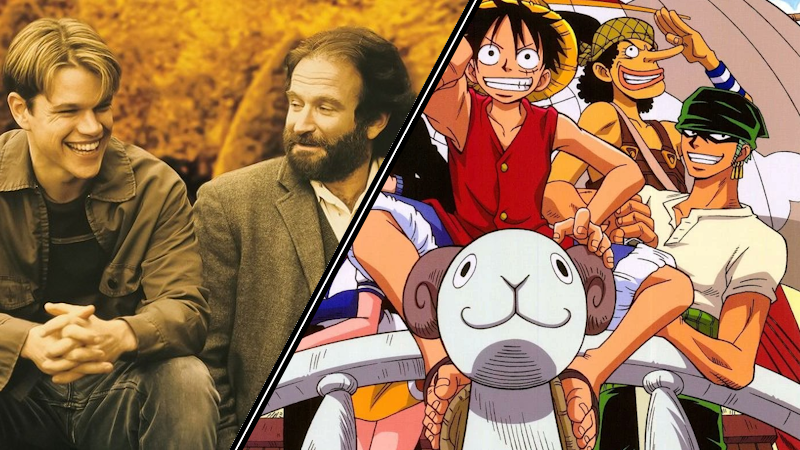
Let's talk about Good Will Hunting, but not just about Good Will Hunting, also about Film: Red and One Piece in general. And I will try to show that OP is actually more sophisticated than GWH.
At first, let's look at two characters: Will from GWH and Robin from OP. And what do we see when we look at their behavior? Will withdraws from others because he fears they'd abandon him or hurt him. Robin withdraws from others because she thinks they'd abandon her or hurt her. But. Their situations are completely structurally opposite. Will is actually safe, he puts others at distance just because of his internal fears. But Robin's situation is actually dangerous, she's not safe. More on that later, but it's not her choice to withdraw, others can really hurt or abandon her. It's only after she finally encounters a special / specific group of people, only after that she's safe, everything before that was real danger.
The same goes for another OP character, Chopper. Before the Straw Hats crew he didn't even have a place in the world: both his herd (of reindeers) and "normal" people - they rejected him. He had only one person he could be with. So, his anxieties are not just well-justified, they're also a proper response to his actual situation.
Will, right from the start of his story, is shown in the situation, which Robin and Chopper encounter only after finding the crew. More than that. Even after they join the Straw Hats, the danger for both Robin and Chopper doesn't go anywhere. The surrounding world is still a threat: The World Government is still hunting Robin, "normal" people still see Chopper as a monster. They find safe and accepting space inside the crew, but the outside danger still exists.
Throughout the whole film, Will is learning to acknowledge safety of his environment. OP also shows this, Robin and Chopper are also learning to feel safe. But that's only a part of their story. And, again, safety in their case is only local, not absolute (as in the case of Will).
One Piece shows 4 stages for these characters:
1. the state of no adequate support;
2. initial receiving of support;
3. the process of living with the support and learning to ease their previous instincts;
4. the continuation of the background threat, and, especially in the case of Robin, a direct confrontation with it.
GWH focuses only on the point 3. It zooms only in the internal work of learning to accept support when it is offered, there are no external negative forces, only memories of them. OP focuses on the external things, and, actually, in a quite more multifaceted way: it shows threats, it shows characters' responses to the threats, it shows safety - and all of that on multiple examples.
Now let's look at the Film: Red. Uta's case is more complicated. She's lonely, she wants some connection, and she tries to at first attract people, and then prevent them from leaving her. But even she is, basically, in a situation of real abandonment and unmet fundamental needs. She (compulsively?) tries to forcefully meet them via control, which causes distress for both her and her fans. She takes it to such extreme that she even tries to die to completely get the fuck away from this world - so that it couldn't have a slightest chance to hurt her again.
But, even if they both show psychological intricacies of characters, the story of Uta and the story of Will - they focus on, essentially, opposite things. One Piece depicts fundamental needs, drives, and emotions, shows them in a more explicit way, Uta even clearly describes her state in her songs. But when it comes to the process of showing how these fundamentals are being met, OP resolves to symbolism and fantasy. The final battle with the "externalized inner demon" of the girl is literally a battle with a demonic creature. The action is not emphasized per se, but the battle there is. Uta's external control of her fans, as well as whole "Uta World" are also clear fantasy elements. They do represent control and withdrawal, but in a symbolic, metaphorical, fantasy form.
And what do we see in Good Will Hunting? GWH shows detailed psychological mechanisms: the realistic process of combating defenses through words and actions, through real relationship dynamics; it shows detaily depicted environments and social circumstances. But GWH doesn't actually show the fundamentals. It shows a detaily depicted specific case of a gifted person working as a janitor at MIT, it doesn't focuses as much on what (universal) emotions and reactions an abandonment causes. It focuses on HOW, not on WHAT.
Film: Red (as well as OP overall) shows fundamental dynamic, which is applicable across different contexts. It, as well as OP overall, operates at quite an abstract level of human need and uses fantastic metaphors in place of realistic detail. GWH, on the other hand, is like a detailed manual about fixing a specific car model. It describes a lot of details: which tools should be used, which bolts should be screwed, in which order. GWH is a detailed case study, while F:R is a conceptual scheme of an issue.
So, what can we say overall about One Piece and Good Will Hunting? Both works are actually quite detailed. But they show very different types of details. One is about realistic mechanics which we can see in the real life, and the other one is a conceptual description of the underlying principles, filled / glued with fantasy and metaphors. OP is much broader in the situations it describes, and GWH is more zoomed in a specific case, even in a specific part of a case. And so we have:
- a "mechanically realistic" Good Will Hunting,
- and a "conceptually metaphoric" One Piece.
So, it's not like one is more sophisticated than the other, but their sophistication lies in completely orthogonal dimensions. Or... not exactly. GWH is just a 2-hours movie while OP overall is 1000+ episodes / chapters series with also a dozen of different related films. So, I suppose, I can safely say, the exploration of the characters is "a bit" more multifaceted in the case of One Piece.