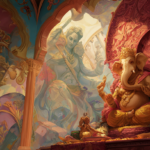
The Cosmic Beheading: Unveiling the Myth of Ganesha’s Elephant Head and Divine Fury 🐘✨
Imagine, if you will, a deity both playful and profoundly wise, whose very form tells a story of creation, devotion, and an astonishing act of cosmic power. It’s a tale that has been whispered across generations, enriching the spiritual tapestry of ancient India.
Our journey takes us to the vibrant, ancient lands of India, a place where legends dance as brightly as the sun, giving birth to a pantheon of gods and goddesses, each with a truly fascinating narrative. This particular story, about the beloved Ganesha, offers, by all accounts, a profound glimpse into divine family dynamics and the sometimes unpredictable nature of creation itself.
Long ago, the powerful goddess Parvati, consort to the great Lord Shiva, felt a deep sense of solitude. She longed for a companion, a child of her very own, to cherish and to guard her privacy. So, she took some ceremonial paste – turmeric and sandal – from her own body, and with her divine will, she sculpted the perfect form of a young boy. Indeed, this creation, infused with her boundless love and immense power, immediately sprang to life, a vision of youthful strength and loyalty.
This new son, whom she named Ganesha, was given a single, solemn command: to guard her chambers, permitting absolutely no one to enter while she bathed. Ganesha, in his profound innocence and unwavering devotion, embraced his mother’s instruction as his ultimate duty. He stood watch, a truly formidable, albeit young, sentinel, utterly committed to her will.
Meanwhile, Lord Shiva, having been away in deep meditation, returned to his abode, eager to rejoin his beloved Parvati. As he approached her chambers, he found his path blocked by an unfamiliar young boy, who politely but firmly refused him entry. Shiva, the Destroyer and supreme Yogi, was quite unaccustomed to being denied access to his own home; this was, in many ways, an unprecedented challenge.
A celestial argument, as you might imagine, quickly escalated. Shiva, growing increasingly frustrated and perhaps a tad impatient, ordered his attendants, the ganas, to remove the boy. Yet, Ganesha, empowered by his mother’s divine energy and his own innate strength, easily repelled every single one of them, proving himself an extraordinarily capable defender. Finally, Shiva himself confronted the boy, his patience, it seems, having completely run out. Unaware that this brave child was his own son, and misunderstanding the depth of Ganesha’s loyalty, Shiva, in a cosmic flash of immense fury, severed the boy’s head with his mighty trident.
The cosmic repercussions were immediate and devastating. Parvati, upon discovering the horrific fate of her son, was consumed by unimaginable grief and a terrifying rage. She threatened, in her sorrow, to utterly destroy creation itself, such was her agony. The other gods, witnessing her fury, quite visibly trembled, understanding the gravity of her pain. Lord Brahma, the creator, intervened, offering a solution to appease the grieving mother: Ganesha could be brought back to life, but with the head of the first living creature found. It was, indeed, a desperate measure.
And so, an elephant’s head was swiftly brought and reverently placed upon the boy’s body, restoring him to life, albeit in a dramatically altered form. Ganesha, now with his iconic elephant head, was not merely resurrected; he was also bestowed with divine blessings. He was proclaimed the leader of the ganas, the ‘Lord of Hosts,’ and, perhaps most importantly, designated the ‘Remover of Obstacles,’ a role he embodies to this very day. In many ways, his story is one of transformation and profound acceptance.
Ganesha’s tale, while perhaps seemingly tragic in its origin, is actually a beautiful narrative of devotion, the power of a mother’s love, and the divine capacity for transformation. He stands as a universal symbol of wisdom, intellect, and new beginnings, a constant reminder that even obstacles can be overcome with a clear mind and a pure heart. His presence, in homes and temples, truly invites us to clear our own paths.
We invite you to delve deeper into these enthralling narratives and more like them! For a seamless reading experience and a constant stream of mythical wonders, join our community on Telegram: https://t.me/Miphiuy
So, the next time you encounter an image of the benevolent elephant-headed god, pause and consider the extraordinary journey that brought him into being. What profound lessons, we might wonder, can Ganesha’s myth offer us in our own lives today?