Unveiling Lamashtu & Pazuzu: Ancient Mesopotamian Demons, Protection, & Their Enduring Mystery 💀✨
Have you ever felt the cold shiver of an unseen presence, a primal fear for the most vulnerable among us? Well, ancient Mesopotamia, a land of sprawling empires and profound wisdom, certainly knew this feeling. And so, they gave form to their deepest anxieties, crafting elaborate stories around beings both monstrous and paradoxically protective. 🌙
Journey with me now to the cradle of civilization, a place where deities walked among mortals and demons lurked in the shadows. It was, after all, a time when the forces of chaos and order were thought to be in constant, often brutal, contention. The very fabric of daily life was, to a certain extent, interwoven with rituals and incantations meant to appease or repel these powerful entities. 📜
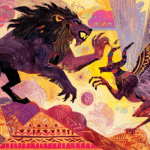
At the heart of many a nightmare stood Lamashtu, a truly terrifying demoness whose very name sent tremors through the stoutest hearts. She was, in some respects, the embodiment of everything that could go wrong in a fragile existence. Imagine, if you will, a creature with the head of a lioness, the body of a donkey, talon-like bird’s feet, and sharp teeth, often depicted suckling a pig and a dog — symbols, no doubt, of her unnatural and voracious appetite. She also, quite often, delivered malady and affliction upon the young ones. Her malevolent gaze was said to snatch away infants from their mothers’ arms, bring about miscarriages, and generally wreak havoc on the health of children and pregnant women. Many ancient texts, you see, describe her as a wanderer, forever seeking out new victims, particularly during the vulnerable hours of night or twilight. 💔
But against such a formidable harbinger of sorrow, humanity, quite naturally, sought a counter. And this is where Pazuzu enters our intriguing tale. He was, to be sure, another demon, yet one with an altogether different, if equally unsettling, reputation. Pazuzu was, in effect, a demon to fight a demon, a lesser evil summoned to combat a greater one. His own visage was, by modern standards, grotesque: a leonine face, the taloned feet of an eagle, two pairs of vast wings, a scorpion’s tail, and a rather prominent serpent-like phallus. Yet, this terrifying appearance was, believe it or not, precisely what made him an effective guardian. 🛡️
The Mesopotamians understood that to repel something truly dreadful, one needed an equally potent, if not more fearsome, symbol. Therefore, Pazuzu wasn’t worshipped in the traditional sense, but rather invoked as an apotropaic figure – a protective charm designed to ward off evil. People would, in fact, hang amulets bearing his likeness in their homes, especially in the rooms where mothers gave birth or where newborns slept. The most compelling image is that of Pazuzu holding his right hand up, almost in a gesture of dismissal, while his left hand points down, effectively casting Lamashtu back into the underworld, or at least away from the innocent. This symbolic struggle was, for many families, a source of immense comfort and hope amidst a world filled with genuine perils. 📿
The story of Lamashtu and Pazuzu is, I think, far more than just an ancient myth about good versus evil. It is, perhaps, a profound exploration of humanity’s enduring need to categorize, understand, and, most importantly, control the inexplicable forces that shape our lives. They also illustrate, in some ways, the human tendency to use whatever tools are at hand, even monstrous ones, to protect what we cherish most. The idea of setting a demon against another demon to achieve a protective outcome is, without a doubt, a fascinating twist on traditional mythological narratives. It teaches us that definitions of «good» and «evil» can sometimes be quite fluid, especially when survival is at stake. 🧐
Even today, long after the Mesopotamian cities have crumbled into dust, the echoes of their beliefs resonate. We still seek symbols of protection, still wrestle with the uncertainties of life, and still tell stories to make sense of the world’s beauty and its inherent dangers. These ancient tales, frankly, remind us of our shared human experience across millennia, connecting us to those who lived under vastly different skies yet faced remarkably similar fears. What protective symbols do you, dear reader, carry with you, even if unconsciously, in your own modern existence? ✨
For more enthralling journeys into the realms of myth, legend, and forgotten lore, do make sure to join our channel on Telegram for convenient reading: https://t.me/Miphiuy. We’d love to have you!