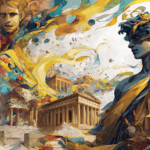
The Unseen Threads: Why Even Legendary Heroes Overlook Fate’s Whispers and Ominous Signs 🔮
Have you ever pondered why the sharpest minds and most courageous souls, those we look up to in tales of old, sometimes seem utterly blind to the most glaring warnings? It’s **indeed** a truly curious phenomenon, isn’t it, how fate’s intricate dance can unfold right before their very eyes, yet they remain oblivious?
In the sun-drenched lands of ancient Greece, a tapestry of myths often reminded humanity of its place beneath the watchful gaze of the gods and the inexorable march of destiny. The pronouncements of seers and oracles were, **as it were**, the very fabric of existence, shaping choices and casting long shadows over even the brightest lives.
Our story unfolds with Oedipus, a young man of impressive intellect and noble bearing, raised as the prince of Corinth. He was, **to be sure**, a person of remarkable promise, seemingly destined for a life of royal ease. Yet, an unsettling prophecy from the Oracle at Delphi — a chilling declaration that he would slay his father and wed his mother — set his world into a tumultuous spin. This grim prediction, **in a very real sense**, spurred him to flee his perceived home, thinking he could outrun the dire pronouncements of the gods.
It was on a dusty road, far from Corinthian marble, that Oedipus encountered a retinue led by an elderly man, and a fierce quarrel over right-of-way erupted, **as such things sometimes do**. In a fit of righteous fury, he slew the travelers, little knowing that among them was Laius, the true king of Thebes and, indeed, his biological father. He was, **frankly**, so wrapped up in the moment’s heated passion that the significance of this bloody encounter completely escaped his notice.
Arriving at the city of Thebes, Oedipus found its people gripped by terror, held captive by the monstrous Sphinx, who posed a deadly riddle to all who dared pass. The city, **one might say**, was suffering a profound spiritual and physical siege. With his keen intellect, Oedipus solved the riddle, breaking the beast’s tyrannical hold and freeing the populace from its suffocating grip. The grateful citizens, hailing him as their saviour, offered him the widowed queen, Jocasta, as his bride and the vacant throne, a proposition he quite understandably accepted. He was, **for all intents and purposes**, a celebrated hero, a new beacon of hope.
Years passed, filled with prosperity and the joyful sounds of children, until a devastating plague descended upon Thebes, turning its vibrant streets into a silent testament to sorrow. The pestilence, **in some respects**, was a stark mirror reflecting a hidden, festering wound within the city’s very soul. Desperate, Oedipus sent to Delphi, seeking divine guidance, and the oracle declared that the plague would lift only when the murderer of King Laius was discovered and punished. He, **quite naturally**, vowed to find the culprit, no matter the personal cost.
The blind prophet Teiresias was summoned, a revered figure whose words carried the weight of ancient wisdom, and he, **perhaps with a heavy heart**, offered veiled yet increasingly direct accusations against Oedipus himself. Oedipus, however, bristled at these dark suggestions, dismissing them as treasonous slander, attributing them, **in fact**, to a conspiracy against him. It was only when an old shepherd, the sole survivor of the crossroads encounter, was brought forth, and Queen Jocasta, with dawning horror, began to piece together the fragmented memories, that the terrible truth started to unravel. Oedipus’s world, **in that moment**, collapsed with the force of a cosmic implosion. He, **too**, could only then see the horrifying mosaic of his own making.
Oedipus’s tale is a powerful, albeit tragic, illustration of how even the most capable among us can be, **well**, remarkably impervious to the very signs and omens that scream their truth from the rooftops. Whether driven by ambition, a deep-seated fear of what the future might hold, or simply a fervent belief in one’s own narrative, we, too, sometimes build walls around ourselves, blocking out inconvenient facts. It’s **almost as if** we subconsciously prefer the comfortable illusion to the stark, often painful, reality that waits to be uncovered.
So, the next time you encounter a puzzling situation or feel a strange intuition, perhaps pause and consider if you, like the legendary Oedipus, are inadvertently turning a blind eye to the profound significance of the world’s subtle whispers. For often, the most crucial revelations are not shouted, but rather gently presented, waiting patiently for a mind ready to truly perceive them. 🌌
Come explore more fascinating tales of fate and revelation! Join us on Telegram for convenient reading: https://t.me/Miphiuy