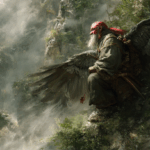
**Whispers from the Peaks: Unveiling the Enigmatic Tengu of Japanese Folklore ⛰️**
Imagine ancient Japanese mountains, shrouded in mist, where the very wind might carry profound secrets. What if those rustling leaves weren’t just the breeze, but the rhythmic beating of powerful, unseen wings? This notion, you see, often sparked deep contemplation among those who ventured into the rugged, untamed wilderness.
In the rich tapestry of Japanese mythology, where every rock and rushing river held a spirit, there existed beings that commanded both fear and profound reverence. It’s quite evident, actually, that these awe-inspiring entities often reflected the complex interplay between man and nature’s raw power.
Among these mythical creatures, none are perhaps as instantly recognizable and deeply intriguing as the Tengu. These compelling mountain dwellers often appear in two primary forms, each possessing a distinctive allure. You might also notice, in fact, that the Karasu Tengu, with their raven-like beaks and feathered wings, are sometimes considered the more ancient and wild manifestation, embodying the spirit of the crow.
Then there are the Daitengu or Yamabushi Tengu, who, as a matter of fact, embody a more human-like visage, typically adorned with a strikingly long, red nose and the distinctive attire of a mountain ascetic. These particular Tengu are frequently depicted as wise, if sometimes arrogant, masters of the mountains, wielding fans that can conjure powerful gales.
These winged beings are, in a very real sense, more than mere fantastical figures; they are formidable entities deeply woven into the spiritual fabric of the land. They are often depicted as master swordsmen, possessing skills that far surpass mortal capabilities. It’s also worth noting, by the way, that their mastery of martial arts is practically legendary, with tales of them teaching renowned warriors like Minamoto no Yoshitsune their most secret techniques.
Yet, their character is not always simply heroic; the Tengu also possess a mischievous, sometimes malevolent streak. They might, perhaps, play tricks on arrogant monks or lead unsuspecting travelers astray with their illusions and powerful storms. One could even suggest, in some instances, that their pranks were a sort of cosmic lesson, teaching humility to the proud or revealing hidden truths to those who dared to question.
Over the centuries, the perception of Tengu underwent a significant metamorphosis. Initially seen as disruptive demons, they eventually transformed into protective, albeit stern, *kami* or deities. This shift, incidentally, often coincided with the rise of the *yamabushi*, or mountain ascetics, who sought spiritual enlightenment in Japan’s wild peaks. It’s fairly clear, in this context, that the Tengu were perhaps viewed as both the spiritual guides and the challenging gatekeepers of these sacred, rugged territories.
Today, the compelling image of the Tengu endures, finding its way into modern anime, manga, and traditional festivals. Their distinctive masks, with the prominent long nose, are a ubiquitous symbol in Japanese culture, hinting at strength, wisdom, and a touch of the uncanny. You’ll definitely find, for instance, that these intriguing figures still captivate imaginations, serving as a powerful reminder of nature’s mysterious forces and the unseen world that parallels our own.
So, the next time you hear the wind howl through the mountains, or see a lone crow take flight 🦅, remember the Tengu. Are they still watching from their lofty perches, guardians of ancient secrets and perhaps, just perhaps, waiting for someone to learn a lesson? It’s a thought, wouldn’t you agree, that really does add a touch of magic to the everyday.
For more captivating tales from the world’s myths and legends, join our community! ✨ Discover new stories and deepen your understanding of ancient wonders right here: https://t.me/Miphiuy