The Sun Goddess’s Retreat: How a Divine Mirror Rekindled the World’s Light
Imagine, if you will, a world suddenly plunged into an unyielding gloom. 🌑 A cosmos where the very source of warmth and brilliance decides to simply vanish, leaving behind only chilling darkness and an unsettling silence. Such, it seems, was the desperate plight that once gripped ancient Japan, woven into the very fabric of its earliest myths.
This ancient tale, indeed, transports us back to a time when gods and goddesses walked the earth and heavenly plains, their actions shaping the very essence of existence. We are, in a sense, about to delve into the profound saga of Amaterasu Omikami, the radiant Sun Goddess, who stands as the revered progenitor of the Imperial House of Japan and a central figure in Shinto cosmology. She is, naturally, the embodiment of light, purity, and life itself.
However, even deities, it turns out, are not immune to family squabbles and the vexations of an unruly sibling. Her brother, Susanoo-no-Mikoto, the impetuous God of Storms and Seas, was a rather wild and destructive spirit, prone to mischievous—and often devastating—antics. One fateful day, his boisterous behavior reached an unbearable crescendo; he, to put it mildly, wreaked havoc upon Amaterasu’s sacred rice fields, defiled her hallowed weaving hall, and even, it is said, tossed a flayed pony into her very sanctuary. This act of profound disrespect and chaos, in some respects, proved to be the ultimate transgression.
Overwhelmed by sorrow and indignation, Amaterasu, the gentle soul, decided she could no longer endure her brother’s disruptive presence. In a moment of quiet despair, she chose to retreat. She sought refuge in the deepest recesses of the Amano-Iwato, the Heavenly Rock Cave, sealing the entrance behind her with a massive stone. Her disappearance was, very naturally, no small matter; with her went the sun, plunging the entire world into an abyssal darkness. Panic, it’s safe to say, soon gripped the hearts of all living beings, as crops withered, demons stirred, and order crumbled.
The vast pantheon of eight million kami, the countless deities of the Japanese heavens, were, in that moment, thrown into utter disarray. They gathered by the banks of the Amenokawa, the Celestial River, to deliberate on how to lure the Sun Goddess from her secluded sanctuary. Many suggestions were made, but it was Omoikane, the God of Wisdom, who devised a rather ingenious and certainly unconventional plan. They would, they decided, create an atmosphere of such profound joy and mystery that Amaterasu herself would be compelled to peek out. They fashioned a sacred mirror, the Yata no Kagami, polished to an exquisite gleam, and strung together magatama jewels. But the true stroke of genius lay in the performance of Ame-no-Uzume, the Goddess of Dawn and Mirth.
Uzume, a playful spirit, then began a dance so spirited and boisterous, so uninhibited and truly comical, that it caused the assembled gods to erupt in riotous laughter. Their joyous peals echoed through the celestial plains, reaching even the solemn depths of Amaterasu’s cave. Curious about the sudden merriment outside, especially when the world should still be shrouded in sorrow, Amaterasu, quite naturally, cautiously pushed the sealing rock just a tiny crack open. «Why are the gods laughing,» she wondered, «when the world should be in darkness?»
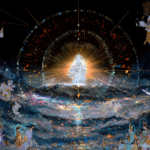
As she peered out, Ame-no-Kojima, the Heavenly Stout Male, quickly held up the Yata no Kagami. Amaterasu, seeing her own radiant reflection, mistook it for another goddess who had appeared, believing perhaps that a new sun had arrived to replace her. As her magnificent curiosity drew her further out, Ame-no-Tajikarao, the God of Strength, seized the opportunity. He then, with a swift and mighty heave, pulled the Sun Goddess completely out of the cave. Immediately, a sacred rope, the shimenawa, was stretched across the entrance to prevent her ever returning to that desolate place. With Amaterasu’s glorious return, light, warmth, and order were restored to a world that had, for a time, nearly forgotten them. It was, in any case, a truly pivotal moment.
This ancient tale resonates through the ages, offering insights into humanity’s enduring fascination with light and shadow, order and chaos. The Yata no Kagami, the divine mirror, became one of the Three Imperial Regalia of Japan, a symbol of wisdom and truth, passed down through emperors. It, moreover, reminds us that sometimes, the greatest light can be found not through grand proclamations, but through moments of shared joy, cleverness, and the simple act of looking at oneself, truly, and seeing one’s own inherent divinity.
What hidden aspects of yourself, we might ask, are waiting to be revealed, perhaps reflected in a mirror you didn’t even know existed? Join us for more captivating journeys through myth and legend! You can find a convenient collection of these stories right here: https://t.me/Miphiuy.