html
Whispers from the Crossroads: Unveiling Hecate, Mistress of the Unseen
Have you ever considered the idea of «transparent fear»? 🤔 It’s an intriguing phrase, isn’t it? One might imagine a fear so pervasive, so utterly clear, that it’s undeniable, yet perhaps just beyond our conscious grasp. While no specific deity in the grand tapestry of world mythologies is *explicitly* known as the «goddess of transparent fear,» the very concept certainly beckons us to explore those ancient figures who presided over the subtle, the unsettling, and the deeply mysterious aspects of dread. And perhaps, the closest we come to such an enigmatic presence is through the formidable, multi-faceted goddess Hecate. 🗝️✨
Hecate is, in some ways, an anomaly in the Greek pantheon. She existed long before the Olympians asserted their dominance, an elder deity who was not only permitted but **also actually** *revered* by Zeus himself. Her domain was vast, encompassing magic, witchcraft, the night, the moon, ghosts, and crossroads—those liminal spaces where worlds often meet and choices must be made. She wasn’t a goddess who simply *caused* fear, but rather one who *embodied* the very essence of the uncanny, the shadow lurking at the edges of our perception.
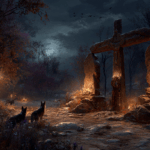
Indeed, her presence was often signaled by the baying of dogs in the dead of night, their howls announcing her approach as she traversed the mortal realm. And, quite naturally, this potent imagery was often associated with a chilling sense of foreboding. She carried torches to illuminate the darkness, but also to guide the spirits of the dead, perhaps even *allowing* their spectral forms to drift into the world of the living. It was, one might say, a fear born not of outright terror, but of an unsettling awareness of forces beyond human comprehension. She truly stood as a sentinel between realms.
The tales of Hecate are not always of grand battles or passionate romances. Instead, they are more subtle, weaving through the fabric of existence itself. We find her most prominently helping Demeter search for her lost daughter, Persephone, guiding the grieving mother through the underworld with her flickering torches. This crucial role perhaps underscores her benevolent side, as well as her profound connection to the deepest cycles of life and death. Yet, this assistance also underscores her familiarity with the gloomy depths. She truly knew the pathways of dread and despair.
Hecate’s iconography often depicts her as a triple goddess, sometimes with three distinct bodies or heads facing in different directions. This powerful imagery symbolizes her omnipresent gaze, her mastery over past, present, and future, and her command over the three paths that meet at the crossroads. For the ancient Greeks, encountering Hecate at such a place was a moment of profound significance, a chance to appeal for guidance or, conversely, to confront the darker energies she controlled. It was a tangible encounter with destiny.
So, while we may not have a «goddess of transparent fear» by name, Hecate embodies a fear that is perhaps even more profound: the fear of the unknown, the subtle dread of the liminal, the chilling realization of the forces that operate just beyond our waking sight. She is the whisper in the dark, the unseen presence that makes the hairs on your neck stand on end, the silent knowledge that not all is as it seems. Her fear is the pervasive awareness that the veil between worlds is thin, and powerful entities walk among us, just out of plain sight.
Does the idea of such an enigmatic figure intrigue you, dear reader? Do you feel a pull towards the shadowed paths where ancient powers still resonate? Then perhaps you’d enjoy delving deeper into the world of myths and legends with us. Come join our community for more captivating stories and explorations of the wondrous and the terrifying tales from across the ages! 👉 https://t.me/Miphiuy 👈 We are always discovering new horizons.