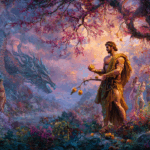
The Immortal Allure: Unraveling the Myth of the Golden Apples of the Hesperides
In the annals of antiquity, certain treasures shimmer with an unparalleled glow, beckoning heroes to undertake quests beyond mortal comprehension. Indeed, tales of legendary artifacts often conceal profound truths and timeless lessons for anyone willing to embark on the journey of discovery.
Ancient Greek mythology, in its boundless tapestry, is certainly replete with such wonders. And yet, few objects capture the imagination quite like the fabled Golden Apples of the Hesperides, a prize of immense power and divine significance.
These weren’t just any ordinary fruits; they were, in truth, an extraordinary wedding gift from Gaia, Mother Earth herself, to Hera, the queen of the gods, upon her union with Zeus. This particular offering was thought to be a symbol of fertility and everlasting youth, and its sanctity demanded unparalleled protection.
Thus, Hera carefully planted these radiant apples in her most sacred garden, situated on the uttermost western edge of the world, shrouded in perpetual twilight. This very secluded haven was diligently watched over by the Hesperides, three lovely nymphs, daughters of the Evening, and, crucially, by Ladon, a terrifying hundred-headed dragon, whose vigilant eyes never quite seemed to close.
Enter Hercules, the demigod known for his immense strength and, it must be said, his often-troubled past. His destiny, in particular, led him to perform twelve arduous labors as penance for a terrible crime, and the eleventh of these seemed utterly impossible: retrieving those very Golden Apples.
The journey itself was a long and peril-fraught expedition, testing the hero’s mettle at every single turn. Indeed, our mighty hero traversed vast lands, encountering fearsome beasts and cunning adversaries, all before he even reached the mythical garden’s general vicinity. He wrestled with the formidable giant Antaeus, whose strength was replenished by touching the earth, and even, it is said, temporarily relieved Atlas, the titan condemned to hold up the celestial sphere, from his colossal burden.
Hercules, facing the insurmountable task of getting past Ladon and the Hesperides, devised a remarkably shrewd strategy. He realized, quite correctly, that direct confrontation with the dragon might prove futile, so he sought the aid of Atlas, who, as a father to the Hesperides, could perhaps retrieve the apples without provoking the mighty serpent.
He proposed a swap: Hercules would shoulder the sky for a short while if Atlas would fetch the apples. The weary titan, it must be admitted, readily agreed, eager for even a fleeting respite from his eternal punishment.
Atlas returned with the glittering apples, but then, perhaps predictably, he announced his intention to carry them to Eurystheus himself, leaving Hercules to bear the sky forever. However, our clever protagonist was not to be outwitted; he calmly agreed, only asking Atlas to take the sky back «just for a moment» so he could adjust his lion-skin cloak for better padding.
Atlas, perhaps a little too trusting, placed the sky back on his shoulders, and in that instant, Hercules seized the apples and made a swift departure, completing his seemingly impossible labor. His quick thinking, one might say, was as vital as his incredible strength on this particular occasion.
But what, you might genuinely wonder, do these lustrous Golden Apples truly symbolize? They are, in many ways, more than mere fruits; they represent immortality, wisdom, and the ultimate divine reward for those who dare to face the most daunting challenges. Their very existence speaks to the human pursuit of the unattainable, the yearning for everlasting knowledge and perfect beauty.
This ancient myth, then, is certainly a profound meditation on strength, cunning, and the intricate dance between divine power and human endeavor. It reminds us, in quite a poignant fashion, that true victory often requires not just brute force, but also intellect and a quick, resourceful mind. The Golden Apples, forever beyond the grasp of ordinary mortals, continue to shine in our collective consciousness, a beacon of what lies at the very limits of possibility. ✨
If you’re captivated by such tales and eager to delve deeper into the rich tapestry of world mythology, you’ll find an abundance of fascinating stories waiting for you. Come join our growing community of myth enthusiasts for more captivating insights and ancient lore: https://t.me/Miphiuy