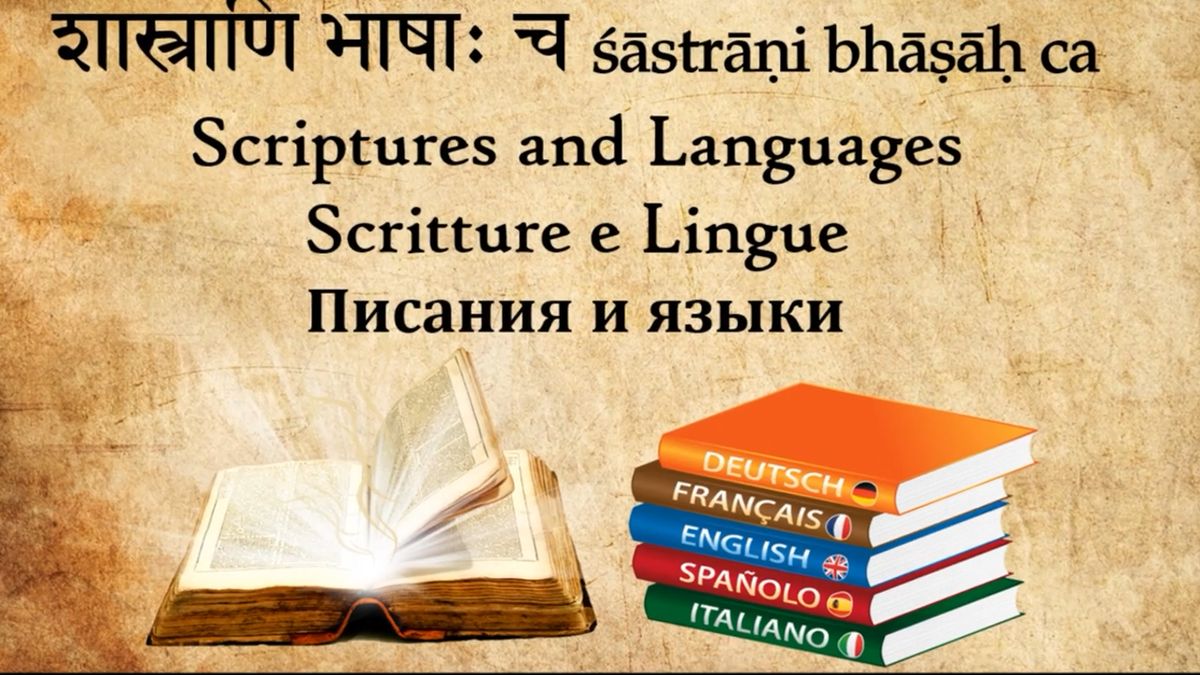
The Sanskrit language is ancient, but it is not truly a dead language, as many might assume.
The Sanskrit language belongs to the Indo-European family of languages; thus, its structure is very similar to that of some Eastern European, Balkan, and Slavic languages.
The Sanskrit alphabet is called Devanagari, which means "the script of the gods," and officially it consists of 59 letters—22 vowels, 33 consonants and 4 extra sounds. The articulatory system of Sanskrit is very rich: it includes soft English-like sounds as well as hard Russian-like sounds.
Sanskrit is often considered a dead language, but in reality, it is not. Hundreds and thousands of scriptures in India are written in Sanskrit, so, essentially, if you are spiritual or religious (and in India, almost everyone is), and if you have an inquisitive mind, you would want to know what is written in them.
True, there are no cities or states in India where people speak Sanskrit as a primary language, but there are villages and families who do speak it. You can find a lot of social media in Sanskrit: television programs, newspapers, journals, animations, movies, and numerous books covering modern topics such as mathematics and science, technology and AI. Nowadays, there are also many websites entirely in Sanskrit that teach grammar, yoga, spirituality, literature, philosophy, and more.
Indian people take great care to preserve their ancient cultures. There are numerous online libraries where you can find such old scriptures that some have not yet been rewritten, translated, or even fully understood! Yet, they are carefully preserved.
There are many schools in India that provide education in the Sanskrit language itself. They teach subjects like science, mathematics, and, of course, literature, philosophy, logic, and religious studies. Many PhDs are involved in studying these scriptures, translating them, preserving them, and spreading this knowledge around the world.
Nowadays, many of the world’s leading universities are interested in studying Sanskrit and Hindu and Buddhist philosophy. There are scientists in fields like physics, psychology, and medicine who are keen to explore what Hindu and Buddhist philosophies say about their subjects.