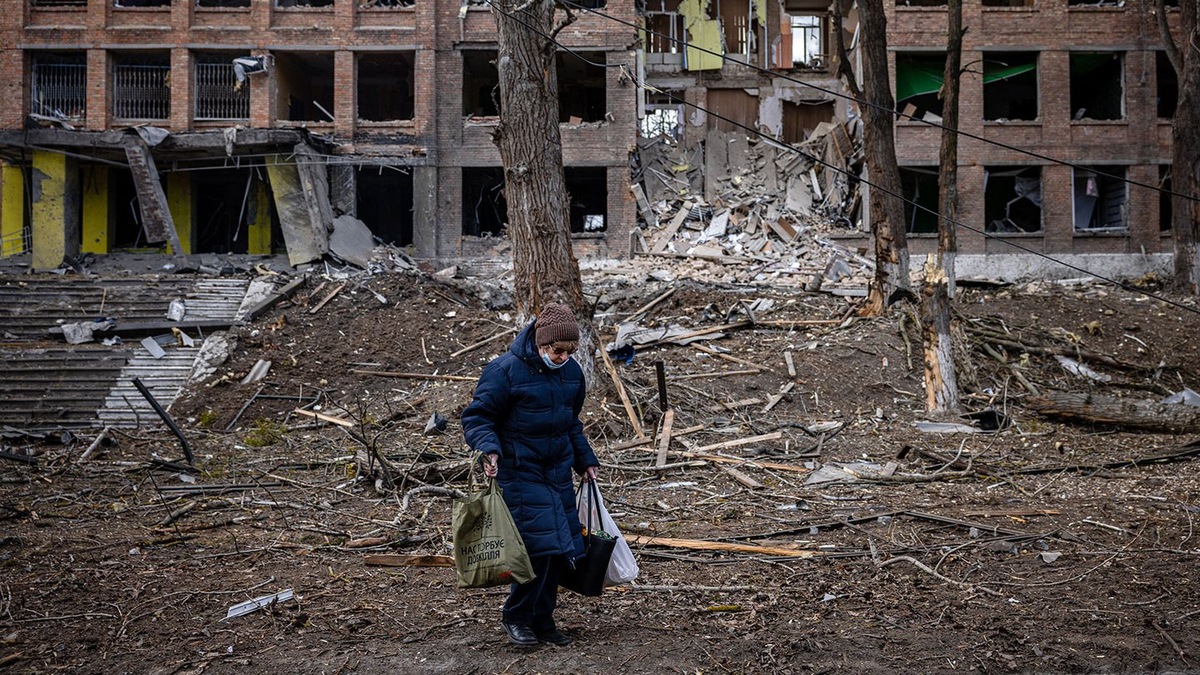
In late July, Donald Trump escalated the threats between Russia and the United States by issuing an ultimatum demanding that Vladimir Putin end the war in Ukraine. This move was accompanied by the dispatch of two US nuclear submarines to areas near Russian territory. In response, former Russian President Dmitry Medvedev announced the start of serial production of the Oreschnik hypersonic missile, capable of carrying nuclear warheads.
The episode marked a shift in rhetoric from the former White House leader, who had recently criticized Moscow's attacks on Ukraine. However, when announcing a meeting in Alaska with Putin to discuss ending the war—without the participation of Ukraine or Europe—Trump argued that Kiev should "swap some land for the benefit of both parties." In practice, the proposal signals a ceasefire with conditions imposed by Moscow, which maintains control over about 20% of Ukrainian territory, including Crimea, annexed in 2014, and large areas of the provinces of Luhansk, Donetsk, Zaporizhia, and Kherson.
For Professor Vinícius Mariano de Carvalho, a specialist in Brazilian and Latin American studies at King's College London, the end of the war is distant. He emphasizes that, as long as there are economic gains from maintaining the conflict, there will be unlikely to be widespread efforts to contain it. "They haven't even achieved a ceasefire that would allow the beginning of peace negotiations, which will be long and complex. Starting a war is simpler than ending it," he states.
Carvalho sees Trump's statements as bravado aimed at an unsuspecting public. "Wars have no deadlines, and ending them is not the result of a declaration or desire by someone who is not directly involved as a belligerent actor," he observes. At the same time, Putin maintains an inflexible stance toward Western interests. The large-scale production of nuclear-capable hypersonic missiles, according to the researcher, sends a clear message: Russia will not surrender and considers nuclear devices part of its deterrence strategy.
The war, which began with the Russian invasion in February 2022, is just another chapter in a long and turbulent relationship between Moscow and Kyiv. Carvalho notes that, even during the Soviet period, episodes like the Holodomor—the Ukrainian famine of 1932-1933, which killed around 10 million people—marked the bond between the countries. After the collapse of the USSR, revolutions like the Orange Revolution (2004-2005) and Euromaidan (2013-2014) deepened the political and ethnic divide. The impeachment of pro-Russian President Viktor Yanukovych in 2014 and Moscow's subsequent annexation of Crimea heightened the dispute.
Today, the conflict is already having global impacts. Carvalho highlights the presence of North Korean troops in Ukraine and the economic pressures resulting from sanctions imposed on countries that trade with Russia, such as India. For him, the question of whether the conflict can be classified as a world war depends solely on how we define that concept.
The defense industry, according to the professor, is a decisive political force. Between 2020 and 2024, the US spent more on five companies in the sector than on diplomacy and international aid, even under a Democratic administration. This scenario highlights the weight of economic interests in foreign policy and the weakening of multilateralism.
Blocs like the BRICS, Carvalho believes, could benefit from Trump's protectionist policies and tariff threats, strengthening internal economic cooperation and reducing dependence on the US. However, the researcher warns of signs of weakening global geopolitical structures, recalling periods preceding the two world wars. The Covid-19 pandemic, the dispute over resources, and the breakdown of trust between countries have exacerbated this situation.
"Let's hope that the lessons of history prevent this from happening," he concludes, making it clear that, on the current international stage, the combination of threats, the arms race, and economic interests keeps the war in Ukraine as an epicenter of tensions that transcend borders and place the world at incalculable risk.
Read: https://www.rand.org/content/dam/rand/pubs/research_briefs/RBA2800/RBA2807-1/RAND_RBA2807-1.pdf