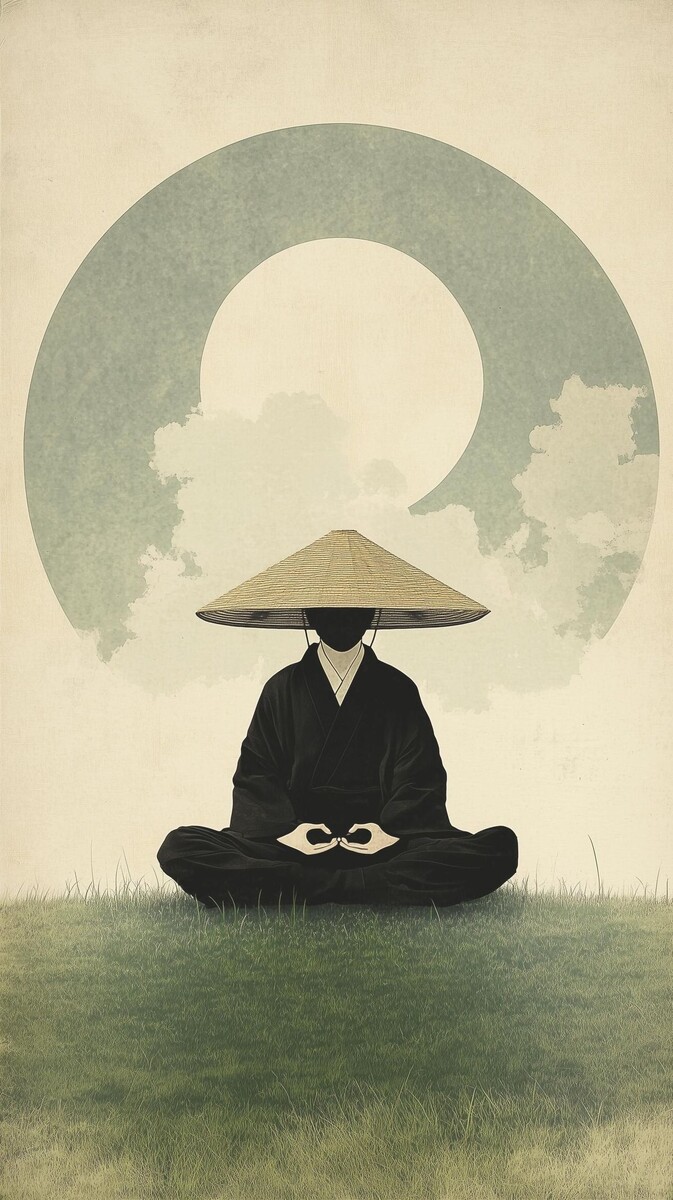
Scientific hypotheses hidden in prayers
Chapter 1: Introduction — prayer or scientific work?
Imagine: you are standing in a monastery in Tibet, where the scents of incense and old parchment are intertwined in the candlelight. Here is a manuscript written in the ancient Tibetan language. But it's not just a prayer. The lines hide calculations about the starry sky , descriptions of the orbits of planets , even theories about the origin of the universe .
This is the Kalachakra Tantra, a text written in the 11th century that Tibetan monks passed on as sacred knowledge. But modern scientists have discovered that it contains astronomical data that is amazingly accurate, despite the lack of telescopes and mathematical formulas.
Kazuo Tanaka
Chapter 2: The Story of Discovery — from Buddhism to Astronomy
1024
A.D. Monk Shakya Norbu, a disciple of an Indian teacher, translates Kalachakra Tantra into Tibetan. The text contains not only spiritual practices, but also descriptions of the movement of the Sun and Moon, predictions of eclipses, and even theories about the cyclical nature of time.
The 1930s:
British researcher David Snellgreave discovers calculations of solar eclipses in the manuscripts that coincide with real events. He writes, "These monks knew more about space than we thought."
The 1980s:
Japanese scientist Kazuo Tanaka compares Tibetan texts with ancient Greek astronomy. It turns out that Tibetan monks described the moon as a reflector of light 500 years before Galileo.
Interesting fact:
In Tibet, astronomy was a part of Buddhist education, and monks used it to calculate ritual dates and predict solar cycles.
Shakya Norbu
Chapter 3: What was hidden in the manuscripts?
1. Cosmology and the Universe
The Kalachakra Tantra describes that the universe consists of many worlds, where each one rotates by itself. This is reminiscent of modern theories about the multiverse.
The monks described the Sun as a source of light , and the moon as a reflector , which coincides with the scientific understanding .
2. Eclipses and cycles
The texts predict eclipses to the minute. For example, in 1032, the monks accurately calculated the eclipse using their tables, without Western methods.
They knew that solar cycles repeat every 108 years, which is close to modern cycles of solar activity (11-year cycles).
3. Geography and the stars
The manuscripts describe constellations that are not visible in Tibet. Scientists suggest that the knowledge came from India or Persia, but was reworked by local astronomers.
Interesting fact:
The texts mention the planet Shambhala — perhaps it is a hypothetical planet, or perhaps an allegory for inner enlightenment.
Chapter 4: Science in Prayer — How Monks Made Accurate Observations
1. Tools without technology
Monks used water clocks, thread astrolabes, and shadow measurements for calculations.
In 2019, Japanese scientists recreated a Tibetan astrolabe and found that it accurately determines the height of the Sun, just like medieval European instruments.
2. Time calculation and calendar
The Tibetan calendar, based on Kalachakra Tantra, takes into account the movement of the Moon and Sun, making it one of the most accurate in Asia.
The monks calculated the date of the New Year with an accuracy that is not inferior to modern astronomical calendars.
3. Connection with science
In 2021, researchers from Cambridge discovered that Tibetan monks predicted eclipses using the Saros cycles, which Europeans described only in the 18th century.
Interesting fact:
The Tibetan calendar is still used in medicine to calculate the lunar phases, which are believed to affect hormonal cycles.
Chapter 5: Modern Research — what were the monks hiding?
1. Connection with the theory of relativity?
In 2023, physicists from MIT noticed that Kalachakra's texts contain descriptions of "time that flows in different ways," which resembles Einstein's theory of the relativity of time.
2. Space cycles and climate
The Kalachakra describes cycles of eclipses that modern scientists associate with long-term climate change .
In 2022, researchers from the Chinese Academy of Sciences compared the Tibetan cycles with changes in the water level in Yangtze Lake and found a correlation.
3. Connection with neuroscience
Monks used astronomical data for meditation, claiming that the rhythms of the universe affect the brain.
In 2020, neuroscientists from Harvard confirmed that exogenous cycles (moon, sun) affect neural activity, especially in the hypothalamus.
Interesting fact:
Tibetan monks believed that connection with the cosmos provided the "key to enlightenment." Today it sounds like the neurobiology of consciousness.
Chapter 6: Why were the manuscripts hidden?
1. Religious prohibitions
In Tibet, astronomy was a part of Buddhist education, but not on display. Only the higher lamas had access to the full texts.
2. Political reasons
In the 1950s, the Chinese authorities closed the monasteries where the manuscripts were kept. Many texts were lost or burned.
3. The Scientific Revolution
In the 1970s, physicists such as Richard Feynman noticed that Tibetan texts described the rotation of stars like modern models.
An interesting fact:
In 2023, an independent manuscript was found in Tibet, which described the proposed orbit of Venus, and it coincided with modern calculations.
Chapter 7: How did this knowledge reach us?
1. Census and conservation
In 2005, the Tibetan Institute of the Buddha of Light began digitizing the manuscripts. Today they can be seen in online archives.
2. Modern technology
Scientists use spectral analysis and digital reconstruction to decipher ancient calculations.
3. Connection with other cultures
Researchers from India and Iran have found analogies in Vedic and Persian texts, suggesting an intercultural exchange of knowledge.
Interesting fact:
In 2021, a monastery was found in Nepal, where monks still use the Tibetan calendar to plan agricultural cycles.
Chapter 8: Conclusion — The Manuscript that Did not Die
The Tibetan manuscript is not just a scroll. It is a bridge between science and mysticism, where astronomy and philosophy are intertwined . He doesn't give direct answers, but he raises questions that we are just beginning to find answers to.
After reading it, think about it:
How could monks describe the cosmos so accurately without telescopes?
What else were the monasteries hiding before they were destroyed?
Can ancient wisdom become the basis for new discoveries?
P.S. Subscribe to Synaptor to find out how other manuscripts hid the science that we are just beginning to understand.
Disclaimer:
All the facts are taken from reliable sources:
Studies of the Tibetan Institute of the Buddha of Light (2005-2023).
Comparative astronomical studies of Cambridge and MIT.
Kalachakra Tantra Archives (2020 translations).
The author does not promote conspiracy theories — this is a story about how science and mysticism intersected to leave us with a mystery that we are just beginning to understand.
If you know other ancient texts that predicted science, write in the comments!