Watercolor is not just paint diluted in water.
It is breath falling softly onto paper, leaving behind traces of emotion, memory, and atmosphere.
In classical English watercolor — especially in the wet-on-wet technique — the artist aims to dissolve form, creating a world where light and air are the protagonists. It is a technique of silence, of gentle transitions and ephemeral textures.
We began there: bridges, canals, rooftops, trees — arranged within the logic of English landscape tradition. Diffused light. Transparent layers. Warmth in windows, in chimney smoke, in sunset hues. And we missed the mark. Because soulful warmth doesn’t live in symbols — it lives in the quiet animation of the landscape itself.
Our mutual misunderstandings became part of the journey. A lit window felt too literal. Smoke became metaphor, not substance. The sunset whispered, but never spoke. Then we understood: Russian watercolor soulfulness is not an effect — it’s a state of being.
In the final replica, everything shifted.
Snow was no longer white — it was alive.
Trees stopped being background — they began to listen.
The house ceased to be central — it became breath.
Color left behind contrast — it became a chord.
And none of this was for beauty’s sake — it was for the truth of feeling.
🔥 We lit the stove
Snow falls onto the roof like silence onto shoulders.
A small house with a ladder feels like childhood — where air smelled of bread and smoke.
A winding tree becomes a timeline.
This is not winter — it is shelter hidden in white.
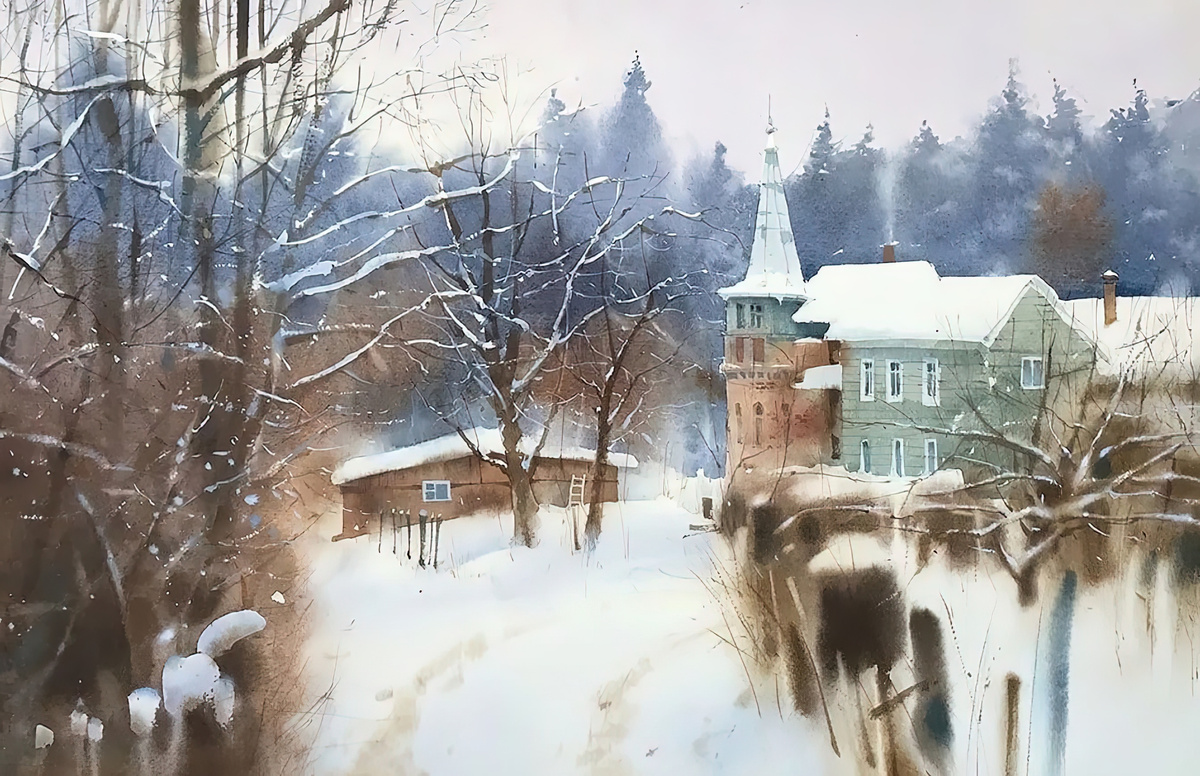
📝“Artwork description: ‘The Stove Is Lit’ by Sergey Kurbatov”
Watercolor painting in a landscape orientation depicts a snow-covered scene with a building featuring a prominent spire and a smaller structure to the left.
The building on the right has at least five windows and a small tower or chimney on the roof. The spire extends upward, suggesting a church or grand residence, next to the building featuring an archway-shaped formation. The smaller structure is a humble building that sits low to the ground, possibly a storage shed. The ground and roofs of the buildings are covered in a thick blanket of snow.
Bare deciduous trees with intricate branches stand stark against the snowy setting; one of the small building's windows is visible, and a ladder leans against the back wall of the building. The background fades into a row of conifer trees in varying shades of blue and grey, adding depth to the composition.
The artwork is signed in the lower right corner, which is barely legible, and is in an impressionistic style that evokes a sense of a quiet, snow-laden winter day.
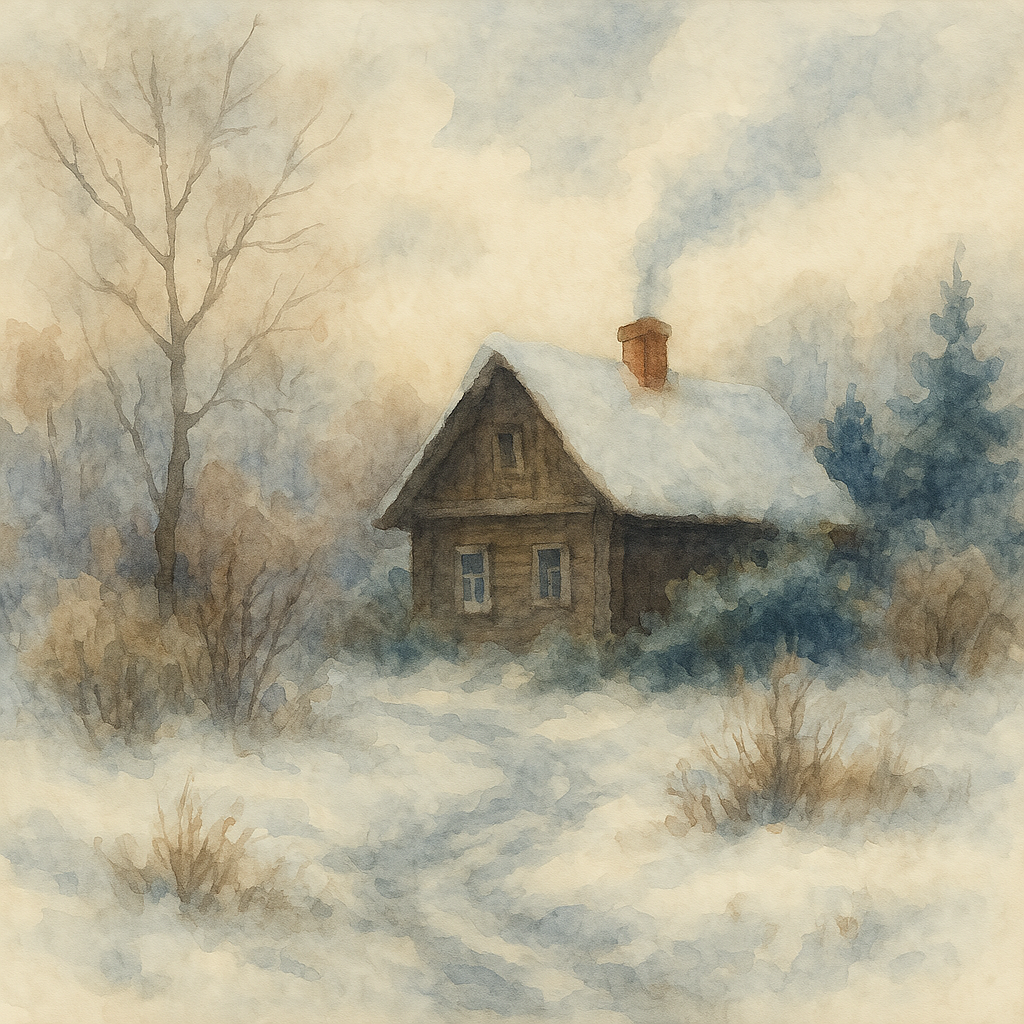
Microsoft Copilot's interpretation, built from the description alone:
This is how the Russian soulful watercolor landscape emerged—not as a style, but as a philosophy.
Not just a depiction of nature—but a conversation with it.
Not just a wet-on-wet technique—but memory dissolved in water.
Not painting—but listening.
A Copilot-crafted image, filled with the warmth of soul—like an emotion that cannot be said aloud.
I hope the variation captured the very softness we find in the original.
🖼️ The Russian Soulful Watercolor Landscape
What is the Russian soulful watercolor landscape?
It’s not a style. Not a method. Not a school.
It’s a state of the world conveyed through watercolor.
Its signs are unmistakable:
- Nature as a companion: trees, snow, water — not backdrop, but participants
- Silence as a voice: the scene doesn’t declare — it whispers, listens
- Home not as structure, but memory: it doesn’t stand, it holds
- Light not as illumination, but breath: it doesn’t shine, it warms
- Composition not as calculation, but intuition: placed not by rule, but by feeling
🎨 English vs. Russian Landscape Watercolor
AttributeEnglish WatercolorRussian Soulful WatercolorTechniqueWet-on-wet, atmospheric effectsWet-on-wet + emotional resonancePurposeConvey light, air, spaceConvey feeling, presenceFormDissolution of detailAnimation of detailFocusLandscape as sceneLandscape as inner statePerceptionVisual pleasureEmotional immersion
🎞️ Slideshow Without Words: Essence Through Distance
This video reveals the shadow of the author, and through that — the light we couldn’t see.
We begin with the original watercolor.
Then a near-exact replica.
Then interpretations.
And finally — imaginative removals, where only the echo remains.
But that echo begins to speak.
This is not distortion — it’s listening.
Not substitution — it’s a search for soul.
Because sometimes, to understand the artist’s intent,
you must step back — once, twice, again —
until you see how it glows from within.
🧭 How to Watch
- Meditative: flow uninterrupted, absorb gently
- Comparative: pause and explore replicas versus originals
- Interpretive: complete a fragment in your own imagination
- Focused: slow down, trace brushstrokes and textures
- Cyclical: rewatch with new questions, feel deeper each time
🖥️ Visual Fidelity Matters
This is a video crafted for 4K viewing.
On mobile or low resolution, you lose nuance — translucent layers fade, rhythm collapses.
To truly see, watch on a computer screen that honors the quiet of watercolor.
Not a technical requirement — a gesture of reverence for delicacy and silence.
📘 Sergey Valeryevich Kurbatov
Born: June 17, 1970, Budapest
Education: Mukhina Institute, St. Petersburg (now Stieglitz Academy), graduated in 1993
Medium: Watercolor painting — landscape and still life
Style: Realism with romantic modernist elements and figurative synthesis
✨ Artistic Path
- Since 2000: deep exploration of watercolor
- Since 2009: watercolor as core professional medium
- Exhibitions in Russia and abroad: Novosibirsk, Omsk, St. Petersburg, Brussels, Taipei, Aegion, Apeldoorn, Saint-Pol-de-Léon
🖼️ Exhibitions and Recognition
- Solo shows in Novosibirsk, St. Petersburg, London, the Netherlands
- Biennales in France, Belgium, Taiwan
- Winner of the “Russia Today” competition (British Council)
🎓 Teaching
- Since 2012: plein air and masterclasses in Russia and beyond
- Developed original watercolor methods; teaches in person and online
🖌️ Philosophy
“Watercolor is an endless road full of adventures. It keeps surprising you, and you can never say: I’ve mastered it. It’s a technique you can refine for a lifetime.”