Title: A Structural Model of Stellar Collapse: Phase Transitions and the Role of Superheavy Element Formation
Abstract: This paper proposes a structural and information-based model for the evolution and collapse of massive stars, moving beyond conventional paradigms focused solely on nuclear fusion exhaustion. We explore a phased synthesis framework, where the interior of a star acts as a stratified structure of nuclear 'constructor' materials. We suggest that stellar collapse is not merely a gravitational event but a structural and energetic phase transition triggered by the formation of a final, superheavy element unique to each star. This model provides a unified view of macroscopic stellar dynamics and microscopic matter restructuring.
1. Introduction Traditional astrophysics views stellar collapse primarily as a result of iron-core formation and the subsequent halting of exothermic fusion processes. This paper introduces an alternative model based on structural evolution, energy resonance, and phase transitions within stratified stellar matter.
2. The Concept of the Nuclear Constructor We define the 'constructor' as a reservoir of sub-nuclear components (proto-nucleons or quark-gluon-like states) that underlie atomic nuclei. In the high-temperature and pressure conditions of stellar interiors, matter is not organized as stable nuclei but as an energetic soup of these components. Fusion occurs at structural phase boundaries where conditions allow rapid reassembly into specific atomic configurations.
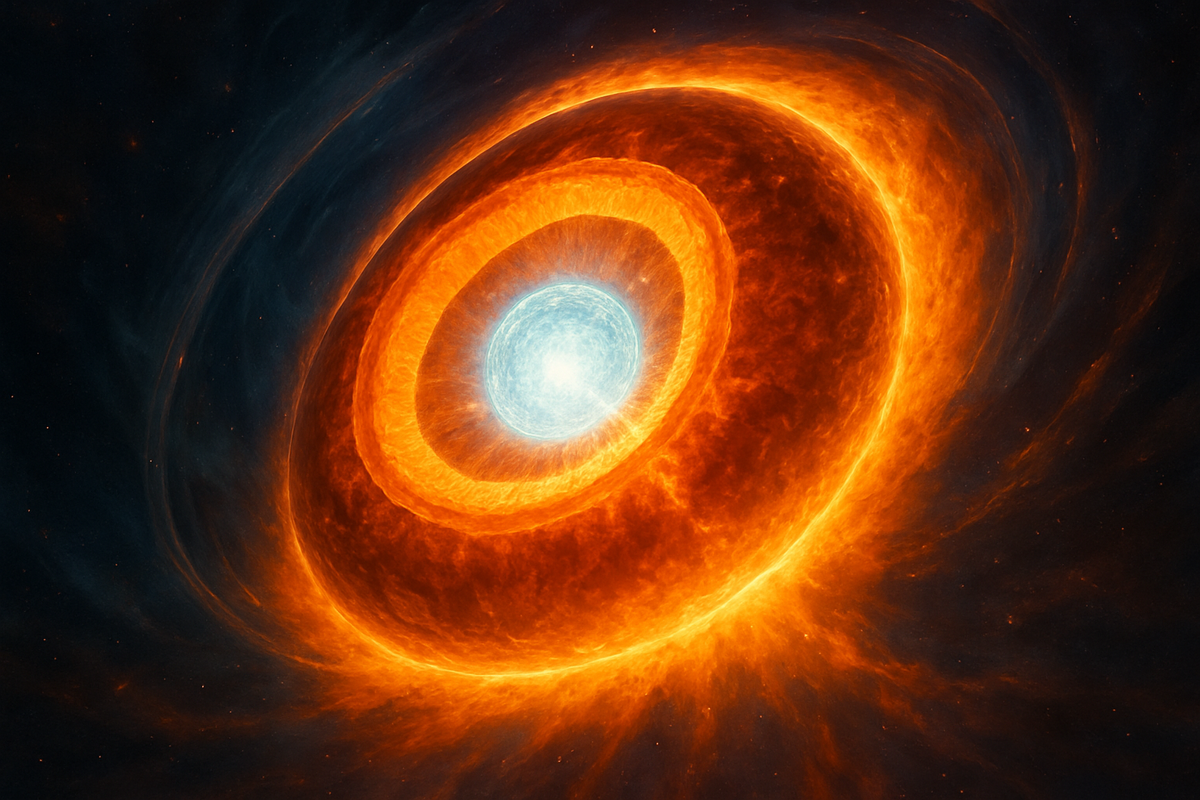
3. Stratified Structure of Stellar Interiors As synthesis progresses, heavier elements form in shells closer to the stellar core, depleting the available constructor material. This stratification results in a layered star with varying structural stability, where each layer represents a different phase of material reconstitution.
4. Synthesis Limitation and Phase Transition Collapse We argue that collapse occurs not when iron merely accumulates, but when the resonance conditions necessary for maintaining synthesis collapse. The sudden formation of a superheavy element acts as a local energy sink, inducing a rapid drop in internal temperature and triggering a system-wide phase transition. This phase transition is the true mechanism of collapse, not simple gravitational imbalance.
5. Unique Collapse Outcomes Based on Final Structure We propose that each star follows a unique pathway to collapse, defined by the final composition of its internal structure. The final superheavy element synthesized varies based on mass, energy history, and compositional layering. This explains the diversity in observed collapse phenomena, from white dwarfs to black holes.
6. Implications for Black Hole and Supernova Formation The model implies that black holes may result from the synthesis of elements beyond the known periodic table, triggering ultra-high density states and extreme spatial compression. Supernovae correspond to transitions that fail to stabilize into these final states, releasing residual energy.
7. Macro-Micro Unification and the Role of Space We also discuss a conceptual framework where space acts as a dynamic information medium that responds structurally to matter. In this view, gravity and inertia arise from the reorganization of informational structures across spatial layers, giving rise to macro-scale gravitational effects from microstructural dynamics.
8. Conclusion This structural model of stellar collapse offers a fresh lens through which to understand the lifecycle of stars. It emphasizes the role of internal structure, phase transitions, and energy-information interactions over traditional fusion-centric narratives.
Keywords: stellar collapse, phase transition, superheavy elements, nuclear constructor, black holes, information structure, stratified fusion, resonance collapse