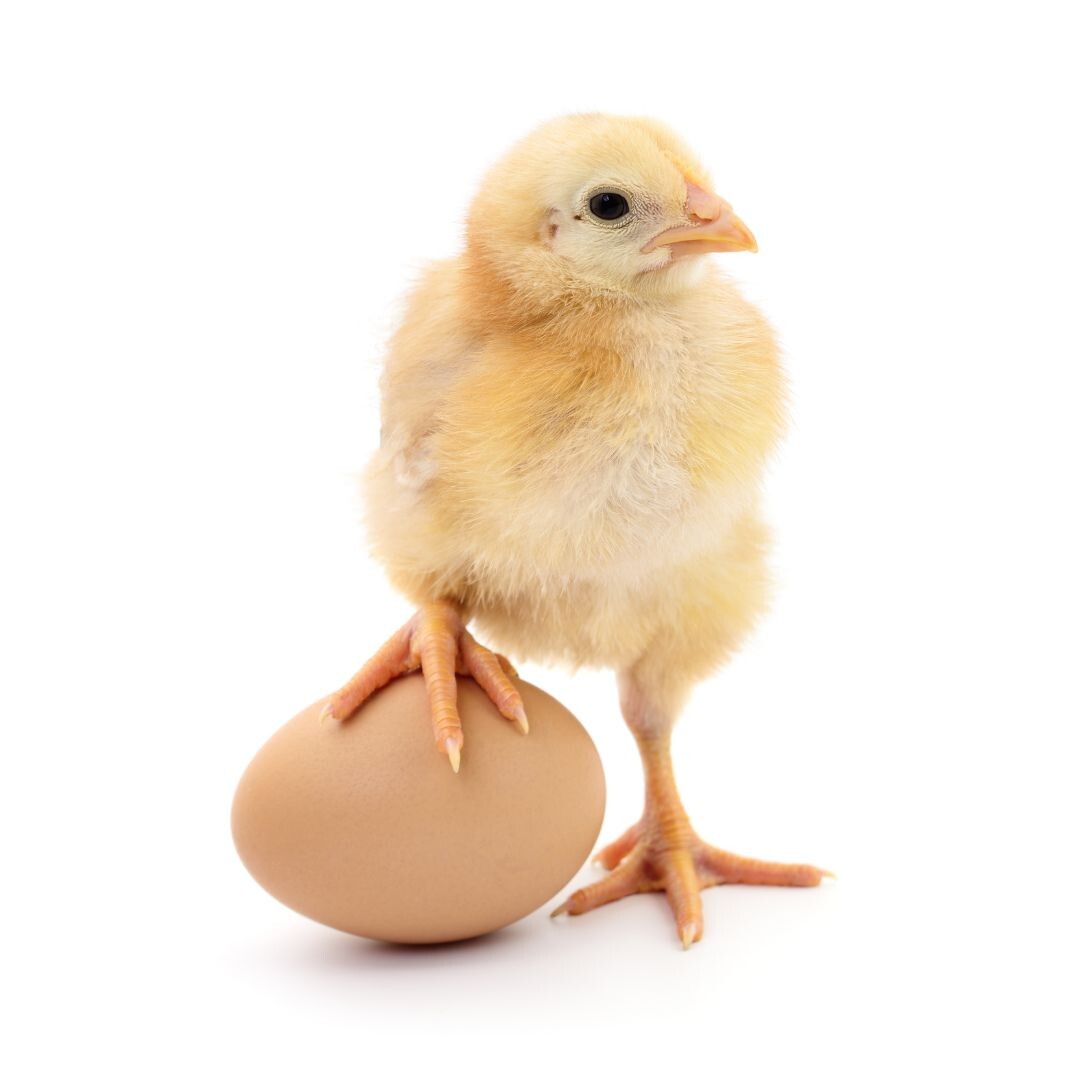
The question of the chicken-and-egg dilemma has been debated for millennia. Biologically, evolution provides a clear answer: eggs (of some kind) existed long before chickens did. Philosophically, however, it remains a classic paradox about causality, origins, and infinite regress. Below we examine both viewpoints.
Biological Perspective
Modern evolutionary biology shows that eggs long predate chickens. Fossil and genetic evidence indicate that hard-shelled eggs first appeared over 300 million years ago (the first amniote eggs), whereas chickens are a very recent species (domestic chickens arose from wild junglefowl only about 8–10 thousand years ago. Indeed, all birds (and many reptiles and dinosaurs) were laying eggs for tens of millions of years before the first chicken ever existed. For example, fossil dinosaur eggs with hard shells evolved roughly 160–200 million years ago, demonstrating that “the egg wins by a country mile” over the chicken in terms of age. In short, if “the egg” is defined broadly as any hard-shelled egg, it clearly came first.
- Egg timeline vs. chicken timeline: The earliest land eggs (amniote eggs) date to ~312 million years ago, while the first true chickens appeared only within the last ~10,000 years. All chicken ancestors – from dinosaurs to early birds – were laying eggs long before domestic chickens evolved.
- Proto-chicken and mutation: In evolutionary terms, there was no sudden first chicken. Instead, a “nearly-chicken” (sometimes called a proto-chicken) laid an egg that contained the critical genetic mutations defining the first modern chicken. In other words, when a male and female almost-chicken mated, their egg’s DNA changed just enough (by mutation in the sperm, egg cell, or zygote) that the hatched bird met the criteria of a true chicken. By this account, the egg containing the first chicken came first.
- Species boundary is fuzzy: Evolution proceeds gradually, so there is no sharp line between “pre-chicken” and “chicken”. The exact first chicken depends on human definitions (which genetic changes count), but in any case a chicken arose from an egg of a bird that wasn’t quite a chicken. One science writer summarizes: “Go back over 10,000 years [to the junglefowl ancestor]… whatever attributes qualified this individual to be a chicken, they were set at the moment the egg and sperm met. I would argue this means the egg came first”.
- Egg proteins nuance (OC-17): Some have noted that a protein (ovocleidin-17) needed for strong chicken eggshells is produced by the hen. If one insisted on the first “modern” chicken egg (with that protein), then the chicken producing the protein would precede that particular egg. However, similar shell-forming proteins exist in many birds (turkeys, finches, etc.), showing that reinforced eggshells long predate the first chickens. This detail does not overturn the basic evolutionary answer.
In summary, from an evolutionary biology standpoint the egg came first. Birds and reptiles were laying eggs for hundreds of millions of years before chickens ever evolved, and the first true chicken hatched from an egg laid by a bird that was almost-but-not-quite a chicken.
Philosophical Perspective
Ancient philosophers treated the question as a profound paradox of origins and causality. Aristotle (4th century BCE) recognized the circularity: he argued that species are eternal or have no clear origin, so there is no “first” chicken or egg. In his view, every chicken comes from an egg and every egg from a chicken, extending infinitely backward in time with no definitive beginning. Plutarch (1st century CE) also discussed the dilemma in his essay Symposiacs. He famously described it as “that perplexed question… Which was first: the bird or the egg?” and pointed out it touches on the very question of whether the universe had a beginning. He playfully gave both answers: one guest argued the egg must come first “for it begets and contains everything,” while another insisted the chicken came first because “in the beginning creation was… perfect [and] entire”.
- Biblical/Creationist view: In medieval and early-modern Christian thought, the Genesis creation story was often taken literally. This meant the first chickens were created fully formed by God (and only later laid eggs). For example, 17th-century thinkers like Ulisse Aldrovandi and later creationists argued the hen did not come from an egg but was made “from nothing,” basing this on scripture.
- Enlightenment thinkers: By the 18th century, skeptics began to question literal creation accounts. Denis Diderot (1769) ridiculed the assumption that animals were always as they are now, writing that the dilemma embarrasses us only if we assume creatures have fixed forms. His point was that if species change over time, then we cannot pretend chickens and eggs were eternally the same.
- Charles Darwin (19th C): Darwin’s theory of evolution reframed the puzzle. He emphasized gradual change and inheritance, leading to the view that chickens had bird ancestors. As one summary notes, “the egg must have come first, but it can’t be said when… [it] is a struggle to distinguish between one species and another given that there’s a lot of overlap as species slowly adapt”. In other words, Darwinian evolution implies the egg predates the chicken, though the transition was seamless.
- Modern philosophical analysis: Today philosophers often regard the chicken-and-egg problem as an example of circular causality. It has been called an “archetypal circular causality dilemma” and a self-referential paradox or “strange loop” (in Hofstadter’s sense) that challenges linear views of cause and effect. Different disciplinary perspectives can “resolve” the paradox in different ways. A recent multidisciplinary study concludes that there is no single ultimate answer; instead the question “illuminates the foundational assumptions” of each approach. In other words, the value of the paradox may lie in how it forces us to think about origins, causation, and the limits of reasoning. As one observer puts it, “there are satisfactory answers but no right answers, and even the satisfactory answers… ultimately just lead you to more questions”.
In philosophical terms, the “chicken or egg” puzzle remains more of a thought experiment than a genuine mystery. It illustrates the difficulty of assigning a first cause in a cyclic chain. For Aristotle and others it underscored infinite regress; for modern thinkers it exemplifies circular logic or bootstrapping issues in causation. Ultimately, the consensus view is that evolution gives the egg a clear precedence, but philosophically the question endures as a lesson in causality and definition.
In summary, science answers the question directly: eggs (as a biological reproductive strategy) existed long before chickens. The first true chicken hatched from an egg laid by a proto-chicken, so in that sense the egg came first. Philosophy, however, uses the dilemma as an illustration of deeper issues. From Aristotle to the present, the puzzle has highlighted questions about first causes, circular causality, and the limits of explanations. Whether one emphasizes eggs or hens, the enduring lesson is that some problems are as much about how we frame a question as about finding a factual answer.
The article was written for the C1 English lesson for Small Talk format in online school GovorEnglish (Говори.online). Join he class for a proper discussion!