В середине 70-х годов под патронажем «Национального Института По Изучению Злоупотребления Наркотиками» - «National Institute on Drug Abuse» была выпущена серия брошюрок из 10 выпусков, затрагивающих те или иные аспекты употребления наркотиков.
NIDA.NIH.GOV | National Institute on Drug Abuse (NIDA)
National Institute on Drug Abuse - Wikipedia
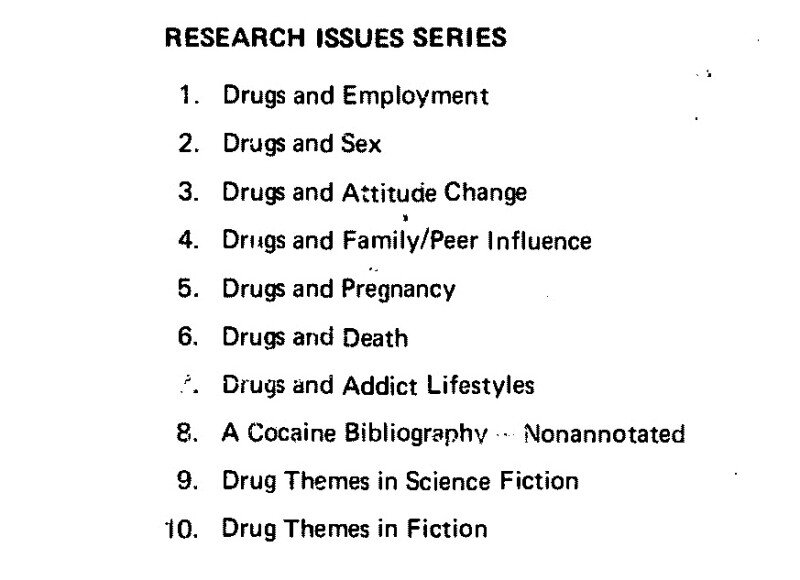
«Research Issues Series» was prepared for the National Institute on Drug Abuse by Documentation Associates, Box 25892, Los Angeles, California,
9 и 10 выпуски представляют собой АННОТИРОВАННУЮ библиографию известных и малоизвестных литературных произведений (до 1974 года) в которых затрагивались различные нюансы использования наркотических веществ.
Several of the volumes in the series represent a departure from the above description. These also represent challenging issues, and issues of current interest; they are, however, virtually unexplored areas which have received little attention from the research world. For example, the subjects of drugs and the visual arts, science fiction, and fiction- aspects of contemporary life which impact on all of us --are explored here by writers who have been deeply involved in those fields. Their content is perhaps provocative, and certainly stimulating.
VOLUME 9 "Drug Themes in Science Fiction" (Robert Silverberg)
Автор — знаменитый писатель-фантаст Роберт Силверберг
Роберт Силверберг/Robert Silverberg - Собрание сочинений [1967-2016, FB2, RUS]
Содержание 9-го тома поделено на три главы временных / «трендовых» промежутков.
Primitive Period circa 1900-1935. Science fiction was then, at least in the specialist magazines, a crude and artless form, and the stories tend to be skeletal and formula -ridden.
Predictive Period circa 1935-1965. As the genre matured, authors began to seek greater complexity of style and structure in their fiction, and to achieve greater thematic perception.
Contemporary Period circa 1965 to date. With drug use now a matter for the news media as well as for solitary experimenters and literateurs, experience with mind-altering phenomena grows; many authors now sample marijuana and LSD and use their experiences as a basis for projections of trends.
Плюс обозначены категории, затрагивающие специфические нюансы использования наркотических веществ в контексте сюжетов фантастических романов, повестей и рассказов:
In preparing this study of drug themes in science fiction, I have employed the following categorical designations:
Drugs as Euphorics: Drugs that give pleasure in simple unstructured ways, through release from depression and tension, much as alcohol does in our society (though alcohol is not strictly speaking a euphoric, of course).
Drugs as Mind Expanders : Drugs that provide "psychedelic" visions of other times or places or that offer a sensation of oneness with the cosmos as a whole; analogous to LSD in our society.
Drugs as Panaceas : Drugs which, through tranquilizing or neutralizing effects, calm the mind without necessarily inducing euphoria.
Drugs as Mind Controllers : Drugs that enable one entity to limit or direct the activities or desires of another; analogous to brain -washing, and generally associated with totalitarian activities.
Drugs as Intelligence -Enhancers : Drugs which have the specific property of extending or amplifying the rational processes of the mind.
Drugs as Sensation-Enhancers : Drugs whose effects are achieved through amplified or extended bodily sensation-response, perhaps analogous to marijuana in our society.
Drugs as Reality-Testers : Drugs which permit the user to penetrate the "real" realities beyond the surface manifestations of daily life.
Drugs as Mind -Injurers : Drugs used as weapons in biochemical warfare, aimed at the mind.
Drugs as Means of Communication : Drugs that have the specific property of opening hitherto unknown channels of communication between minds.
Соответственно, каждый мини-обзор произведения сопровождается ремаркой принадлежности к упомянутым категориям:
VOLUME 10 "Drug Themes in Fiction" (Digby Diehl)
Автор Дигби Диил — также известная личность в «писательском» мире.
This essay is a survey of selected literary works of fiction with drug-related thematic content. The themes represented in the survey reflect popular American attitudes toward drugs from pre-World War II through the 1970's.The roots of these themes, beginning with 17th century French cultural attitudes are explained.The subject has been treated broadly; there is no attempt to analyze literary characters who used drugs (for example, Sherlock Holmes),nor to consider the effect of drugs on the creativity of any authors who may have used drugs.
Структура - как и 9 том разделена на главы-временные периоды
Within English and American traditional fiction from 1945 to the present we may roughly distinguish three chronological and thematic categories:
0. Post Victorian. The nineteenth century Romantics in France particularly Baudelaire and his literary circle-provided the first concentration of drug-relatedliterature which was not only a curiosity of Eastern exoticism, butan aesthetic mode.
1.Post World War II through the late 1950's.The prevalentdrug is heroin; the central figure is the junkie; and the literary emphasis is upon a life style of existential alienation--a Romantic submergence in the drug subculture.
2.The Rock 'n Roll Flower Children of the 1960's.The prevalent drugs are marijuana and LSD; the central figure is the youthfulstudent hippie; and the literary emphasis is upon experiential politicsand social philosophy — the emergence of a "counter-culture" which challenges the dominant culture.
3.The Disillusionment of the 1970's.The prevalent drug (if you will) is imagination; the central figure is the visionary; and the literary emphasis is upon the drug hallucination--the imaginative projection as a mode of alternative reality.
Рассказ начинается со вступительной статьи, дающей исторический обзор развития «наркотической» темы в литературных произведениях. А затем идет набор мини-обзоров.
Подобные издания просто кладезь новых знаний, в них можно обязательно открыть для себя что-нибудь неожиданное и выделить на первую очередь прочтения те произведения, которые могли бы быть интересны, исходя из нюансов использования «веществ» в сюжетах.
Брошюры находятся в полностью открытом доступе на Архив-орге или здесь
БОНУС — ПСИХОДЕЛИКА В ФАНТАСТИКЕ
Отличным дополнением здесь может быть выпуск Ютюб-Влога Стивена Эндрюса (Outlaw Bookseller) — это один из самых глубоких и серьезно ориентированных ютюб-каналов, посвященных фантастике и фэнтези.
Выпуск Psychedelic Science Fiction посвящен самым ярким «психоделическим» произведениям фантастики (и фикшн также упоминаются).
Сначала Стивен дает краткий обзор всей «психоделической» темы с упоминанием известных книг Хаксли/Кастанеда/Уильям Берроуз / Филип Дик. А затем углубляется в дебри жанра, скрытые большинству. И здесь можно открыть для себя что-либо интересное и новое.
Karin Boye, David McDuff - Kallocain (2019, Penguin Classics)
Attanasio, A A - Radix (1981)
MOSF 142 Cordwainer Smith - Norstrilia
[Empire of the Sun 2 ] Ballard, James G - The Kindness of Women
Norman Spinrad — Bug Jack Barron (1969)
Farmer, Philip Jose - Night of Light
Charles Platt - The Gas (1980)
Carter, Angela - The Infernal Desire Machines of Doctor Hoffman (1972, Penguin Books)
Анжела Картер - Адские машины желания доктора Хоффмана (1972, 2000)
Mick Farren - 1974 The Tale Of Willy's Rats
Brian W. Aldiss - 1969 Barefoot in the Head
Christopher Priest - 1970 Indoctrinaire
Плюс:
Michael Moorcock - The Cornelius Chronicles (The Final Programme, A Cure for Cancer, The English Assassin, The Condition of Muzak) (1988, Fontana)
Antczak, Stephen L - God Drug (2011)
Lucius Shepard - Green Eyes (1984)
и другие...
Конечно упоминается и повесть Станислава Лема — «Футурологический Конгресс / The Futurological Congress from the Memoirs of Ijon Tichy»
(книга) Станислав Лем "Футурологический Конгресс..."
Стивен Эндрюс / Stephen E. Andrews — автор трех сборников-гидов-энциклопедий в мир фантастики/фэнтези/фикшн
https://www.youtube.com/@outlawbookselleroriginal