This article examines various theoretical arguments and empirical findings in the literature concerning the impact of democracy on economic growth. Despite an increasing number of studies suggesting significant economic benefits associated with democracy, there remains no consensus on whether democracy enhances economic growth. Some policymakers and academics argue that authoritarian regimes are necessary for promoting economic development, especially in poorer countries, a perspective often referred to as the 'Lee Thesis' (Sen 1999, 15). This viewpoint is supported by examples of fast-growing dictatorships like the East Asian tiger states, Pinochet’s Chile, and present-day China.
On the other hand, some argue for an 'agnostic position,' suggesting there is likely no consistent effect of democracy on economic growth, or that such an effect remains uncertain. This stance is backed by various statistical studies, with Przeworski et al. (2000) being a notable contribution, and is endorsed by many leading political scientists. Despite this, recent studies have found evidence that democracy does indeed foster economic growth, although results vary across studies.
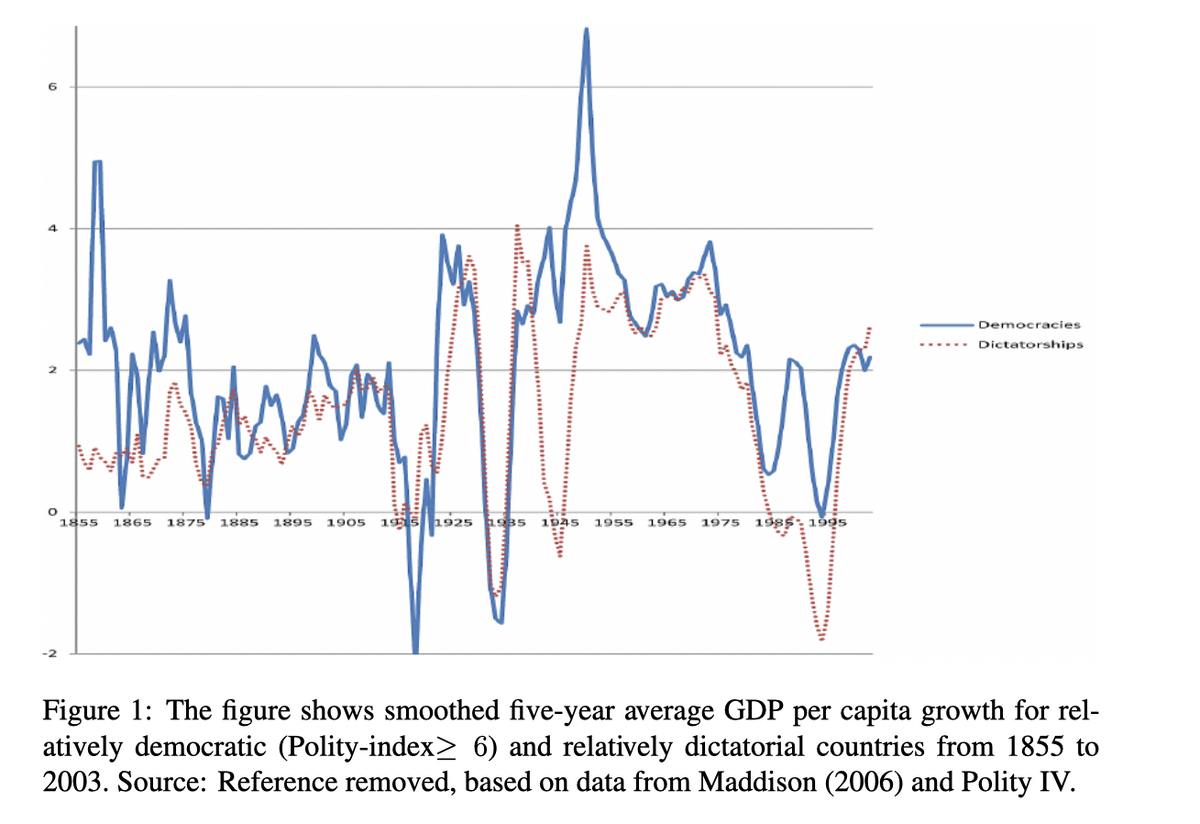
One consistent finding, however, is that democracy shows a positive correlation with economic growth when considering data from all regions worldwide. However, this correlation does not necessarily imply a causal relationship; other factors such as historical patterns, political-institutional variables, or geographical factors may also influence both regime type and economic growth systematically. Additionally, economic growth itself may affect the likelihood of democratization and democratic stability. Figure 1 illustrates smoothed five-year average annual GDP per capita growth rates from 1855 to 2003, based on data from Maddison (2006), categorized by relatively democratic and dictatorial countries using the Polity Index (PI) (Marshall and Jaggers 2002). The PI assesses countries based on the competitiveness and openness of executive recruitment, concentration of power in the chief executive, and regulation of political participation.
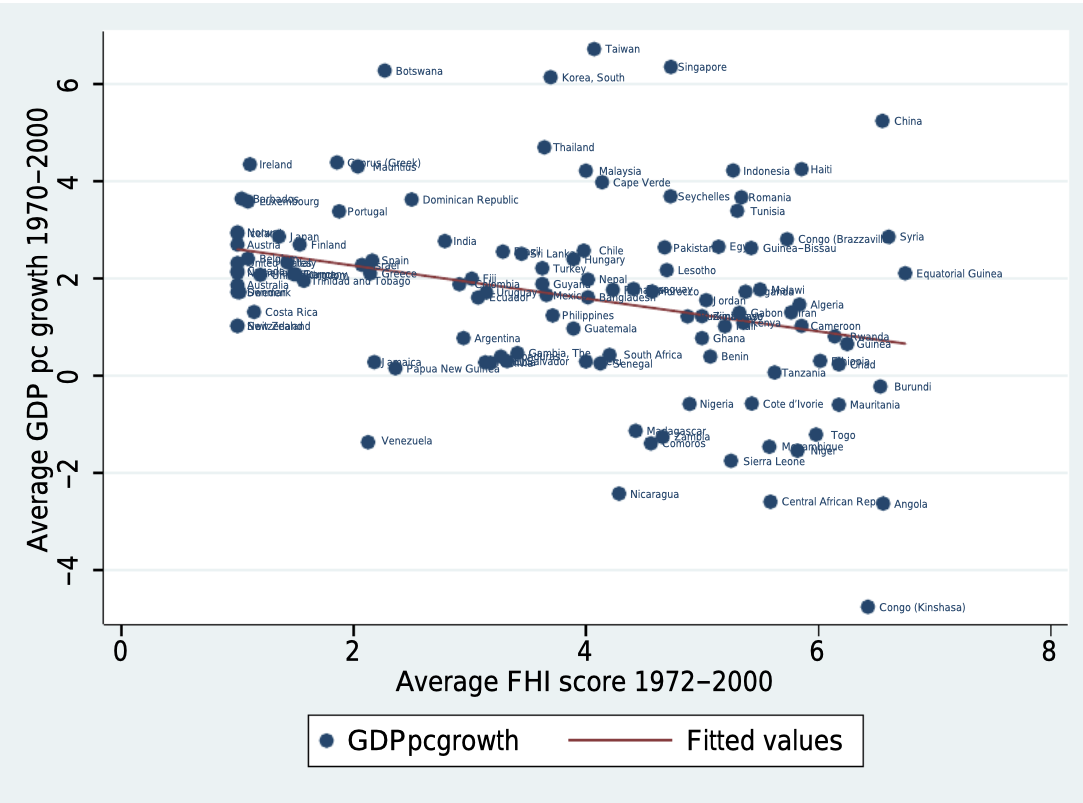
There exists significant and consistent variation in growth rates among countries with similar levels of democracy. Upon closer examination of recent trends, there are instances of both democracies and dictatorships exhibiting strong and weak economic growth performances. Figure 2 depicts a scatter plot comparing average annual GDP per capita growth from 1970 to 2000 with the average score on the Freedom House Index (FHI) from 1972 to 2000. The FHI, an alternative measure of democracy widely used in literature exploring democracy's impact on growth, incorporates civil liberties, offering a more comprehensive assessment of democracy compared to the Polity Index (PI).
Over this 30-year period, Figure 2 illustrates a negative correlation between the FHI and economic growth, suggesting a positive correlation between democracy and growth. Additionally, it reveals significant variability in growth rates among regimes with similar average FHI scores, particularly noticeable in countries governed by highly dictatorial regimes. It's widely acknowledged that dictatorships exhibit much greater variation in economic growth performances compared to democracies, and numerous studies have delved into the potential sources of this variation.
For instance, researchers have explored the economic policies and outcomes of different non-democratic countries, such as Singapore and Zaire, highlighting how diverse economic policy choices can lead to disparate economic outcomes even among non-democratic nations.