«The sound of colours is so definite that it would be hard to find anyone who would express bright yellow with base notes, or dark lake with the treble»
Wassily Kandinsky
«и цвет – / не плод небытия…»
Иосиф Бродский
«Mere colour, unspoiled by meaning, and unallied with definite form, can speak to the soul in a thousand different ways»
Oscar Wilde
Let us look carefully on the picture of Wassily Kandinsky «Dominant Curve», which was painted during artist’s creative upsurge. What do wee see? A combination of lines, shapes, volumes, biomorphic figures. The details of the picture seem to be of biological origin; pink and white roundness, similar to crustacean claws, two multi-coloured formations resembling a human profile; black and dark green elements, in appearance - the stems and leaves of plants. However, the main character of the picture is still colour.
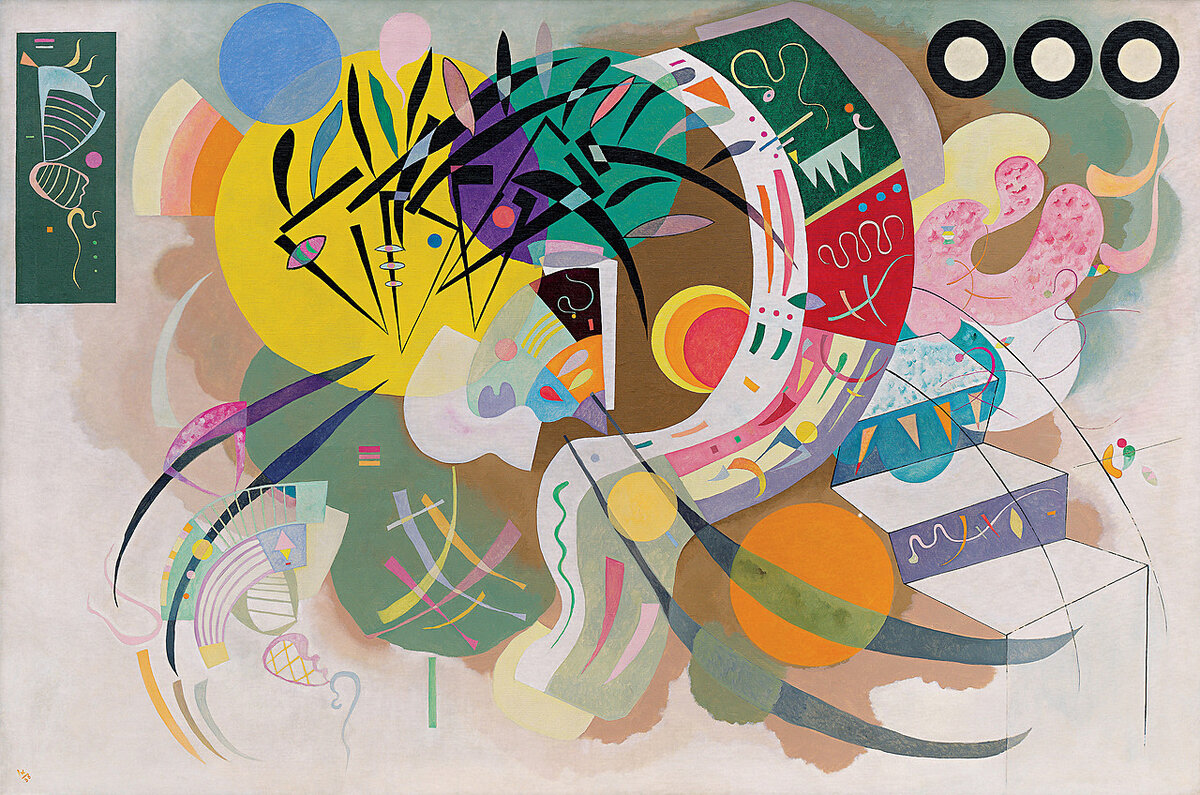
«Colour directly influences the soul. Colour is the keyboard, the eyes are the hammers, the soul is the piano with many strings. The artist is the hand that plays, touching one key or another purposively, to cause vibrations in the soul.» (« Вообще цвет является средством, которым можно непосредственно влиять на душу. Цвет - это клавиш; глаз - молоточек; душа - многострунный рояль. Художник есть рука, которая посредством того или иного клавиша целесообразно приводит в вибрацию человеческую душу»). We meet these words in the essay called «On the Spiritual in Art»/ «О духовном в искусстве». Thus, the question is what colour is and why it has such a strong effect on human consciousness. Against this background, the central problem that motivates this paper is to understand how the English and Russian idioms of colour designation show a unique worldview of people who speak these languages.
Historically, colour was used at first as a simple connecting medium between objects, then a sign-symbol, and recently as a linguistic system. In determining the meaning of colour specific historical conditions have always been taken into account. At first, a person felt that heated objects turn red, distant objects turn blue in mid-air, and later he realized that of all the colours, blue is «the farthest» and red is «the warmest». The development of colour sign system proceeded inextricably with the development of artistic culture; therefore it is impossible to analyze it and especially understand the symbolic meaning of colour in isolation from human history and culture. A person perceives information in colour on the basis of his experience and education. The preference for certain colours in different cultures is explained by historical background, traditions, customs, the corresponding character and temperament of the people, aesthetic norms, religious beliefs and the surrounding nature. If the colour reflects objects, reality or any concepts, then it carries cognitive value in the form of code pictorial sign. An unconditional colour pictorial sign is a color documentary image in which color is its essential inseparable attribute. Colour is superimposed on the image, therefore such expressive characteristics as warm (red), cold (blue), close (yellow), light (white), severe (black) acquire a stable association value over time, but these associations are different in different languages and cultures.
For these reasons, colour designations are widely used in the formation of idiomatic expressions. Almost all nations found it convenient to perceive specific colours as symbols that hide a deeper meaning that it might seem at first glance. These explanations compliment each other and help to illuminate the phenomenon of the importance of colour for language and culture. Let us turn to the idioms of English and Russian to prove and illustrate this idea.
Red/ Красный Red is one of the most controversial colours in the linguistic picture of the world of many nations. For many cultures, red was not just color of many but rather the only color worthy enough to be used for social purposes. Red pigment made from ochre was one of the first colours used in prehistoric art. In Roman mythology, red as the colour of blood was associated with the war god Mars. The Ancient Egyptians and Mayans coloured their faces red in ceremonies. The colour red has represented many things, from the life force and the divine to love, and anger. Up through the Middle Ages, red held a place of privilege in the Western world. The first colour developed for painting and dying, red became associated in antiquity with war, wealth, and power. In the medieval period, red held both religious significance, as the colour of the blood of Christ and the fires of Hell, and secular meaning, as a symbol of love, glory, and beauty. The sixteenth century in England, no less cruel than the other centuries-brothers, but bright and brilliant - this is the kingdom of red. The kings of the Tudor dynasty, which ruled then in England, knew a lot about it, in this truly royal colour. Jane Seymour, the quietest, most modest wife of Henry VIII, in her most famous portrait is depicted in a red velvet dress. Her son, the young King Edward VI, will like the shades of blood and clove red, his half-sister, Maria - the shades of the colour of rubies. The devout Mary, “Bloody Mary,” wore strict, closed dresses, but the red underskirts and sleeves, or the patterned red upper dresses immediately showed who the queen was. After the French Revolution, red gained new respect as the color of progressive movements and radical left-wing politics. «Two main “referents” of this colour - fire and blood» as a remarkable researcher of European culture Michel Pastoureau writes in his book «Red: The History of a Colour». In the Russian avant-garde culture, Wassily Kandinsky, who has already been mentioned, will characterize the red colour as the one that has the greatest influence on a person: «The red color, as we imagine it, is a warm color; internally, it acts like a very vibrant, moving restless paint.» («Красный цвет, как мы его себе представляем — тёплый цвет; внутренне он действует, как очень живая, подвижная беспокойная краска»). Let’s look at how this rich cultural experience is reflected in the language. For the Russian picture of the world, red is a bright, joyful and festive colour. We can verify this ides with the following examples:

На миру и смерть красна
Ради красного словца
Красная строка
Красному гостю красное место
Проходить красной нитью
Долг платежом красен
Красная цена
Красна девица
Внезапно красным стал окрестный лес
И облако впитало красный отсвет.
Светился праздник листьев и небес
В своем спокойном благородстве. (Д. Самойлов)
Зерна огненного цвета
Брошу на ладонь,
Чтоб предстал он в бездне света
Красный как огонь. (М. Цветаева)
In English, we also find idioms that indicate a positive perception of red, but they are not so numerous:
A red letter day - счастливый/ памятный день
Roll out the red carpet - приветствовать кого-то наилучшим образом
Nevertheless, the main part of the English thesaurus is idioms, where the red color acts as a symbol of danger or anxiety:
A red flag - сигнал о том, что что-то работает неверно
To be in the red - быть в долгах
See red - разозлиться, выйти из себя
Red-heated - вспыльчивый человек
Rad tape - волокита, канцелярская работа
To take the red eye - совершать очень раннюю поездку
Ears are red - покраснеть от смущения
Etc
We see how much linguistic perception of colour can vary in different cultures. It is interesting that in English and Russian political discourse red is associated with communism. But the opposition «white-red» is familiar only to Russian historical experience, going back to confrontation between the Red Army and the White Army during the Civil War.
Green/Зеленый Green was not always considered a symbol of life. In «The Canterbury Tales» by Geoffrey Chauser, the green color is referred to as the “color of lightness in love». Green plays the same symbolic role in the famous song "Green Sleeves». There is a persistent belief that it was composed by Henry VIII for his lover and future queen consort Anne Boleyn. Boleyn allegedly rejected King Henry's attempts to seduce her and this rejection may be referred to in the song when the writer's love "cast me off discourteously».
Alas my love you do me wrong
To cast me off discourteously;
And I have loved you oh oh long
Delighting in your company.
Greensleeves was my delight,
Greensleeves was my heart of gold
Greensleeves was my heart of joy
And who but my lady Greensleeves.
Despite this love story, this cultural code had a more far-reaching interpretation, since in the time being described, green was a hallmark of courtesans' clothes. The connotations of green in European culture (as well as in the case of red) are quite contradictory. Over the history of its existence, green has undergone many ways of its production and the values attached to it. Green is the color of vegetation, the color of forests and meadows, the color of youth and fertility. Nowadays it is the color of ecology, renewable energy and organizations struggling with environmental threats.
In the Middle Ages, people identified green with water, not blue. On geographical maps, rivers, lakes and oceans have long been indicated in green. Green was called the colour of the Devil and his retinue (snakes, vipers, sirens, crocodiles, dragons and toads), the colour of witches, sorcerers and poison. Green eyes also had a bad reputation: these are the eyes of depraved women and traitors. Judas, Basilisk, and the Devil himself had green eyes. Here are a few idioms that are currently used in English:
to have green fingers - быть хорошим садоводом
have a green thumb - употребляется в значении иметь хорошие руки
to give smb the green light - подарить кому-либо надежду (в этом значении встречается в романе Ф. Фицджеральда «Великий Гэтсби»)
to be green about the gills - дословно: стать зеленым вокруг жабр; русский эквивалент - сильно побледнеть
The curious thing is that the phrase «green eyes» in Russian is very poetic, suggesting witch-craft eyes.
Была бы бабою простой —
Всегда б платили за постой —
Всё эти же — веселые —
Зеленые глаза. (Марина Цветаева)
Ты напоила друга своего.
Но час настал в зеленые глаза
Тебе глядеться, у жестоких губ
Молить напрасно сладостного дара
И клятв таких, каких ты не слыхала,
Каких еще никто не произнес. (Анна Ахматова)
Сорокалетний где моряк,
С которым жизнь вести?
И благороден, и высок,
Морщин не отыскать,
Ресницы, брови и висок, -
Ну, глаз не оторвать!
Румянец нежный заиграл,
Зарделася щека, -
Таким никто ведь не видал
И в детстве моряка.
И волос тонок, словно лен,
И губы горячей,
Чудесной силой наделен
Зеленый блеск очей… (Михаил Кузмин)
Подвижная сфера зрачков, в изумруде
текучем сужаясь,
Расширяясь, сливает безмолвно
привлеченную душу с душой.
В глубоких зрачках искушенья, во влаге
зеленой качаясь,
Как будто бы манят, внушают:
«Приблизься, ты мне не чужой» (Константин Бальмонт)
The same phrase in English serves as a figurative synonym of envy and jealousy, which was called «green-eyed monster» in «Othello» by Shakespeare.
Blue/ Cиний/ Голубой The British are the nation of sailors, so in English the dark blue color is called «navy blue». England was actively mastering a new colour - “indigo”. The name comes from a plant found in India. Local residents made dye, which was used to dye clothes and body and for the image of mandalas - complex drawings that carry certain information encrypted in color and shape. In Russian, unlike English and many other Indo-European languages, there are two adjectives designating shades of blue - “dark blue” and “light blue”. For idioms in which blue symbolism occurs, both negative and positive meanings are characteristic.
blue devils — меланхолия, хандра
to be in the blues - унывать хандрить
blue study - тяжелые раздумья
blue law - закон, обусловленный религией или традицией
blue-sky ideas - недостижимые мечты
Blue Monday - худший день в году
blue stocking - об отсутствии женственности и обаяния
As for the Russian tradition, for a contrasting comparison, we can mention Sergey Yesenin’s poems, which are characterized by an understanding of blue as synonymous with happiness, dreams, hopes and inspirations.
Я не скоро, не скоро вернусь!
Долго петь и звенеть пурге,
Стережет голубую Русь
Старый клен на одной ноге
О, Русь — малиновое поле
И синь, упавшая в реку, –
Люблю до радости и боли
Твою озерную тоску
Ты мое васильковое слово,
Я навеки люблю тебя.
Что-то всеми навек утрачено.
Май мой синий! Июнь голубой!
As we can understand these are far from all colours that can be analyzed from an idiomatic point of view. But let us pay some attention to another important phenomenon and try to see how colour idioms are realized in a concrete poetic context. For this, we need to turn to the works of a bilingual poet, which means that his poetry was created in English and Russian. The colour perception of Joseph Brodsky is one of the most exciting topics in modern literary criticism and linguistics. For Brodsky, the Russian language was a kind of religion, faith, life position («Пока есть такой язык, как русский, поэзия неизбежна»). His forced emigration to America could not but leave an important print on his work.This was reflected in the change in the color palette. The riot of colors of his Russian poems cannot but amaze the attentive reader. Here are just a few examples:
Тюльпаны в прозрачной вазе, / алея без всякой связи / с краской этого края, поют о блаженстве рая
Космос всегда отливает слепым агатом
Рука была белей, чем самый лист, / хоть ярче кровь
Вдоль белесого неба, черно-красных умолкших процессий
Эти строчки в твои персты / попав… / побелеют
О, Петербург, твои карманы / и белизна моих манжет
Все сливается в снег, в белизну святую
В луче зари, / цветущей алым пламенем
слепое, агатовое великолепье / непроницаемого стекла
На стене акварель: в воде / отражается вид моста неизвестно где
Багровеет известка / трехэтажных домов
Завоеванье белого у черных / поставлено с размахом синевы
Северозападный ветер его поднимает над / сизой, лиловой, пунцовой, алой долиной Коннектикута.
И колыбель любви / – белее снега
Белы поля зимой заемным светом
В феврале далеко́ до весны,
Ибо там, у него на пределе,
Бродит поле такой белизны,
Что темнеет в глазах у метели.
What can be said about Brodsky's English poems? The colour dictionary is significantly impoverished. We find only a few colours that are rarely used. Colours such as brown, chestnut, rose, lilac, rust, scarlet, khaki, etc., are found once. Perhaps the reason lies in the different nature of the two languages. So, in Russian, the ability of words to form derivatives is much more active and diverse than in English. But the matter is not only in the features of the English and Russian languages. Brodsky’s example shows how a poet with a tremendous poetic gift, cannot, nevertheless fully integrate into the linguistic and poetic context of the new culture, because he does not know the idioms that underlie it. This greatly limits the range of poetic possibilities.
All in all, we can see then, that discussion has attempted to prove how important the symbolic role of colour idioms is for Russian and English language consciousness. Clearly, some propositions that we have offered are not entirely unique. However, we have come to understand that color symbolism is a means of expressing mentality. Idiomatic expressions help to better understand the culture of different languages, and sometimes the creative path of one author; idioms are living genuine evidence of the incredible creative power of the human imagination and the ability of culture to preserve the experience of the past for posterity. Let us conclude our thoughts with the words of Marcus Aurelius, who rightly remarked that “The soul becomes dyed with the colour of its thoughts.”
References
Kandinsky, Wassily (1911). Concerning the Spiritual in Art. translated by Michael T. H. Sadler (2004). Kessinger Publishing.
Brodsky J. Collected Poems in English. Manchester: Carcanet Press Ltd, 2001.
Yale University, Beinecke Rare Book and Manuscript Library. Joseph Brodsky Papers. GEN MSS 613. New Haven, Connecticut. 2008
Цегельник И. Е. Семантика и функционирование «синих цветообозначений в поэзии Иосифа Бродского // Научная мысль Кавказа. Приложение. 2006. № 8. С. 7.
Карин Юханнисон «История меланхолии»
Michel Pastoureau:
Green: The History of a Color (Princeton 2014),
Black: The History of a Color (Princeton 2008),
Blue: The History of a Color (Princeton 2001),