Найти в Дзене
Хайтек

Посмотрите на ослепительный звездный «роддом» на снимке «Джеймса Уэбба»

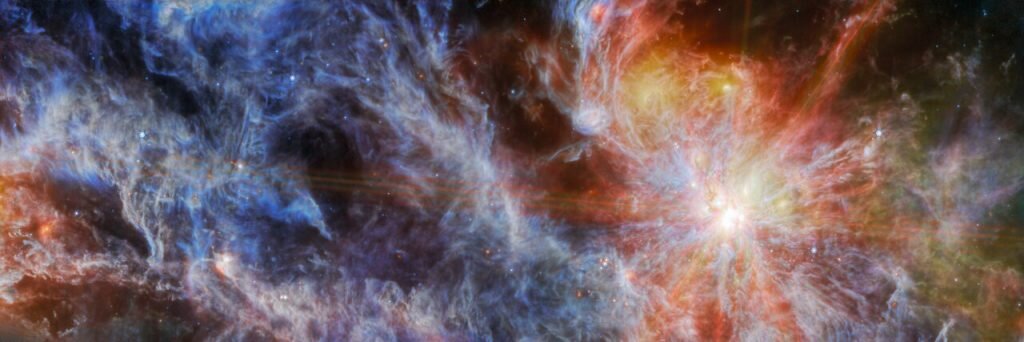
Европейское космическое агентство (ЕКА) опубликовало изображение области звездообразование в малоизученной части соседней галактики. Астрономы использовали чувствительную оптику космического телескопа «Джеймс Уэбб» для исследования малоизученных областей Большого Магелланова Облака. На снимке, опубликованном ЕКА, виден комплекс молекулярных облаков N79 South, в котором активно формируются новые звезды. N79 — это массивный комплекс звездообразования, охватывающий примерно 1630 световых лет в юго-западной области Большого Магелланова Облака. Он представляет собой область ионизированного межзвездного атомарного водорода. N79 South — один из трех гигантских комплексов молекулярных облаков. Область звездообразования N79 South. Фото: ESA/Webb, NASA & CSA, O. Nayak, M. Meixner Отчетливый узор «звездообразования», окружающий яркий объект в центре изображения, представляет собой серию дифракционных пиков. У всех зеркальных телескопов есть такие артефакты, связанные с конструкцией прибора. В слу
   This image from the NASA/ESA/CSA James Webb Space Telescope features an H II region in the Large Magellanic Cloud (LMC), a satellite galaxy of our Milky Way. This nebula, known as N79, is a region of interstellar atomic hydrogen that is ionised, captured here by Webb’s Mid-InfraRed Instrument (MIRI).This image is a cropped view of the wider N79 region. The full image can be seen here. N79 is a massive star-forming complex spanning roughly 1630 light-years in the generally unexplored southwest region of the LMC. N79 is typically regarded as a younger version of 30 Doradus (also known as the Tarantula Nebula), another of Webb’s recent targets. Research suggests that N79 has a star formation efficiency exceeding that of 30 Doradus by a factor of two over the past 500 000 years.  This particular image centres on one of the three giant molecular cloud complexes, dubbed N79 South (S1 for short). The distinct ‘starburst’ pattern surrounding this bright object is a series of diffraction spikes. All telescopes which use a mirror to collect light, as Webb does, have this form of artifact which arises from the design of the telescope. In Webb's case, the six largest starburst spikes appear because of the hexagonal symmetry of Webb's 18 primary mirror segments. Patterns like these are only noticeable around very bright, compact objects, where all the light comes from the same place. Most galaxies, even though they appear very small to our eyes, are darker and more spread out than a single star, and therefore do not show this pattern. At the longer wavelengths of light captured by MIRI, Webb’s view of N79 showcases the region’s glowing gas and dust. This is because mid-infrared light is able to reveal what is happening deeper inside the clouds (while shorter wavelengths of light would be absorbed or scattered by dust grains in the nebula). Some still-embedded protostars also appear in this field. Star-forming regions such as this are of interest to astronomers be Александр Шереметьев
This image from the NASA/ESA/CSA James Webb Space Telescope features an H II region in the Large Magellanic Cloud (LMC), a satellite galaxy of our Milky Way. This nebula, known as N79, is a region of interstellar atomic hydrogen that is ionised, captured here by Webb’s Mid-InfraRed Instrument (MIRI).This image is a cropped view of the wider N79 region. The full image can be seen here. N79 is a massive star-forming complex spanning roughly 1630 light-years in the generally unexplored southwest region of the LMC. N79 is typically regarded as a younger version of 30 Doradus (also known as the Tarantula Nebula), another of Webb’s recent targets. Research suggests that N79 has a star formation efficiency exceeding that of 30 Doradus by a factor of two over the past 500 000 years. This particular image centres on one of the three giant molecular cloud complexes, dubbed N79 South (S1 for short). The distinct ‘starburst’ pattern surrounding this bright object is a series of diffraction spikes. All telescopes which use a mirror to collect light, as Webb does, have this form of artifact which arises from the design of the telescope. In Webb's case, the six largest starburst spikes appear because of the hexagonal symmetry of Webb's 18 primary mirror segments. Patterns like these are only noticeable around very bright, compact objects, where all the light comes from the same place. Most galaxies, even though they appear very small to our eyes, are darker and more spread out than a single star, and therefore do not show this pattern. At the longer wavelengths of light captured by MIRI, Webb’s view of N79 showcases the region’s glowing gas and dust. This is because mid-infrared light is able to reveal what is happening deeper inside the clouds (while shorter wavelengths of light would be absorbed or scattered by dust grains in the nebula). Some still-embedded protostars also appear in this field. Star-forming regions such as this are of interest to astronomers be Александр Шереметьев

Европейское космическое агентство (ЕКА) опубликовало изображение области звездообразование в малоизученной части соседней галактики.

Астрономы использовали чувствительную оптику космического телескопа «Джеймс Уэбб» для исследования малоизученных областей Большого Магелланова Облака. На снимке, опубликованном ЕКА, виден комплекс молекулярных облаков N79 South, в котором активно формируются новые звезды.

N79 — это массивный комплекс звездообразования, охватывающий примерно 1630 световых лет в юго-западной области Большого Магелланова Облака. Он представляет собой область ионизированного межзвездного атомарного водорода. N79 South — один из трех гигантских комплексов молекулярных облаков.
-2

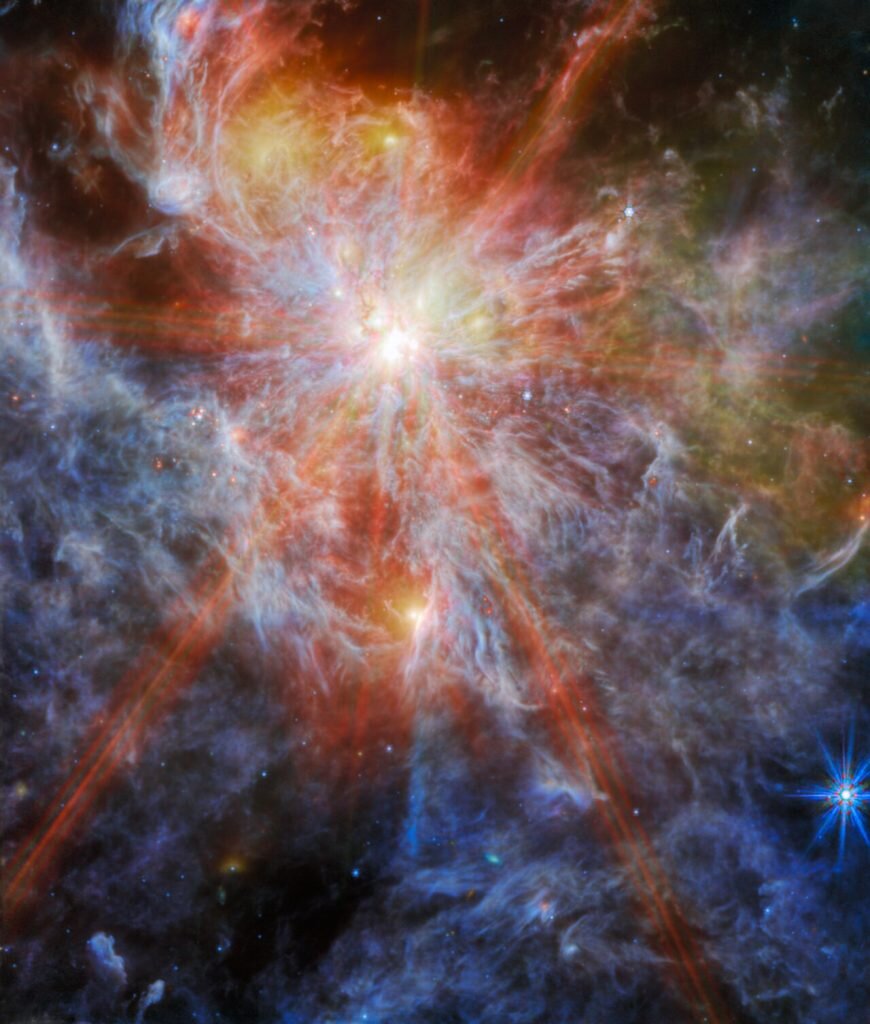
Область звездообразования N79 South. Фото: ESA/Webb, NASA & CSA, O. Nayak, M. Meixner

Отчетливый узор «звездообразования», окружающий яркий объект в центре изображения, представляет собой серию дифракционных пиков. У всех зеркальных телескопов есть такие артефакты, связанные с конструкцией прибора. В случае «Уэбба» шесть мощных лучей появляются из-за гексагональной симметрии 18 сегментов главного зеркала телескопа.

На большей длине волны телескоп фиксирует светящийся газ и пыль, скрывающий область звездообразования. Это связано с тем, что средний инфракрасный свет способен выявить то, что происходит глубже внутри облаков (в то время как более короткие волны света будут поглощаться или рассеиваться пылинками в туманности). При наблюдении в среднем инфракрасном диапазоне исследователи видят некоторые артефакты протозвезд.

Область звездообразования N79 South

Области звездообразования, подобные N79, представляют большой интерес для астрономов, поскольку их химический состав должен быть аналогичен тем, что существовали, когда Вселенной было всего несколько миллиардов лет, а звездообразование находилось на пике. «Уэбб»предоставляет астрономам возможность сравнить и сопоставить наблюдения за звездообразованием в N79 с данными о далеких галактиках в ранней Вселенной

Читать далее:

Тектоническая плита под Тибетом расслаивается на части, предполагают ученые

На CES 2024 показали гаджет «из будущего»: он все делает сам

Найдена галактика, которая просто не может существовать

На обложке: область звездообразования N79 South. Фото: ESA/Webb, NASA & CSA, O. Nayak, M. Meixner