What is this article about? The Moscow metro was opened in 1935 (on May 15, 1935). Unlike railways in other countries, Moscow was presented not only with the functional task, but also ideological - to demonstrate the superiority of the socialist system over the capitalist.
English level - middle
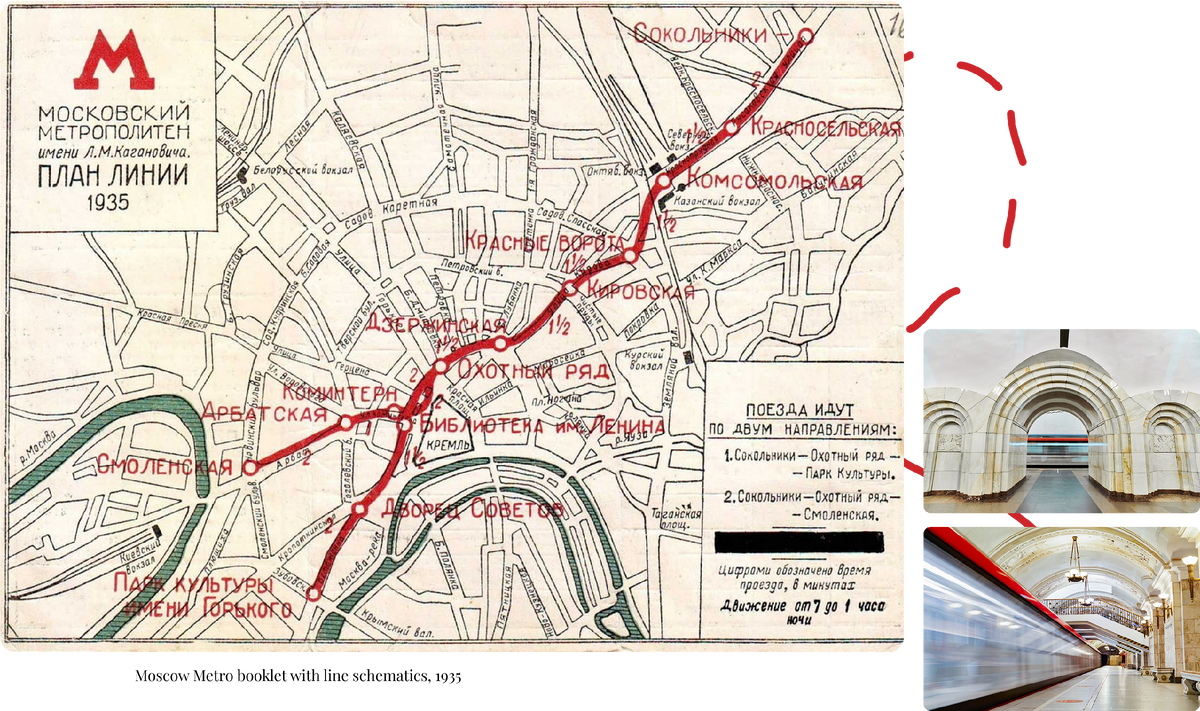
The first Soviet metro was built in a record short time. The decree of establishment was adopted in 1931, construction began in 1933, and already in 1935 an 11.2-kilometre line with 13 stations was opened (the lobbies of all stations opened at the same time, at 6:45). On the first line - the Sokolnicheskaya line - trains started running from Sokolniki to Park Kultury, branching off from Okhotny Ryad to Smolenskaya. And you might find that this line connected three main train stations of Moscow.
Despite such a short period of time, architecture of the future stations was as important as everything else. Metro stations were originally designed like underground palaces for people. Platforms and lobbies were lined in marble and granite mined in Crimea, the Caucasus mountains, Karelia, and the Urals.
Then the war and post-war stations became examples of the Stalinist style in its full-fledged form. The stations of the Circle Line and Arbatsko-Pokrovskaya radial line that opened in 1950-1954 were thoroughly imbued with the theme of the triumph of the Soviet people and the recent victory. The architecture of the stations became almost temple-like, the forms being bigger, and the ornamentation more pompous. The metro began containing numerous images of Stalin as the leader of the people.
words to learn:
decree (noun) - an official order from a leader or a government that becomes the law
branch off (ph.verb) - if a road or path branches off, it goes in another direction
marble (noun) - a type of hard stone that is usually white and used for decoration (мрамор)
to mine - to dig out of the ground minerals such as coal, metals, and valuable stones
full-fledged (noun) - completely developed or established
imbue someone or something with sth (ph. verb) - to fill sb or sth with a particular feeling, quality, or idea
pompous (adj) - too serious and full of importance
What are the themes of the station on the Circle Line?
Park Kultury represents recreation, sports and art in the Soviet Union, Paveletskaya stands for the Volga Region, Kurskaya signifies the Chernozemye (Central Black Earth Region), Komsomolskaya is a triumph of the Victory, Prospekt Mira symbolises a boost in agriculture, and Krasnopresnenskaya commemorates the victory of the 1905 and 1917 revolutions.
In 1954 on the initiative of the new Soviet leader Nikita Khrushchev a resolution to simplify the style, diminishing excesses in design and construction was adopted. “Soviet architecture should be characterised by simplicity, rigour in form, and efficiency in design”. The designs of the stations became dramatically simplified, the authors turned away from cladding and especially away from decoration.
In typical residential districts metro stations had to be typical as well. A modular construction of stations included two rows of 40 (later 26) square concrete columns. The work of architects was reduced to the ability to choose the colour and pattern of the granite flooring, the marble for the columns, and the tiles for the track walls. The first station of this type appeared in 1962 - it was on the Kaluzhsko-Rizhskaya radial line. However, gradually the requirements were softened, and the stations opened after 1965 had some decorative elements.
words to learn:
boost (noun) - an increase in smth
to commemorate (somebody/something) - to remind people of an important event or person from the past with a special action or object
to diminish - to become smaller, weaker, etc.; to make smth become smaller, weaker, etc.
rigour (noun) - the fact of being careful and paying great attention to detail (тщательность)
cladding (noun) - material that covers the surface of smth and protects it
modular (adj) - consisting of separate parts that, when combined, form a complete whole
tile (noun) - flat, square pieces that are used for covering roofs, floors, or walls
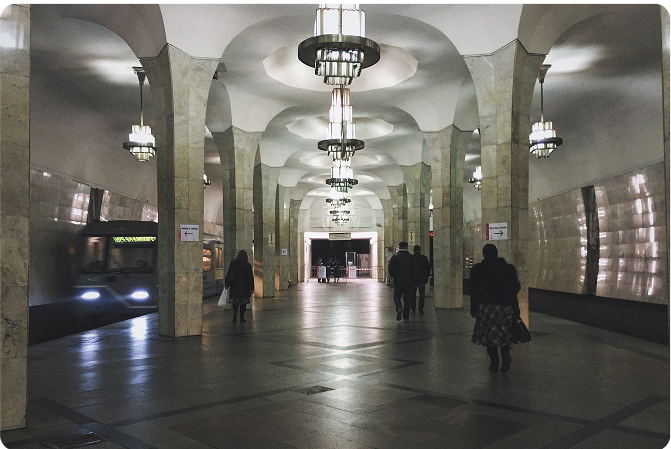
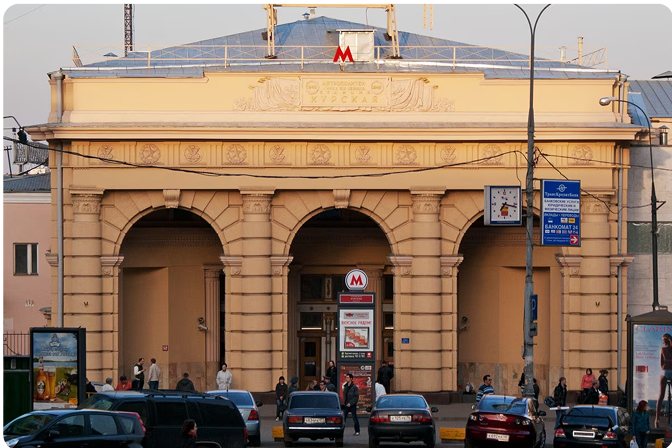
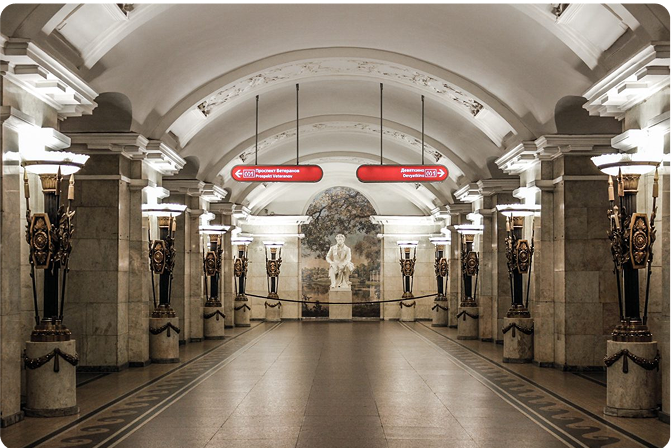
A new stage of metro construction began in 1971 with the opening of two stations - Kitay-Gorod and Tretyakovskayam; they depicted the new interpretation of the "palace theme" (in a very modest way). This form of Moscow metro stations, which are to some degree replicated today, emerged particularly during the second half of the 70s early 80s.
In the second half of the 1970s and 1980s true palaces were constructed, referring back to the architecture of the 1930s-1950s: Pushkinskaya (1975), Chertanovskaya (1983), Marksistskaya (1979), and Ploshchad Ilyicha (1979). As usual each station had the special topic, such as youth (Polyanka, 1986), ancient history of Moscow (Nagatinskaya, 1983), environmental protection (Nagornaya, 1983) and even the history of political hard labour in Russia (Shosse Entuziastov, 1979).
The collapse of the Soviet Union led to a sharp decline in funding and in the volume of construction (only one line of the Moscow metro was opened in the 1990s - the Lyublinskiy radial line). In the 2000s, the metro was dominated by architecture that was neither classical nor modern (nor post-modern).
But then the experiments with metro stations continued. For example, the Lermontovskiy Prospekt (2013) and Zhulebino (2013) stations included a range of the colour spectrum changing from green to red-orange. Such a colour scheme was designed to cheer up Moscow metro passengers.
An important milestone in the development of the metro was Moscow Mayor Sergei Sobyanin's ambitious programme for 2011 to 2020, which stimulated the construction of more than 160 km of metro lines and 78 new stations. That provided 93% of the residents of the Russian capital with "close proximity" to a station. Since that time the construction of the metro in Moscow continues unstoppably.
words to learn:
to emerge - to become known
labour (noun) - type of work that needs a lot of physical effort
milestone (noun) - a very important stage or event in the development of something
proximity (noun) - the state of being near sb/smth in distance or time
Why have lines got specific colours such red, green, blue, etc?
“Initially, they had no fixed colour; for example, Sokolnicheskaya was either red or black. But in 1957, Moscow hosted the 6 th World Festival of Youth and Students, a grandiose event that brought together people from different countries. To make it easy for foreigners to navigate in the metro, the lines were marked with colours. They chose the three easiest to print: red, green, and blue. And if mixed, they make brown. Hence the colour of the Circle Line,” says Irina Chizhevskaya.
Elements worth paying attention to
At the Rimskaya station you can find the only underground fountain. The station is decorated with three Corinth style pillars and statues of Romulus and Remus, twin founders of Rome.
The Pykhtino station has a model of the Tu−144 passenger jet suspended over the escalator there.
The Lyublinsko-Dmitrovskaya line is about literature. The Dostoevskaya station features characters from Dostoevsky’s novels, such as Crime and Punishment, Idiot, Demons, and Brothers Karamazov. Looking at the walls, you can see Rodion Raskolnikov, Sonya Marmeladova, Prince Myshkin, etc. A huge portrait of Fyodor Dostoevsky is also displayed there (in the upper lobby).
The Fonvizinskaya station, on the other hand, is inhabited by characters from D. Fonvizin’s play, The Minor. The characters are shown on 28 digital panels, each four metres large.
Through modern-made stations passengers can go to the Rasskazovka station and at its platform pillars find an online book cataloug and even get free-of-charge access to e-books.
words to learn:
to suspend something - to hang smth
to display - to put smth in a place where people can see it easily; to show smth to people
to inhabit - to live in a particular place
pillar (noun) - a strong column made of stone, metal, or wood that supports part of a building
Thank you for reading!🤍