The EEG method turned exactly 100 years old in 2024. Despite such a seemingly advanced age, electroencephalography remains one of the main instrumental methods for diagnosing the functional state of the brain. EEG is widely used in modern clinical practice and is also used in numerous scientific studies.
One of the vectors for further development of this diagnostic method has become an increase in the number of recording channels. If traditionally 19-25 EEG channels are recorded for routine EEG examinations, then 32 channels are used in advanced laboratories, and 64- and even 128-channel systems are often used for scientific research. As a rule, multi-channel systems are used for invasive EEG. For scalp EEG, the logical limit for the number of EEG electrodes applied has become 64 channels, although there are exotic solutions for recording 256 EEG channels from the scalp.
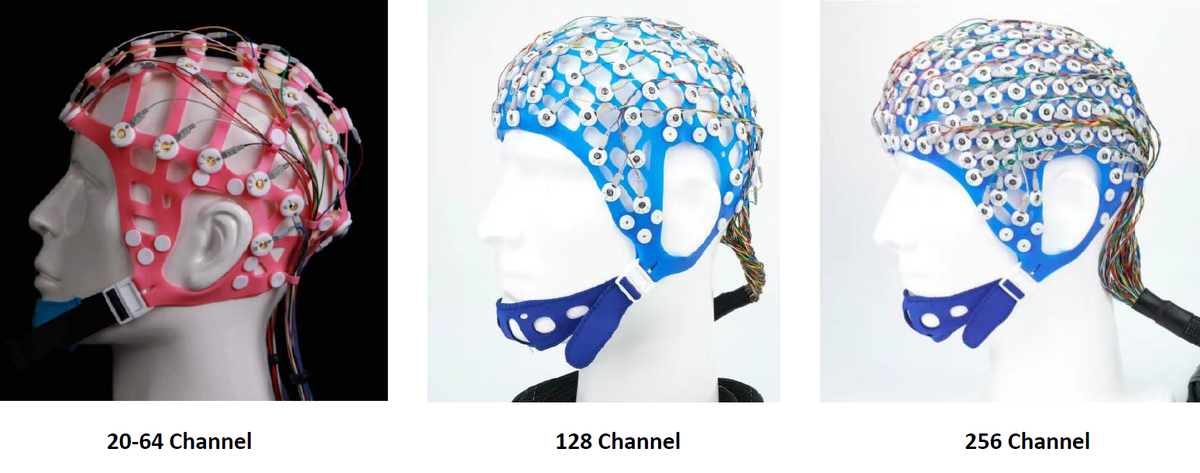
Electroencephalography is a sensitive non-invasive method for studying the functional state of the brain. Based on the results of the EEG examination, it is possible to assess the functional state of the brain structures and determine the sources of pathological electrical activity. The scope of EEG use in medical clinical practice is currently quite extensive: from routine EEG examinations in a clinic to invasive EEG video monitoring before surgical treatment of the brain (tumors, epilepsy). EEG is also used in intensive care units and in neonatal departments for neuromonitoring of newborns.
The resolution of this examination method depends on the number of EEG electrodes used during recording. In clinical practice, in accordance with international recommendations (IFCN, ILAE), 19 to 32 EEG electrodes are used, located on the head of the subject according to the "10-20%" system.
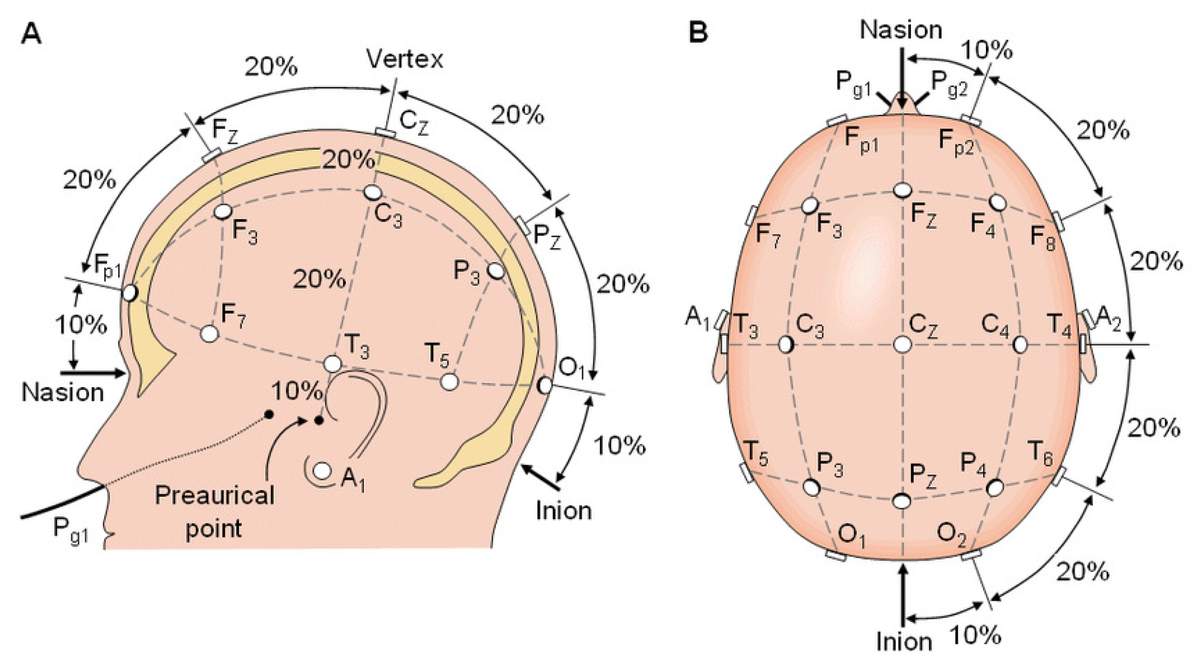
To apply a larger number of electrodes, the "10-10%" system is used, according to which up to 64 EEG electrodes can be applied:
But sometimes this is not enough. In some cases, usually for scientific research, it is necessary to record EEG with a higher density of electrodes on the subject's head. This is high-resolution EEG (High density EEG).
For high-resolution EEG recording, 128, 256 or even 512 EEG electrodes can be used. It is clear that applying such a number of electrodes requires a lot of time and perseverance. As a rule, specialized electrode systems are used.
The term "High Density EEG" has come into use to describe EEG equipment that can record 64 or more EEG channels.
From the point of view of clinical diagnostics, high-resolution EEG allows to increase the accuracy of localization of the epileptiform focus or the source of other pathological activity of the brain. Together with visualization methods, such as CT and MRI, EEG coupled with programs for 3-dimensional localization allow to determine the location of the pathological focus with high accuracy. And the accuracy is higher, the greater the number of electrodes. 64 channels in this case now seems optimal, since a further increase in scalp EEG electrodes does not provide a significant increase in accuracy, since each electrode records the electrical activity of neurons of the cerebral cortex with an area of several square centimeters.
Neurosoft, a Russian manufacturer of medical equipment, offers a solution for recording high-resolution multichannel EEG, consisting of two latest-generation Neuron-Spectrum-65 EEG recorders.
Two Neuron-Spectrum-65 units are connected to a computer via USB or LAN and work together as a single recorder. The advantage of this solution is that Neuron-Spectrum-65 units can be used both together and separately when a large number of EEG channels is not required.
Multichannel high-resolution EEG allows for more accurate localization of the focus of pathological activity in the brain and is, in some ways, an alternative to invasive EEG. High-resolution EEG can be recorded using cup EEG electrodes.
But it is much more convenient to use electrode systems with pre-installed electrodes. The Russian company MKS produces specialized 64-channel EEG systems with integrated electrodes according to the international "10-10%" system.
Multichannel EEG in Neuron-Spectrum.NET software looks a little unusual. The density of EEG curves on the screen is much higher than usual.
For a more familiar display, you can view the EEG not for all recorded channels, but only for selected channels, by creating separate montages for viewing.
In addition to EEG, evoked potentials (EP) are also recorded on 64 channels.
Thus, it can be concluded that high-resolution EEG is gradually entering not only scientific research, but also finding application in clinical practice. All necessary equipment and accessories for this method are manufactured in Russia.