Марийская народная сказка
Один мужик облюбовал себе в лесу место под ржаное поле. Хорошее место — на холме, на южном склоне.
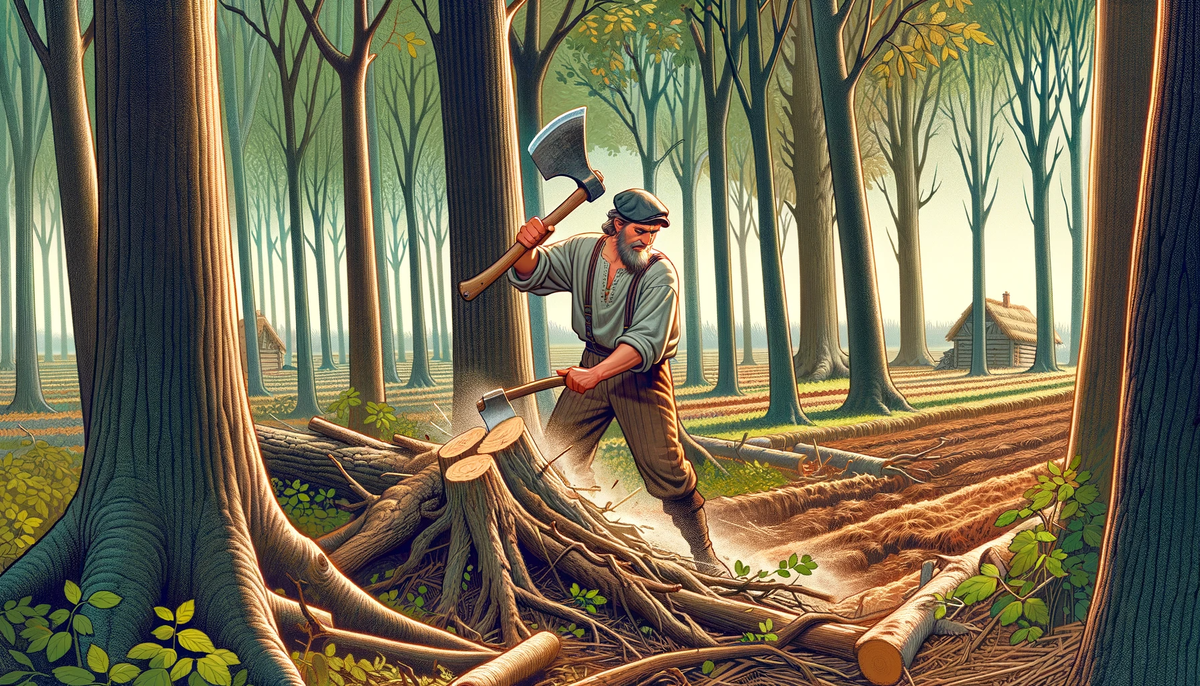
Стал мужик сводить лес, валить деревья, расчищать поляну.
С рассвета дотемна раздавался по лесу стук его топора: тюк да тюк, тюк да тюк.
Сначала он срубил деревья, потом принялся корчевать пни.
А когда подошло время сеять рожь, оглянулся мужик и видит: сил положил много — места расчистил мало. С такого поля не прокормишься. Да еще бревна и пни надо с поля прочь убрать. Тоже работа нелегкая.
Сидит мужик под елкой и горюет.
Вдруг видит он: но лесу среди черных лип и белых берез, среди желтых сосен и зеленых веток идет кто-то. Вроде бы и человек, да чудной какой-то. Быстро идет, словно ветром его несет. Кафтан на нем алый, широкий, длинные-полы развеваются, белую подкладку кажут.
Приблизился он к мужику, остановился и говорит:
— Удачи тебе, мужик, в твоем деле. А что ты делаешь?
— Лес под поле свожу. Трудился, трудился не покладая рук — расчистил лишь малое место. С такого поля не прокормишься. Да еще надо бревна и пни убрать, тоже работа нелегкая.
— Хочешь, я тебе помогу?
— Помоги, приятель. Вдвоем больше сделаем.
— Я один управлюсь, а ты отойди в сторону.
Мужик отошел в сторону, а тот распахнул свой алый кафтан, взмахнул широкими рукавами на белой подкладке, взмахнул алыми полами.
Стали рукава белым дымом, а полы алым пламенем.
И тотчас же наваленный на поле сушняк задымился, полетели искры, забушевало пламя, охватило и пни, и бревна.
Мужик испугался.
«Высок его дым, остер красный язык, этак он и меня съест, — подумал мужик. — Бежать надо».
Кинулся мужик прочь, да споткнулся о ведро с водой. Ведро опрокинулось, вода разлилась, пламя потухло.
Обернулся мужик, видит: вместо бревен и пней одна серая зола, а на поляне стоит тот, в алом кафтане, в своем прежнем обличье и похваляется:
— Видал, как я с бревнами и пнями управился?
Видал, — отвечает мужик. — Спасибо тебе. Да кто же ты такой будешь?
Я — Огонь. И тебе спасибо, мужик, за угощенье: ведь для меня нет ничего лучше смолистой сосны и белой березы. Теперь ты приходи ко мне в гости. Угощу я тебя тем, чего ты никогда не едал: печеным да вареным.

Полетел Огонь дальше, а мужик распахал поле и посеял рожь.
Хорошо уродилась рожь. Осенью убрал ее мужик, смолотил, сложил в клеть.
«Теперь можно и в гости сходить», — решил мужик.
Пришел он к Огню:
— Здравствуй, друг Огонь.
— Здравствуй, друг мужик. Садись за стол.
Уселся мужик, а Огонь выставил перед ним горячих блинов жареных да румяных пирогов печеных.
Очень понравились мужику блины и пироги. Правду говорит: жареный, да еще с маслом, и лапоть съешь.
Наелся мужик, завел беседу.
— Что-то ты, друг Огонь, вроде отощал, вроде поменьше ростом стал.
Как тут не отощаешь, когда в доме ни обеда, ни ужина: ни смолистых плах сосновых, ни белых поленьев березовых, ни даже щепы осиновой, — вздохнул Огонь. — Ежели я сегодня не подкреплюсь, то завтра мне придет конец.
— Зачем же тебе, друг, конца ждать? Пойдем ко мне, уж я найду, чем тебя попотчевать.
Пришли они к мужику. Наколол мужик сухих березовых дров для друга.
Набросился Огонь на поленья, вмиг спалил. От поленьев осталась маленькая кучка пепла, зато Огонь сразу раздобрел, повеселел, алым румянцем заиграл и помирать раздумал.
— Давай, мужик, вместе жить, — говорит он. — Ты меня будешь кормить, а я на тебя работать.
— Давай, — согласился мужик.
Поставил мужик посреди своей деревянной избы каменные палаты — печку, и поселился Огонь в печке.
Так подружился человек с огнем. Огонь жарит блины, печет пироги, щи да кашу варит, в холодную пору согревает, а человек заботится, чтобы всегда в доме были дрова.
A peasant had chosen a place in the forest for a rye field. It was a good spot - on a hill, on the southern slope.
He began to clear the forest, felling trees, and clearing a glade. From dawn to dusk, the sound of his axe echoed through the forest: thud and thud, thud and thud.
First, he cut down the trees, then he started to uproot the stumps.
But when it was time to sow the rye, the peasant looked around and saw that he had put in a lot of effort but cleared only a small area. You can't make a living from such a field. And the logs and stumps still needed to be removed from the field. Another tough job.
The peasant sat under a spruce tree, feeling sorrowful.
Suddenly, he saw someone coming through the forest among the black lindens and white birches, among the yellow pines and green branches. It seemed to be a person, but a strange one. He moved fast, as if carried by the wind. He wore a wide red caftan, with long skirts fluttering, showing its white lining.
He approached the peasant, stopped, and said:
"Good luck to you, peasant, in your work. What are you doing?"
"I'm clearing the forest for a field. I worked hard, tirelessly, but only cleared a small space. You can't make a living from such a field. And I still need to remove the logs and stumps, another tough job."
"Do you want me to help you?"
"Help me, friend. Together we'll do more."
"I'll manage alone, you just step aside."
The peasant stepped aside, and the man in the red caftan flung open his garment, waved his wide sleeves with white lining, and swung his red skirts. The sleeves became white smoke, and the skirts became red flames. Immediately, the stacked dry wood on the field began to smoke, sparks flew, flames roared, engulfing both stumps and logs.
The peasant got scared.
"The smoke is high, the red flame is fierce, it might even consume me," thought the peasant. "I have to run."
He ran away but tripped over a bucket of water. The bucket overturned, water spilled out, and the flame extinguished. The peasant turned around and saw: where there were logs and stumps, now only grey ash remained, and the man in the red caftan stood in the clearing in his former appearance, boasting:
"Did you see how I dealt with the logs and stumps?"
"I saw," the peasant replied. "Thank you. But who are you?"
"I am Fire. And thank you, peasant, for the treat: there's nothing better for me than resinous pine and white birch. Now come visit me. I'll treat you to something you've never eaten before: roasted and boiled." Fire flew away, and the peasant plowed the field and sowed the rye.
The rye grew well. In the autumn, the peasant harvested it, threshed it, and stored it in a bin. "Now I can go visit," the peasant decided. He came to Fire:
"Hello, friend Fire."
"Hello, friend peasant. Sit at the table."
The peasant sat down, and Fire served him hot pancakes and ruddy pies.
The peasant enjoyed the pancakes and pies. As they say, fried, especially with butter, even a bast shoe tastes good. The peasant was full and started a conversation.
"You seem, friend Fire, to have become thinner, a bit shorter."
"How can I not become thinner when there's neither lunch nor dinner in the house: no resinous pine planks, no white birch logs, not even aspen chips," sighed Fire. "If I don't get stronger today, I'll meet my end tomorrow."
"Why wait for your end, friend? Come with me, I'll find something to treat you."
They went to the peasant's house. The peasant chopped dry birch wood for his friend.
Fire devoured the logs, burning them in an instant. Only a small pile of ash remained, but Fire immediately cheered up, became lively, glowed with a red blush, and decided not to die.
"Let's live together, peasant," he said. "You'll feed me, and I'll work for you."
"Let's," agreed the peasant.
The peasant built a stone oven in the middle of his wooden house and settled Fire in the oven.
Thus man befriended fire. Fire cooks pancakes, bakes pies, boils soup and porridge, warms in cold weather, while the man makes sure there's always firewood in the house.