
Art deco was a popular international design movement from 1925 until 1939, affecting the decorative arts such as architecture, interior design, and industrial design, as well as the visual arts including fashion, painting, the graphic arts, and film. This movement was an amalgam of many different styles and movements of the early twentieth century, including Neoclassical, Constructivism, Cubism, Modernism, Bauhaus, Art Nouveau, and Futurism. This is a style of visual excess that first rose to popularity in the years after World War I and remained a cornerstone of the international art community for decades. Art deco was strongly fascinated with the rise of technology reflected in the burgeoning science-fiction industry. Artists incorporated sharp angular lines reflective of futurist art deco impulses. The movement spread because of its intangibles and its displacement of conventional boundaries. Artists were free to explore and expand their futuristic influences in pursuit of creating art as grandiose as the rapidly changing industrial economic landscape.
The structure of Art Deco is based on mathematical geometric shapes. It was widely considered to be an eclectic form of elegant and stylish modernism which derived from a variety of sources. Among them were the so-called "primitive" arts of Africa, Ancient Egypt, and Aztec Mexico, as well as machine-age or streamline technology such as modern aviation, electric lighting, the radio, the ocean liner and the skyscraper. It is in Streamline Moderne styles that this technology fully manifests itself and, although it is not antithetical to Art Deco, it is now considered to be a separate architectural style.
The bold use of stepped forms and sweeping curves (unlike the sinuous, natural curves of the Art Nouveau), chevron patterns, and the sunburst motif are typical of Art Deco. Some of these motifs were ubiquitous–for example, sunburst motifs were used in such varied contexts as ladies' shoes, radiator grilles, the auditorium of the Radio City Music Hall, and the spire of the Chrysler Building.
Art Deco was an opulent style, and its lavishness is attributed to reaction to the forced austerity imposed by World War I. Its rich, festive character fitted it for "modern" contexts, including interiors of cinema theaters and ocean liners such as the Île de France, the Queen Mary, and Normandie. Art Deco was employed extensively throughout America's train stations in the 1930s, designed to reflect the modernity and efficiency of the train. The first art-deco train station in the United States was the Union Station in Omaha, Nebraska. The unveiling of streamlined trains paralleled the construction of the art deco stations.
A parallel movement called Streamline Moderne, or simply Streamline, followed close behind. Streamline was influenced by the modern aerodynamic designs emerging from advancing technologies in aviation, ballistics, and other fields requiring high velocity. The attractive shapes resulting from scientifically applied aerodynamic principles were enthusiastically adopted within Art Deco, applying streamlining techniques to other useful objects in everyday life, such as the automobile. Although the Chrysler Airflow design of 1933 was commercially unsuccessful, it provided the lead for more conservatively designed pseudo-streamlined vehicles. These "streamlined" forms began to be used even for mundane and static objects such as pencil sharpeners and refrigerators.
Art Deco celebrates the Machine Age through explicit use of man-made materials (particularly glass and stainless steel), symmetry, repetition, modified by Asian influences such as the use of silks and Middle Eastern designs. It was strongly adopted in the United States during the Great Depression for its practicality and simplicity, while still portraying a reminder of better times and the "American Dream."
In the words of F. Scott Fitzgerald, the distinctive style of Art Deco was shaped by "all the nervous energy stored up and expended in the War." Art Deco has been influenced in part by movements such as Cubism, Russian Constructivism and Italian Futurism, which are all evident in Art Deco decorative arts.
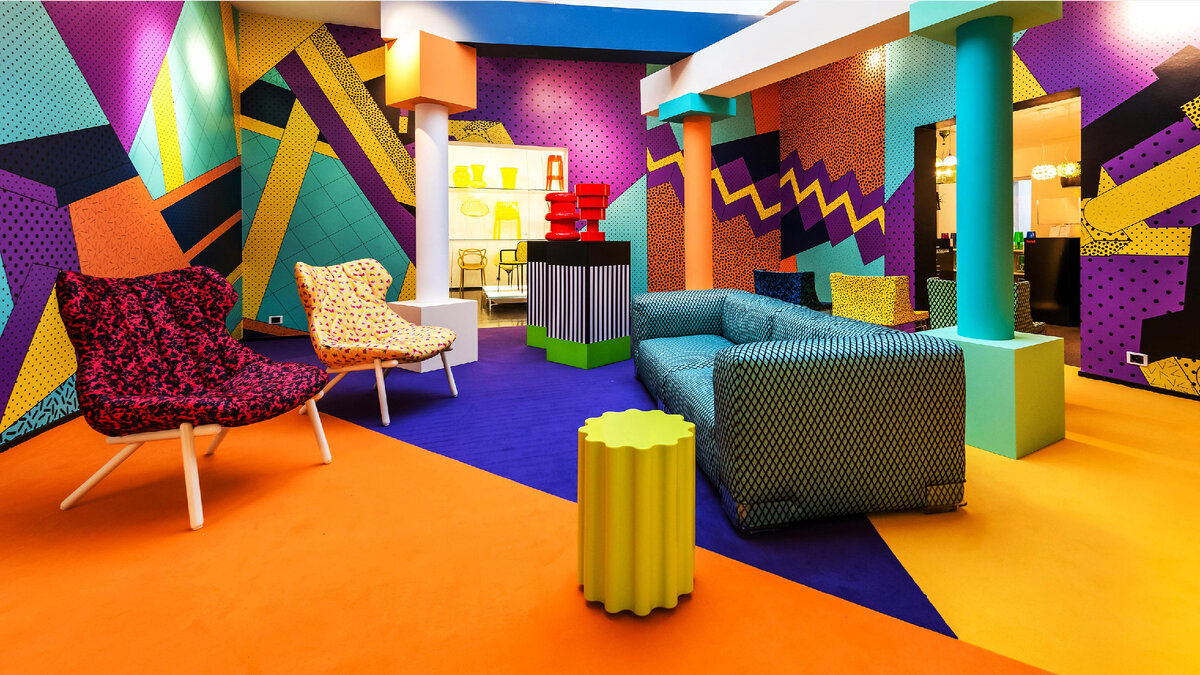
Art Deco slowly lost patronage in the West after reaching mass production, when it began to be derided as gaudy and presenting a false image of luxury. Eventually, the style was cut short by the austerities of World War II. A resurgence of interest in Art Deco came with graphic design in the 1980s, where its association with film noir and 1930s glamor led to its use in ads for jewelry and fashion. Memphis Group Art Deco also helped to inspire the Memphis Group, an influential Italian design and architecture movement of the 1980s. The group was founded by Ettore Sottsass. The group disbanded in 1988. Named after the Bob Dylan song Stuck Inside of Mobile with the Memphis Blues Again, the movement was a reaction against the post-Bauhaus "black box" designs of the 1970s and had a sense of humor that was lacking at the time in design. The Memphis Group offered bright, colorful, shocking pieces. The colors they used contrasted the dark blacks and browns of European furniture. In addition to Art Deco, they drew inspiration from Pop Art as well as the 1950s Kitsch and futuristic themes. Their concepts were in stark contrast to so called 'Good Design'.