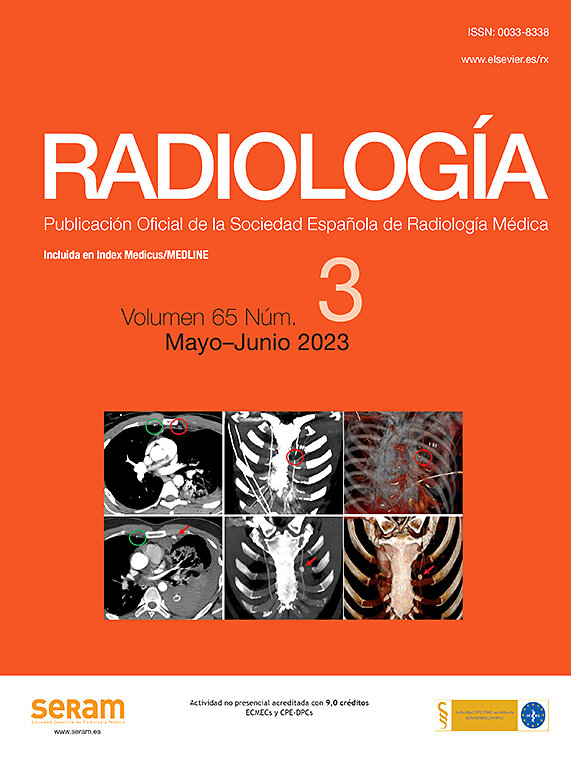
Уважаемые коллеги, доброго времени суток! Представляем вам испанское научное издание Radiologia. Журнал имеет четвертый квартиль, издается в Ediciones Doyma, S.L., его SJR за 2022 г. равен 0,218, печатный ISSN - 1578-178X, электронный - 0033-8338, предметная область Радиология и радиационная медицина. Вот так выглядит обложка:
Редактором является Кристина Гарсия Вильяр, контактные данные - cristina.garcia.villar@gmail.com, rx@elsevier.com.

Основанный в 1912 году, журнал Radiología является официальным журналом Испанского общества медицинской визуализации (испанская аббревиатура SERAM). Он выходит раз в два месяца (6 выпусков в год) на испанском и английском языках. Все статьи проходят тщательный процесс двойного слепого рецензирования. Radiologia фокусируется в основном на оригинальных исследованиях и обзорных статьях, хотя публикует и другие материалы. Radiología будет уделять приоритетное внимание публикации работ такого типа, чтобы у них было меньше времени ждать момента их появления. Все статьи посвящены клиническим или фундаментальным исследованиям, включая метаанализ, по аспектам, связанным с диагностической визуализацией, интервенционной радиологией или любым технологическим аспектом, в котором применяется изображение.
Адрес издания - https://www.sciencedirect.com/journal/radiologia
Пример статьи, название - Pulmonary CT angiography in the first wave of the COVID-19 pandemic: comparison between patients with and without infection and with a pre-pandemic series. Заголовок (Abstract)
Background and aims
To analyze the diagnostic performance of pulmonary CT angiography and to compare different D-dimer cutoffs for the diagnosis of acute pulmonary embolism in patients with and without SARS-CoV-2 infections.
Materials and methods
We retrospectively analyzed all consecutive pulmonary CT angiography studies done for suspected pulmonary embolism in a tertiary hospital during two time periods: the first December 2020 through February 2021 and the second December 2017 through February 2018. D-dimer levels were obtained less than 24 hours before the pulmonary CT angiography studies. We analyzed the sensitivity, specificity, positive and negative predictive values, area under the receiver operating curve (AUC), and pattern of pulmonary embolism for six different values of D-dimer and the extent of the embolism. During the pandemic period, we also analyzed whether the patients had COVID-19.
Results
After excluding 29 poor-quality studies, 492 studies were analyzed; 352 of these were done during the pandemic, 180 in patients with COVID-19 and 172 in patients without COVID-19. The absolute frequency of pulmonary embolism diagnosed was higher during the pandemic period (34 cases during the prior period and 85 during the pandemic; 47 of these patients had COVID-19). No significant differences were found in comparing the AUCs for the D-dimer values. The optimum values calculated for the receiver operating characteristic curves differed between patients with COVID-19 (2200 mcg/L), without COVID-19 (4800 mcg/L), and diagnosed in the prepandemic period (3200 mcg/L). Peripheral distribution of the emboli was more common in patients with COVID-19 (72%) than in those without COVID-19 and than in those diagnosed before the pandemic [OR 6.6, 95% CI:1.5?24.6, p< 0.05 when compared to central distribution].
Conclusions
The number of CT angiography studies and the number of pulmonary embolisms diagnosed during the pandemic increased due to SARS-CoV-2 infection. The optimal D-dimer cutoffs and the distribution of the pulmonary embolisms differed between the groups of patients with and without COVID-19.
Keywords: COVID-19; Pulmonary embolism; Fibrinogen degradation products