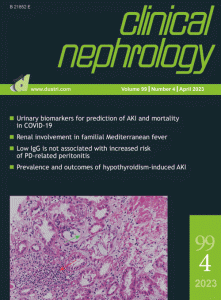
Уважаемые коллеги, доброго времени суток! Представляем вам немецкое научное издание Clinical Nephrology. Журнал имеет третий квартиль, издаётся в Dustri-Verlag Dr. Karl Feistle, его SJR за 2021 г. равен 0,365, электронный ISSN - 0301-0430, предметные области - Нефрология, Медицина (общие вопросы). Вот так выглядит обложка:
Редактором является Хартмут Маллуке, контактные данные - hhmall@uky.edu, Editor-in-Chief@clinnephrol.com.

Журнал выходит ежемесячно и публикует рукописи, содержащие оригинальный материал, с акцентом на следующие темы: профилактика, патофизиология, иммунология, диагностика, терапия, экспериментальные подходы, диализ и трансплантация.
Адрес издания - https://www.dustri.com/nc/journals-in-english/mag/clinical-nephrology.html
Пример статьи, название - Urinary biomarkers to predict acute kidney damage and mortality in COVID-19. Заголовок (Abstract)
Introduction: Acute kidney injury (AKI) is a frequent condition in patients hospitalized for COVID-19. There are only a few reports on the use of urinary biomarkers in COVID-19 and no data so far comparing the prognostic use of individual biomarkers in the prediction of adverse outcomes.
Materials and methods: We performed a prospective mono-centric study on the value of urinary biomarkers in predicting the composite endpoint of a transfer to the intensive care unit, the need for renal replacement therapy, mechanical ventilation, and in-hospital mortality. 41 patients hospitalized for COVID-19 were enrolled in this study. Urine samples were obtained shortly after admission to assess neutrophil gelatinase-associated lipocalin (NGAL), kidney injury molecule-1 (KIM-1), calprotectin, and vascular non-inflammatory molecule-1 (vanin-1).
Results: We identified calprotectin as a predictor of a severe course of the disease requiring intensive care treatment (AUC 0.728, p = 0.016). Positive and negative predictive values were 78.6% and 76.9%, respectively, using a cut-off concentration of 127.8 ng/mL. NGAL tended to predict COVID-19-associated AKI without reaching statistical significance (AUC 0.669, p = 0.053). The best parameter in the prediction of in-hospital mortality was NGAL as well (AUC 0.674, p = 0.077). KIM-1 and vanin-1 did not reach significance for any of the investigated endpoints.
Conclusion: While KIM-1 and vanin-1 did not provide prognostic clinical information in the context of COVID-19, the present study shows that urinary calprotectin is moderately predictive of the need for intensive care unit (ICU) admission, and NGAL may be modestly predictive of AKI in COVID-19. Calprotectin and NGAL show promise as potential helpful adjuncts in the identification of patients at increased risk of poor outcomes or complications in COVID-19.