1. Introduction
Modern society is unthinkable without the use of information systems and technologies. If only a few decades ago it was mainly about a digital enterprise, now the picture is quite different [1-2]. The steps of digitization, digitalization and digital transformation are relevant both for the company's digital format of work and digital life of citizens. Smart devices, homes and cities; food, music and entertainment suggested based on machine learning algorithms; the industrial internet of things, robotic process automation and other technological innovations running under software make us think about understanding its lifecycle [3].
One kind of software is corporate information systems designed to automate business processes of enterprise and entire holding company, which imposes restrictions and pay the focus to other project tasks compared to local software solutions [4]. It distinguishes corporate systems from their progenitors, information systems, as described in [5-6]. However, the lifecycle of both corporate and information systems remains uniform and unchanged [7].
2. State of the art
There is a large number of books and papers on information systems [8-10], describing various aspects of their analysis, design and development. There is emphasis mainly on the activities and tasks of implementation project in them. The reader also has access to all possible bodies of knowledge on information technology and systems, such as: project management, processes, data, business analysis, architecture and ITIL [11-16]. Thus, understanding the entire lifecycle of corporate information systems requires considerable effort. However, familiarization with all these literary sources does not guarantee a clear understanding all the details of corporate information systems. Thus, forming a visual picture of the lifecycle of ERP-ERP3 class of software systems remains relevant.
3. Problem statement
The purpose of the paper is to analyze and clarify the lifecycle of corporate information systems from business case to termination of their use. Consideration of the lifecycle will make it possible to highlight the activities preceding the implementation project that are poorly described at the moment, as well as to emphasize the tasks that organizations face and resolve after the completion of software deployment.
4. Overview
Let's consider the classical lifecycle of software product, which includes five phases (fig. 1):
- a concept, where the idea of a software product is formulated, benefits of its implementation are analyzed, advantages and disadvantages are described;
- design, where analysis and design of the future software solution is carried out;
- built, which implies development and configuration of the software product;
- productive operation, including go-live hypercare support, as well as subsequent support of the regular business processes within software solution;
- termination of use.
The confusion begins here, because the lifecycle of a software product and its implementation project are not the same thing. The deployment project is a basic, but far from the only component of the product lifecycle. An inept reading the literary sources [8-10] only exacerbates the contradiction: after reading them, there is an erroneous feeling that work on a software begins with its development and implementation.

Projects for the deployment of corporate information systems are mainly organized based on the cascade implementation scheme containing seven stages (fig. 2). During the preparation stage tasks are performed to organize project office, mobilize project team and prepare templates of key documents (designs, functional specifications, configurations, test scenarios, etc.); moreover, stakeholders are determined together with the customer to form steering committee, the project schedule is detailed and, at the end, kick-off meeting with the project participants is carried out.
The completion of the preparation stage indicates beginning of the analysis phase. There are such tasks to be performed on this stage: conducting sessions to collect, identify and detail user requirements, Fit/Gap-analysis of identified requirements [18], as well as formation of the requirements traceability matrix that combines all collected and prioritized needs.
The design stage begins once requirements are clarified. If software program needs to be developed for requirement from the Gap area, then functional specification document would be prepared first. Realization of remaining requirements from the Gap area is described in configuration documents. TO-BE processes must be detailed in the design documents. It’s mandatory all project documents to be approved by the customer [17].
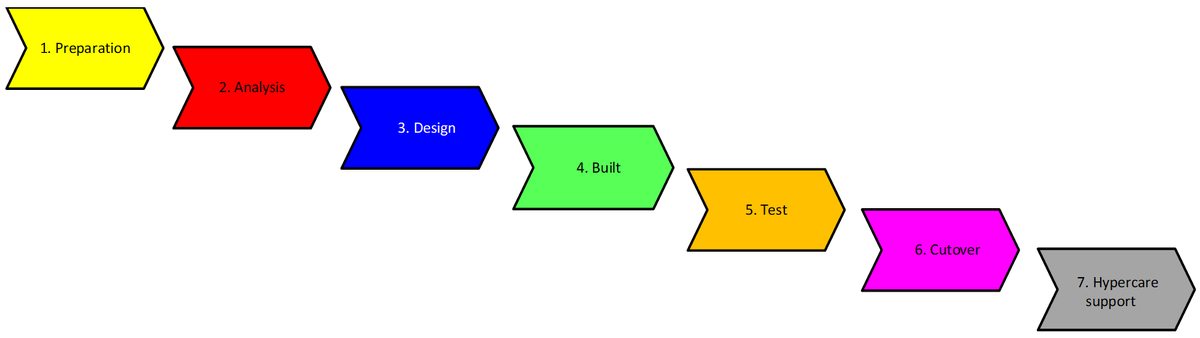
The confirmed project documents shape the list of required developments and configurations for the next stage of implementation. At the realization phase, the software system is developed and configured, as well as its unit testing is performed.
The built software system allows you to start its full testing by supplier and customer. Integration testing scenarios are prepared and executed by the supplier for this purpose. Important results of the integration tests are demonstrated to the customer. Next, user acceptance testing is carried out by the customer's key and end users [19].
After successful completion of testing, detailed user instructions are created, end users are trained, productive software system is prepared, into which the necessary data is migrated [20]. Go or no-go decision is to be made by steering committee to launch productive system. All this is done at cutover phase.
Hypercare support stage starts in case of successful decision making. Intensive support of end users is conducted, software defects are registered and resolved. The stage is completed by transferring the system and project documentation to the customer. Steering committee makes final decision to complete a whole project.
Taking into account fig. 1-2, it is worth noting that the project of implementing corporate systems correlates with the phase of design, built, as well as partially the phase of productive operation from the software lifecycle. At the same time, ERP-system implementation project does not affect the phase of idea, termination of use, as well as the rest of the productive operation phase. Let's slightly change the lifecycle of software product, dividing it into three blocks of works:
- activities preceding the implementation project, which we will call the pre-project;
- implementation project;
- as well as the stages after the completion of implementation project, let’s call them post-project.
Consequently, most of the scientific papers [8-10] describe one third of the lifecycle of corporate information systems: the implementation project. Therefore, next we will focus on activities that occur before and after deployment of the software solution.
Full version of article is available here: https://stepanovd.com/science/article/197-2024-4-thelifecyclecis