26. In Great Britain and Japan, black cats are good luck.
Black cats are considered to be a bad omen in the U.S., but in Great Britain and Japan, they’re perceived as auspicious. In the English Midlands, new brides are given black cats to bless their marriage, and the Japanese believe that black cats are good luck—particularly for single women. Meanwhile, the Germans believe that a black cat crossing your path from left to right is ominous, but if the feline switches directions and goes right to left, it’s fortuitous.
27. Nyan Cat was based on a real cat.
Remember Nyan Cat? The famous viral meme of a gray kitty with a Pop-Tart body who shoots rainbows from its posterior (the internet, folks!) was based on a real-life feline: a Russian Blue named Marty, owned by Nyan cat illustrator Chris Torres.
28. Cats can't taste sweets.
Cats are genetically predisposed to not be able to taste sweets. They will likely nibble off your plate if it contains meat, but they’ll leave it alone if it’s laden with cake.
29. Cat shows have been around since at least 1871.
The world’s first major cat show was held at London’s Crystal Palace in July 1871. Hundreds of felines (and dozens of breeds) were placed on display, and around 200,000 guests are said to have attended the event.
30. Some breeds get heavy.
Most cats weigh in the single or low-double digits, but some breeds are truly huge. For instance, Norwegian Forest Cats, Maine Coons, and Ragdolls often range in weight from 15 to 22 pounds. You should know this before you catsit for your friend with a Maine Coon.
31. Cute cat videos have been around for more than a century.
Long before Keyboard Cat took the internet by storm, inventor Thomas Edison filmed two kitties "boxing" inside a ring. Created in 1894, the brief clip proves that humans have been obsessed with cute cat videos since long before the advent of YouTube.
32. There was a video game based on President Clinton's cat.
Socks the Cat, a black-and-white tuxedo cat, was owned by Bill Clinton’s family during his time in the Oval Office. If you're like me, your third grade class handwrote letters to Socks. Anyway, during the early 1990s, Super Nintendo Entertainment System created a video game called Socks the Cat, featuring the First Feline. It was never officially released, and when the game’s publisher shut down, Socks the Cat was lost for years, until video game collector Tom Curtin bought the (reportedly) only existing copy, purchased the rights, and partnered with game publisher Second Dimension to give it a second life. Socks the Cat Rocks The Hill was finally released in 2018.
33. Some cats have extra toes.
Beyond their impressive size, Maine Coon cats are sometimes born with six toes.
34. People who go to college are more likely to have a cat.
If you went to college, you’re more likely to have a cat than a dog. In 2010, researchers from the University of Bristol surveyed 3000 people about their pets, geography, and scholastic history. They found that people with university degrees were 1.36 times more likely to own a kitty than other pet owners. This phenomenon might be attributed to the fact that cats are low-maintenance, and therefore better companions for accomplished people with busy careers.
35. Your cat has more bones than you do.
A cat has 244 bones in its entire body—even more than a human, who only has 206 bones.
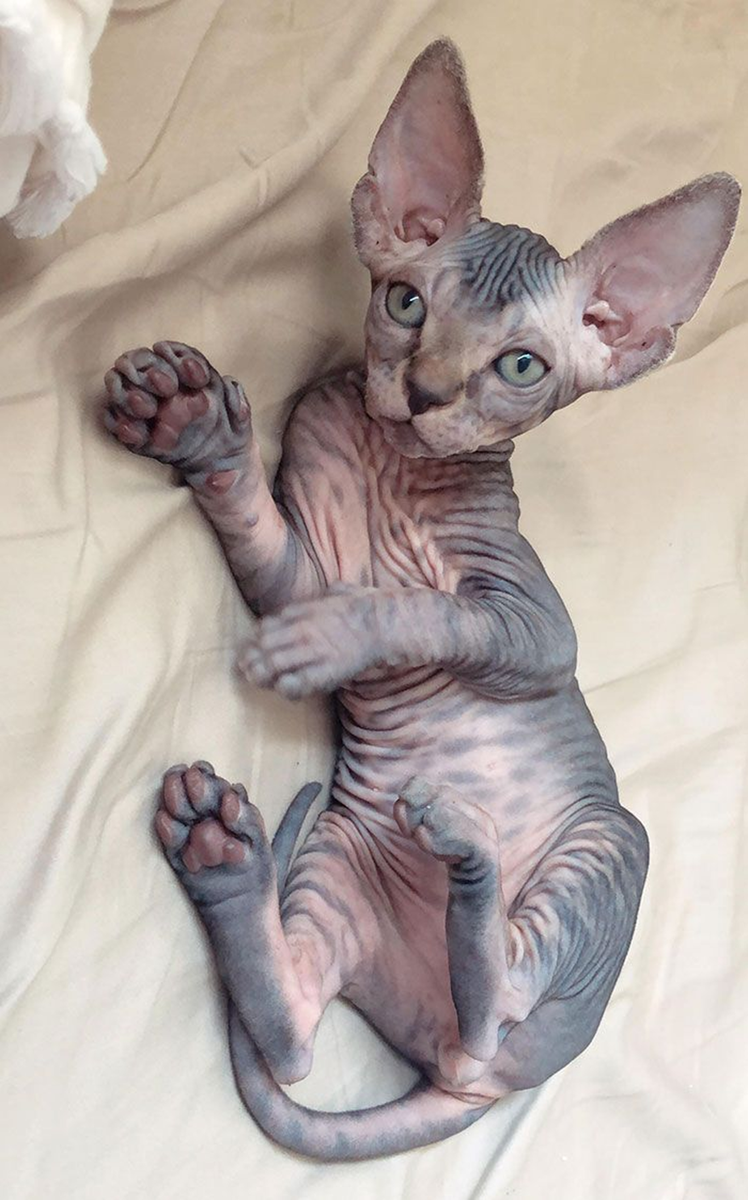
36. Not all cats have fur.
Sphinx cats don’t have fur coats, but their body temperature is still four degrees warmer than a typical feline.
37. Most cats don't like getting wet because they lose control.
Experts think that cats hate water because it’s uncomfortable to have soggy fur, or because it’s frightening for a kitty to lose control of its buoyancy.
38. But not all cats hate water.
While many kitties do, breeds including the Turkish Van, Maine Coons, and Bengals are said to enjoy taking a dip every now and then.
39. Cats like small spaces.
Why do cats love to cuddle up in boxes? Animal experts think that the enclosed spaces make felines feel more protected, secure, and important—kind of like they’re back in the womb. (Sure enough, researchers found that when shelter cats are provided with boxes to cuddle up in, they adjust faster and are less stressed than kitties that aren't given boxes.) Also, sleeping in a box might help a feline retain more body heat so it stays nice and toasty, and therefore relaxed.
40. We don't know why cats meow.
Nobody knows quite why cats meow, but experts think they might be channeling their inner kitten. Baby cats make the plaintive noises to get their mother’s attention, but as full-grown felines, they don't meow while interacting with other cats. Some experts think that felines use the noises they made as infants with humans to convey their emotions and physical needs.
41. Cats can sweat.
Cats sweat through their paws (and sometimes when they get very hot they pant).
42. Most of their lives are spent sleeping.
Beyond grooming all the time, according to one estimate, a cat spends nearly two-thirds of its life asleep.
43. Some hotels have lobby cats.
Just like bodegas, the iconic Algonquin Hotel in midtown Manhattan owns a pampered lobby cat named Hamlet. He's one of a dozen rescue felines that have lived in the storied institution since the early 1920s. Hamlet took over the post following three Matildas. (Matilda III passed away in October 2017.)
44. Disneyland has a lot of feral cats (with an important job).
Approximately 200 feral cats roam the grounds of Disneyland, where they help control the amusement park’s rodent population. They’re all spayed or neutered, and park staffers provide them with medical care and extra food.
45. Cats are not good at delivering mail.
In the 1870s, the city of Liège, Belgium tried to train 37 cats to deliver the mail. Letters were enclosed in waterproof bags tied around the kitties’ necks, but it turns out that cats weren’t great at delivering the goods on time (or to the correct address). But maybe we simply haven't found the correct training method yet.
46. Quotation marks have a feline connection.
The Hungarian word for "quotation marks," macskaköröm, literally translates to "cat claws."
47. There are more pet cats in the u.s. than pet dogs.
There are an estimated 85.8 million pet cats in the U.S. In contrast, there are only an estimated 78 million dogs.
48. Not all historical figures loved cats.
Napoleon, Caesar, Genghis Khan, and Hitler are all said to have hated cats.
49. Did you know that all newborn kittens have blue eyes? Neither did we! It turns out that our little feline friends don’t develop eye pigmentation until they’re around six weeks of age and while some kittens (like the siamese) will retain their blue eyes, most kittens' eyes will change color when they’re seven weeks of age. Until then, what we see as blue-hued eyes is a lack of pigment combined with light refraction.
50. Cats can jump up to five times their own height.
Or six times its length—and make the entire thing look easy.
This story has been updated for 2020.