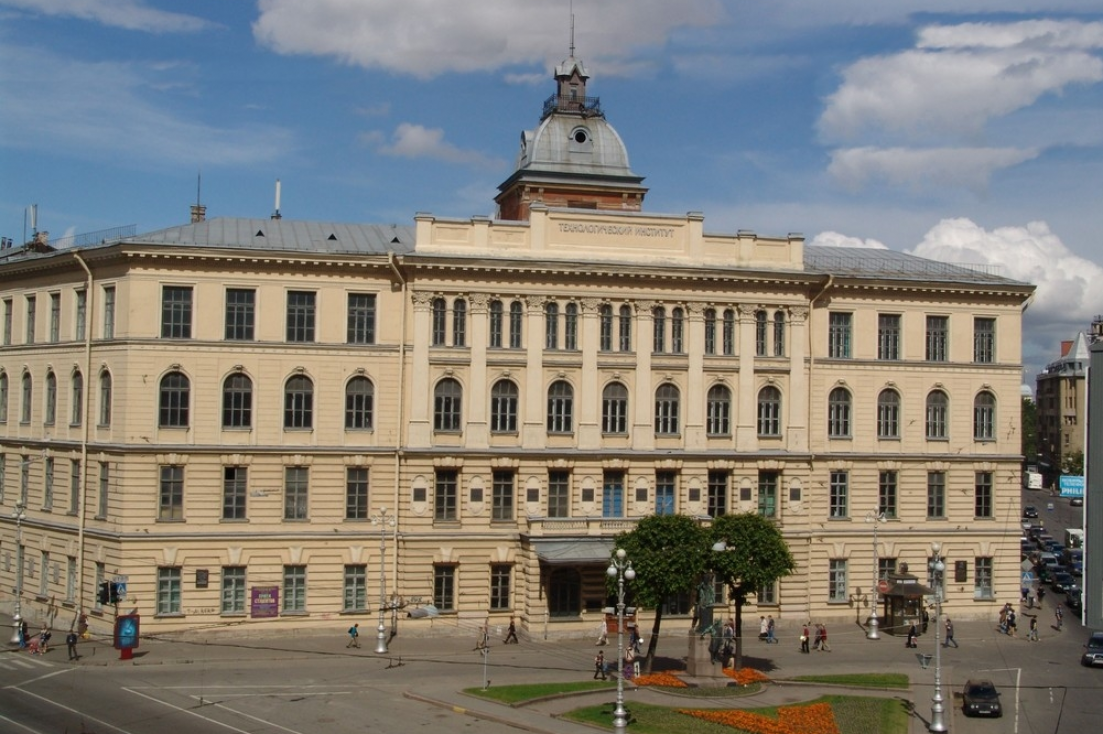
The St.-Petersburg State Institute of Technology was founded in November 28, 1828. It was the first, and for a long time the only technological institute in Russia training technical specialists, engineers and managers of factories.
From 1862-1868 great changes transformed the Institute into a high-level educational establishment. A department of mechanical engineering was opened, as was a chemical engineering department. These departments trained engineers in a variety of specialists.
By its fiftieth anniversary in 1878 the Institute had grown into a leading higher education facility, the source of numerous inventions and advanced ideas in the area of technical thought in Russia.
In 1896 the Institute was renamed the Technological Institute. Its growth was closely connected to development in industry and science. It played a great role in the training of specialists and in the development of industry.
A new chemical technology department was formed in the 1930s to train specialists in the field of the technology of solids, explosives and jet fuel components. In 1949 a department of nuclear engineering was added. In 1972 the Institute became the Technical University. Since then it has been training engineers according to individual programmes and curricula.
In 1995 a new system was established at the institute. At the present time the St.-Petersburg Institute of Technology trains specialists at 8 full time faculties (information and control systems) and the evening faculty. The Institute offers post-graduate courses in the following specialties: organic and analytical chemistry, physical and colloid chemistry, biotechnology, automation of technological processes and so on.
Many famous scientists worked and took part in the education of engineers and technologists at the Institute, among them the creator of Periodic System of the Elements D.I.Mendeleev, the founder of the modern science of metals D.K.Chernov, the inventor of the first electron beam tube B.L.Rosing, the founders of the Russian synthetic rubber industry S.V.Lebedev and V.V.Byzov...etc. Among the graduates of the Institute are the founder of cracking processes A.A.Letniy, the organizer of a world renowned school of physicists A.F.Ioffe, the founder of the scientific school of specialists in the field of organic synthesis and phototropic substances A.E.Poray-Koshits and many other famous scientists.
At the Institute museum one can see original documents of D.I.Mendeleev and D.K.Chernov, books and articles by outstanding scientists which were published during their life.
Today the Institute is a large educational and scientific centre. Anyone who has a secondary education may apply to the Institute. The applicants take entrance examinations in maths and physics. Among the teaching staff are academicians and associate members of Russian and international Academies, state prizewinners, honoured workers of science and technology, professors, doctors od science, assistant professors and candidates of science. The Institute is headed by the Rector, Professor A.S.Dudyrev, a doctor of chemical science. Dr. Dudyrev is also the head of the department of explosives. He has several vice-rectors. They take care of the administrative activities necessary for the smooth functioning of the Institute.
The academic year is divided into 2 terms. During the term the students attend lectures, practical and laboratory classes, seminars, etc. At the end of the term, they take written and oral tests and examinations.
There is a winter and a summer vacation period.The Institute has many well-equipped auditoriums, computer and TV centres, numerous research and educational laboratories. The management of our Institute is responsible for providing the laboratories with up-to-date equipment.
The Institute’s library is our pride. It is one of the best in the country among technical universities – light, spacious, comfortable halls, qualified personnel, a rich collection of books including indispensable journals on chemistry and chemical technology and a wide selection of fiction literature are at the disposal of the Institute’s students and research workers. The total collection of library numbers around one million volumes. Undergraduate and postgraduate students spend a large amount of time in the library.
To receive a diploma an undergraduate has to submit a paper or project and defend it before State Examinations Board. The undergraduates are involved in research work at different departments of the Institute and some of this work is highly estimated and recommended for practical application. Due to their education, in a wide range of subjects, the graduates of the Institute may work in different branches of chemical industry and at research institutes. The best students have the possibility to become postgraduate students.
Facts:
In 1993 the Institute joined the International Technical University Association.
According to the results of a rating published in 1996 by the State Committee of Higher School the Institute holds the 12th position among the technical universities of our country, the 6th among the St. Petersburg higher educational establishments, the 3rd among the chemical-technical higher schools of Russia.
Ex. Answer the following questions:
- When was the St Petersburg State Institute of Technology founded and what kind of specialists did it train?
2. In what connection arc 1878 and 1896 mentioned in the history of the Institute?
3. How did the Institute change in the course of time?
4.When and for what purpose was a new chemical technology department formed?
5.When did the Institute become Technical University?
6. What structure has been established at the Institute since 1995?
7. What faculties are there at our Institute?
8.What famous scientists worked at our Institute?
9. What do you know about the Institute museum?
10. What can you say about the teaching staff and the administration of the Institute?
The Educational System
- What can you say about the curricula of the Institute?
- How is our Institute equipped?
- What can you say about the Institute library?
- Where do the graduates of our Institute work?
- What is it accessary to do to receive a diploma?
#studywithnadi #chemistry #topics #dzen
Подпишись на наш Вконтакте и Телеграм
https://t.me/englishexamsEGEIELTS
VK: https://vk.com/studywithnadi