Khomai: The Mythical Bird of the Bashkir Epic “Ural Batyr”
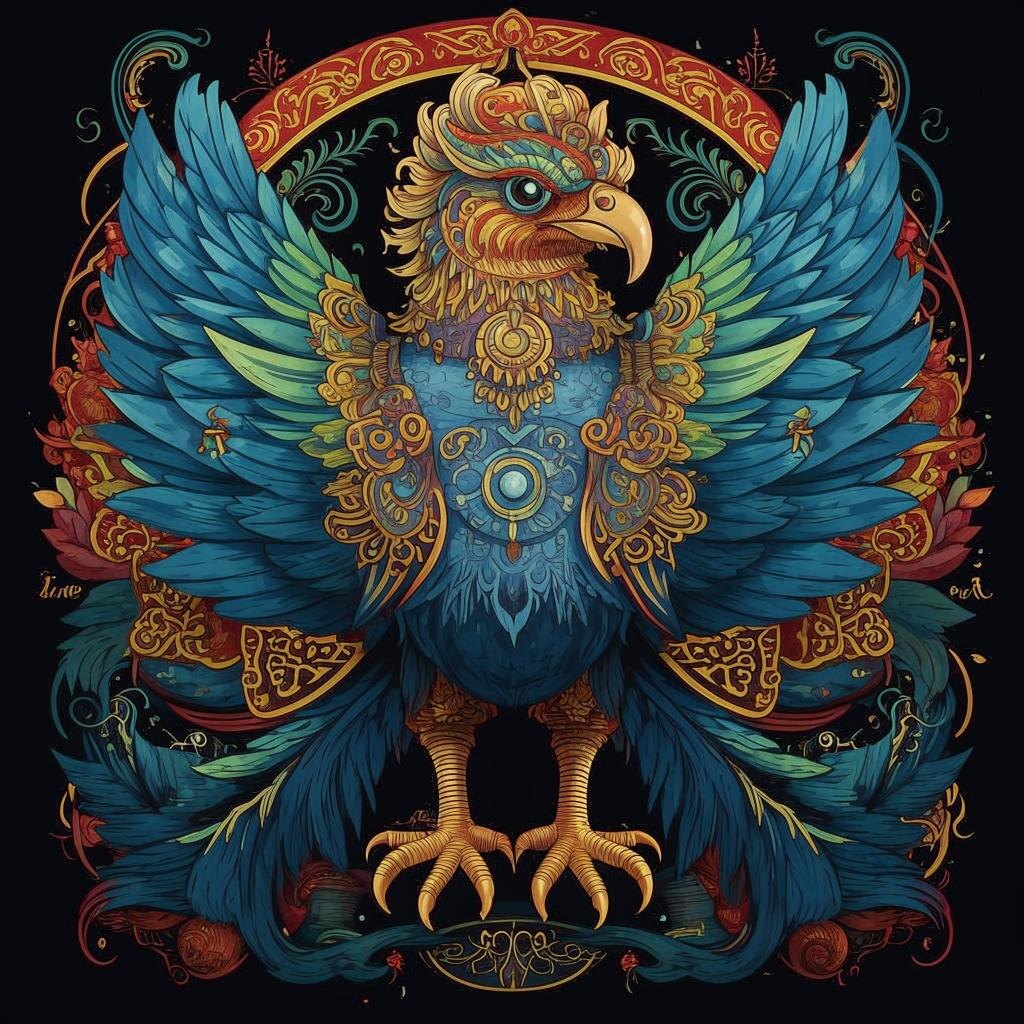
In the rich cultural heritage of the Bashkir people, the epic “Ural Batyr” holds a special place, preserving ancient myths, beliefs, and philosophical concepts. Alongside the hero Ural, the central figure of this epic tale is the bird Khomai (Humai) — an embodiment of wisdom, eternity, and the connection between worlds. Rooted deeply in Turkic mythology, her image reflects ideas of natural harmony, the cyclical nature of life, and spiritual transformation.
Origins and Mythological Context
Khomai belongs to a family of mythical beings whose origins trace back to pan-Turkic and Iranian cosmogonic myths. Her father, Samrau (Samrauk), is the supreme bird, akin to the Persian Simurgh and the Kazakh Samruk. In the epic, Samrau personifies cosmic order: he lays golden eggs atop the Tree of Life (Baiterek), symbolizing cycles of creation and destruction. Khomai, as his daughter, inherits sacred wisdom and the role of mediator between the heavens, earth, and the underworld.
The name “Khomai” (from the Turkic root “khum” — “sand, dust”) is linked to fertility and rebirth. In some dialects, it echoes the Persian Humaayun — “blessed” — emphasizing her status as a divine patroness.
Khomai’s Role in “Ural Batyr”
The epic’s plot revolves around the quest of the hero Ural, who seeks the “Water of Life” — a source of immortality capable of saving humanity from death. Khomai becomes his guide and savior, fulfilling several key roles:
Savior and Mentor
When Ural teeters on the brink of death, Khomai rescues him, carrying him across chasms or appearing as an old woman to share wisdom. She reveals cosmic secrets, teaching him to understand nature’s language and overcome illusions.
Guardian of the “Water of Life”
The magical spring Ural seeks is hidden in unreachable lands. Khomai knows its location but shares the secret only with those who prove their purity of intent. This motif echoes myths of the World Tree, where birds guard the elixir of life.
Mediator Between Worlds
Khomai freely traverses:
The Heavens (realm of gods and spirits),
The Earth (world of humans),
The Underworld (domain of the demon Katil).
Her ability to shapeshift (e.g., into a human) underscores the unity of all
cosmic elements.
Parallels with Other Mythical Birds
Khomai fits the universal archetype of the “magical bird” but carries unique traits. The Persian Simurgh, like Khomai, symbolizes wisdom and guards the Tree of Life, yet emphasizes regality over maternal instincts. The Hindu Garuda, a mediator between realms, shares her role as a divine messenger but is tied to the god Vishnu and embodies warrior energy. The Phoenix, a Greco-Egyptian symbol of rebirth, focuses on solitary cycles of death and resurrection, unlike Khomai’s emphasis on generational continuity. The Slavic Firebird, with its glowing plumage, parallels Khomai’s radiance but represents temptation through material wealth. Khomai stands apart through her familial bonds (as Samrau’s daughter) and ecological role — she safeguards not just humans but the natural world itself.
Philosophical Significance
Khomai embodies the epic’s core themes:
Immortality as Unity with Nature
The “Water of Life” is not a physical elixir but a metaphor for harmony achieved through respect for the world.
Wisdom Over Strength
Ural defeats enemies not with a sword but through knowledge gifted by Khomai, highlighting the value of spiritual growth.
Cyclical Renewal
Samrau’s golden eggs and Khomai’s life-giving power symbolize the universe’s eternal regeneration.
Cultural Legacy and Modern Relevance
Khomai remains vital to Bashkir culture:
Symbolism: Her image adorns regional emblems and logos of environmental organizations.
Art: In 2013, a monument to Khomai was erected in Ufa (sculptor Khabibrakhmanov), depicting her mid-flight with outstretched wings.
Literature and Media: She inspires writers and filmmakers, such as in the animated film “Ural Batyr” (2013), where Khomai voices reason amid chaos.
Festivals: Annual celebrations in Bashkortostan feature theatrical performances with actors dressed as
Khomai.
Interesting Facts
Etymology: In some dialects, “Khomai” is linked to “khomus” (a mouth harp), highlighting her role as nature’s “singer.”
Ornithological Inspiration: Scholars suggest her image may derive from observations of golden eagles — sacred birds in Turkic cultures.
Gender Dynamics: Khomai is one of the few female mythical birds in global folklore, reflecting women’s high status in Bashkir tradition.
Conclusion
Khomai from “Ural Batyr” is more than a mythical character. She is a bridge between past and present, a reminder that true power lies in harmony with nature and ancestral wisdom. Her wings shelter not only heroes but all who seek to grasp life’s depths. As a Bashkir proverb says: “If you have a guardian bird, even a flight to the sky will not be lonely.”
In an age of ecological crises and spiritual searching, Khomai’s image resonates anew, urging balance between progress and preservation. Her legacy endures as a beacon of hope, guiding humanity toward reverence for the interconnected web of life.