War. War never changes.
We all remember these eternal words from Fallout.
The first ground explosion of an atomic device was carried out on July 16, 1945 at the Alamogordo test site (New Mexico, USA), and the first nuclear tests in the USSR took place on August 29, 1949. These tests caused a long chain of events that brought sadness and joy. On the one hand, humanity has received a powerful source of energy and the only really effective one at the present time, and on the other hand, a weapon capable of destroying most of the civilized world.
On August 6 and 9, 1945, the United States launched a nuclear attack on Japanese territory, attacking the peaceful civilian cities of Hiroshima and Nagasaki.
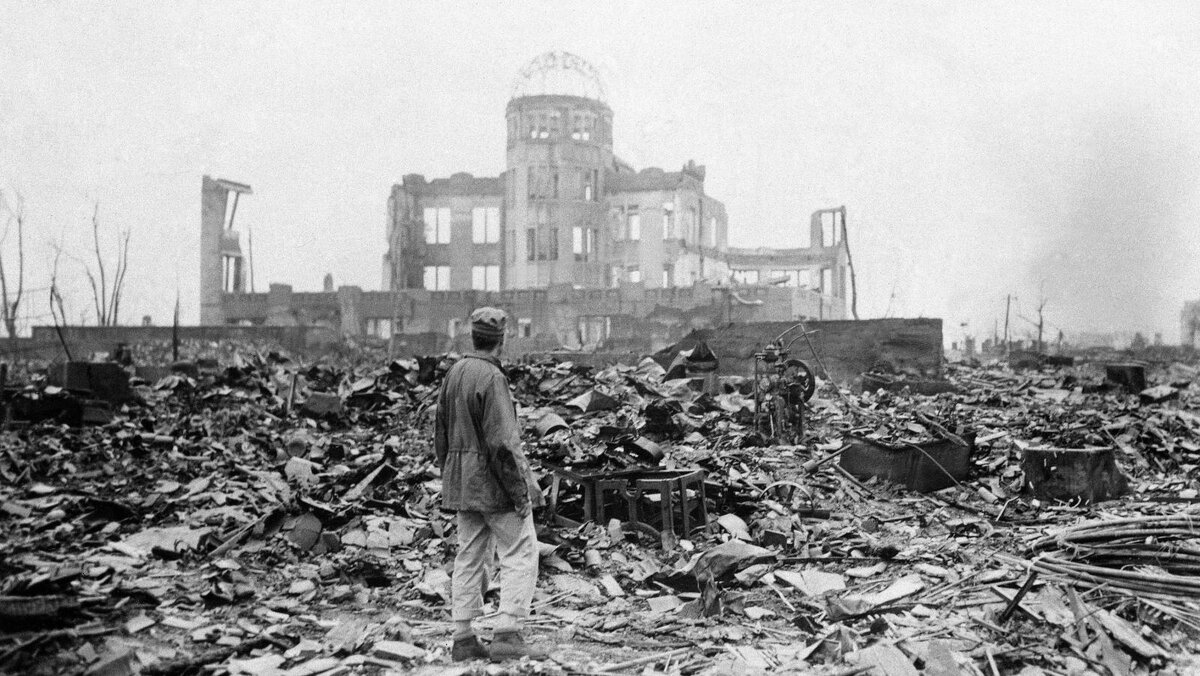
The target for the atomic bomb "Little Boy" was the city of Hirashima, it had a mass of 4.4 tons and an explosion power of 13 to 18 kilotons, this bomb claimed the lives of 166 thousand people. The explosion occurred near the Ayoi bridge, 600 meters from the Sima hospital, where doctors treated seriously ill children. After 3 days, the city of Nagasaki became the target of a nuclear strike, a nuclear bomb "Fat Man" weighing 4.7 tons and with a capacity of 21 kilotons was dropped on it. The explosion occurred at an altitude of 500 meters above the city of Nagasaki and claimed the lives of 80 thousand people. A huge number of people subsequently died of cancer and radiation sickness. These sad events marked the beginning of the Cold War between the USA and the USSR, each of the countries understood that the lagging behind would be destroyed forever.
On August 12, 1953, the first Soviet hydrogen bomb called “Product RDS-6s” was tested at the Semipalatinsk test site, and the USSR received a weapon using thermonuclear fusion, which made it possible to reduce the mass and design of the charge while increasing the explosion power. Further improvement of the technology made it possible to create a thermonuclear bomb RDS-37 weighing 7 tons, with an explosion power of 1.6 megatons with a lesion diameter of 70 kilometers and a total area of destruction of 3848 square kilometers. 3 hours after the explosion at a distance from the epicenter from 95 to 272 km, the maximum dose after the decay of RV was from 0.13 to 0.23 roentgens. This explosion gave a huge amount of information both about the thermonuclear reaction itself and about the fight against radiation and its consequences.
On October 30, 1961, tests of the new AN602 hydrogen bomb weighing 26.5 tons took place. Khrushchev Nikita Sergeevich, who was then chairman of the Council of Ministers, saw AN602 and jokingly called her "Kuzka's mother." The explosion yield of AN602 was 58.6 megatons, the diameter of the lesion was 205 km, and the total active area of the lesion was 33,006 square kilometers.
As mentioned earlier, the RDS-37 bomb had a mass of 7 tons and an area of destruction of 3848 square kilometers, but is it a lot or a little? I think everyone will have their own answer, but I'd rather give a good theoretical example. The area of a country like the United States, excluding Alaska, is 8,115,661 km². If this number is divided by the area of impact of the bomb, then you get 2109, and this is the number of charges that are needed to cover 100% of the United States. The area of England is 132,938 square kilometers, divided by the area of destruction of the bomb, we get 34 nuclear charges needed to cover 100% of the area.
According to data published by the Stockholm International Peace Research Institute, as of January 2020, Russia has more than 6,375 nuclear warheads, including 1,572 mothballed, deployed on combat-ready carriers and on constant duty. I think the number of missiles on combat duty in Russia has apparently increased by 2022, but that's not the point. The vast majority of the main population of countries is usually concentrated in small areas, for example, in the United States, only 40% of the territory is densely populated, the rest is agricultural land, nature reserves, mountains and other sparsely populated places. This suggests that Russia has the ability to almost completely destroy a number of unfriendly countries, which will naturally lead to a retaliatory strike. The core of Russia's nuclear shield is Voyevoda missiles with warheads weighing 7 tons. In addition, a new generation of Sarmat missiles has now appeared; they can carry a warhead weighing from 10 to 14 tons with hypersonic units.
Thus, it can be assumed that the probability of a nuclear war is minimal, it is hard to believe that there is a person who wants to arrange a thermonuclear skirmish with the Russian Federation and disappear at the same time. However, do not forget that now the United States and Europe are headed by not quite adequate people, so you need to be prepared for any situation without exception.